My mother-in-law is Dr Sylvia Hardy, noted scholar, a past secretary of the HG Wells Society, and an academic with a string of qualifications in English as well as Film. She can run rings around me on James Joyce, post-structuralism and literature – she recalls every book she’s read in outstanding detail – and, since she was a small girl watching films in Weymouth’s picture houses, she’s loved John Wayne. Despite Wayne’s politics and his attitudes to women and minorities, a whole list of things they would have argued about, he’s still one of the great stars for her.
She even likes Brannigan, a British-made film that
allows Duke to carry off a tough-guy role at 68 although she feels he’s perhaps
missing a horse… and it’s true, there is something charming about this film
perhaps because we know his next film was Rooster Cogburn and we know
he’s near the end but also because his persona is intact. He’s helped, of
course, by a great supporting cast as well as superb backdrops of London: Brannigan
is a real time-capsule film that takes in everything from Tower Bridge to the
Garrick and RAC Clubs via Park Lane, Battersea and Piccadilly.

Mr Wayne
Directed by Douglas Hickox, Brannigan afforded
Wayne the chance to ape the Clint Eastwood style (he had turned down Dirty
Harry only to regret it) and allows a fresh twist by transporting his
unchanging cowboy act to Blighty: a horse-wrangler out of water as it were...
There are repeated moments in the film which play on this from attempts to get
Brannigan to not carry his gun and to follow native procedures. There’s also a
nice running contest between the character and his British counterpart,
Commander Sir Charles Swann (Richard Attenborough) which plays up every known
cliché about the “special relationship”.
Brannigan’s assigned liaison officer, Detective Sergeant
Jennifer Thatcher (the marvellous Judy Geeson) quotes her father in saying that
there’s only three things wrong with “yanks”: “over-paid, over-sexed and over
here…” But you know mutual respect won’t be far behind and, age-appropriate at
that, here Wayne is more of an uncle figure being three times Geeson’s age.
It’s entertaining and undemanding fun and very well put
together. There’s also a fine example of a hard-top e-type Jaguar and you can’t
say further than that for men of a certain age, especially with Morris Minors,
River 800s and so many classic cars on view.

Judy Geeson
Lieutenant James Brannigan is a Chicago cop who has his
own way of doing thing but (you guessed it…) he gets results. He’s tracking
down one particularly nasty crime lord, Ben Larkin (John Vernon, a tad "Larger than life" here...), who has been
caught trying to flee to England. Somewhat against his will – and to the
audience’s delight – Duke… sorry, Brannigan is sent to bring him back. Somehow,
we sense that it’s not going to be quite that simple… and the old dog’s
unconventional methods will be all the more so in London Town.
Brannigan arrives and is treated like a red-hot cinder by
the locals as Swann and his number two, Insp. Michael Traven (John Stride – who
was excellent in the Rosencrantz and Guildenstern are Dead I saw a few years
later…in Manchester), struggle to reign him in. Miss Thatcher is altogether
more understanding and there’s an under-current of fatherly affection between
her and the old grump. But where did they get that second name from? The “Milk
Snatcher” was a shadow cabinet minister at the time…
Meanwhile the plot has really kicked in. A hit man is
assigned to off Brannigan by Larkin’s team led by Mel Fields (Mel Ferrer) –
he’s Gorman (Daniel Pilon) the nastiest in the business but at least he drives
that e-type. Then Larkin is kidnapped from his health club by two Brit
gangsters played by Charlie-the-Handle (played by The Genius, James Booth!) and Drexel (Del Henney)
whose aim is to hold him to ransom.
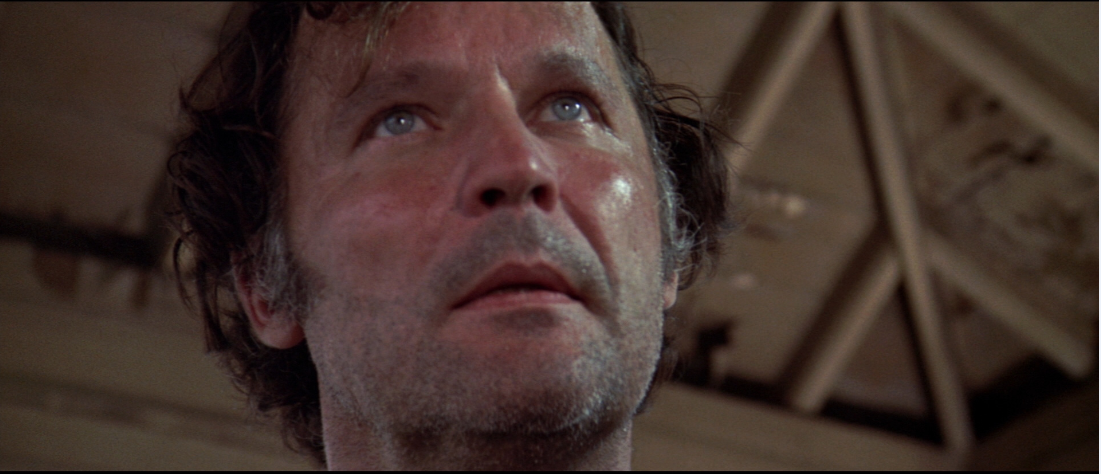
John Vernon
So now Brannigan has to help the Limeys save face as well
as catch his man. The first attempt to snag the kidnappers fails as they
extract the money from a drop in Piccadilly by drilling a hole beneath a post
box.They seem to be one step ahead of the local Plod, but not Brannigan of course.
There are some lively police-procedurals as Brannigan
and co set about scaring the truth out of the likes of Brian Glover and Tony
Booth (Cherie’s dad) not to mention the far less threatening Tony Robinson –
“look kids it’s Baldric!”, “Who?”, “Er… the guy out of Time Team!”, “Oh yeah…”
There’s also - of course - a classic bar brawl at a pub in Leadenhall
Market in which Attenborough joins Wayne in slugging it out on that violent but
harmless way of every good-humoured scrap since The Quiet Man: glassing with a
smile and mutually respectful manliness all round. Personally I've only ever turned the other cheek - all my fighting has been outside of the pub, but it's a strange cinematic ritual of male bonding even now.
 |
| Sir Richard Attenborough |
Then there’s a car chase which is very well executed and
shows off some of the highlights of central London including Tower Bridge over
which the cars fly as the draw bridge lifts higher. Famously Telly Savalas made an advertorial about Birmingham at around this time saying how good it was, "my kinda town!" and, in its way, Brannigan shows the love for London as well as the legend around whom the script and action was so carefully constructed.
All the while Brannigan’s hit-man gets closer and closer to the kill, narrowly avoiding nailing Miss Thatcher as the dead-eyed cop reacts just in time to put him off. Predictable it may be but the plot is well constructed as the main elements race to a satisfying conclusion as the double-crossing crosses over itself in the inevitable deserted offices of decaying docklands (probably now the home of gastro pubs and luxury flats).
Wayne still convinces and went on to make Rooster Cogburn
next, his best late period film and he met Kathryn Hepburn for the first time in London
during filming and this is how she became involved in that classic. When I was younger,
I was less generous to his attempts to stay in the game but this was all he knew
from being an extra in silent films in the late twenties, he worked for over 50 years in cinema.
 |
| Duke explains modern badness to the limeys |
Apart from featuring so much British talent living their
best life acting with Wayne, cameos from Don Henderson and Lesley Anne Down
among others, the film is worth watching for the cars and the streets of 1974.
There’s an article on the BFI website looking at the locations then and now and
it’s truly fascinating to watch the city in high resolution almost 50 years
ago. It’s changed, we’ve changed… and yet, in some ways, it and we haven't.
A couple of years later, The Squeeze showed a
sleazier and more authentic side to London’s criminal classes, followed by
others, but Brannigan helped keep the British crime flick alive at a
time of struggle.
 |
| The booklet cover says it all! |
This BFI Blu-ray is presented with the usual high-quality
extras:
·
Presented in High Definition
·
Audio commentary by Steve Mitchell and critic
Nathaniel Thompson (2017)
·
A Duke Out of Water (2023, 37 mins):
reminiscences from the people who made Brannigan.
·
Frank Henson on Brannigan (2021, 4 mins): the
veteran stuntman looks back on doubling the Duke.
·
Take It to the Bridge (1905-1956, 23 mins):
historical glimpses of the Thames, Tower Bridge and other Brannigan locations.
·
A Policeman’s Lot (1896-1973, 35 mins): a
copper’s clutch of films concerning crimefighters and crooks, proceeding from
the very earliest days of cinema towards the Brannigan era.
·
The Guardian Interview: Richard Attenborough
(1983, 89 mins, audio only): the award-winning actor and director, and John
Wayne’s Brannigan co-star, reflects upon his illustrious career.
·
An extensive selection of location photographs,
featuring cast and crew.
·
Original trailer
·
Illustrated booklet with new essays by Johnny
Mains and John Oliver, notes on the special features and credits.
You can order the set direct from the BFI Shop and if
you’re quick you’ll get the limited edition of 2,000 which includes the
fascinating essay booklet.


+colour.png)