Showing posts with label Arthur Chesney. Show all posts

Sunday, 7 May 2017

Silent Sheffield… The Lodger (1927), Neil Brand, Orchestra of St Pauls, Ben Palmer, Abbeydale Picture House, Yorkshire Silent Film Festival


This is only the second year of the Yorkshire Silent Film Festival and already you can sense it gathering momentum and a personality all its own driven by organiser-in-chief Jonathan Best. This year’s edition is a month-long celebration of silent film played out across that big county to the right of Lancashire, featuring a roster of key silent films all played by some of the most vibrant musical minds in the country, on their own or in ensembles.

Tonight was a major-league kick-off with a World premiere of Neil Brand’s sparkling new score for Hitchcock’s ground-breaking The Lodger as played by the Orchestra of St Pauls conducted by Ben Palmer. It was part of a weekend of silent spectacles in Sheffield’s amazing Abbeydale Picture House – one of the city’s oldest cinemas and one saved for film projection by a kindly benefactor who realised its communal significance far outweighed initial plans to re-work it as a climbing space.


The Abbeydale opened in 1920 but rarely can it have played host to such an intoxicating blend of on screen atmospherics and such refined accompaniment, emphatically performed by a truly World-class ensemble.  For me at least, this score far out-ranks the previous orchestration provided for the Hitchcock Nine restorations by Nitin Sawhney: that was musically interesting and inventive but doesn’t synchronise emotionally or narratively as well as Neil’s work. It’s the difference between Rita Hayworth trying to match Fred Astaire’s movement for their first feature, You'll Never Get Rich (1941), versus Ginger Rogers on their ninth: you’d still enjoy watching Rita dance but...

Here there’s a coherence that speaks of an obsession with replicating the emotional nuance of the source material and gifting supremely able players with a chance to fully immerse their sonic output with the sights on screen: from the grand moments of fear and dread murder to the sexual splash as Ivor Novello stands outside the bathroom listening as June Tripp taking a dip to a rising cluster of notes as she raises a laugh: it’s an emotional ballet written in response to Hitchcock’s 90-year old choreography.


Sat in the second row, feet away from the violins in the Abbeydale’s plush green seats, you’re swept up under the combination of giant Ivor face and mesmerising musicality… all weekly woes dissipate and the cinema takes you on a strange journey just as it would have done your grandparents… just as the director intended when, as Mr Brand said in his introduction, he decided to make voyeurs of us all…

It starts with as scream and as newspapers report all on the Avenger’s murderous spree and the people on and off screen lap it up – we can’t help ourselves. This man who only murders blondes – already with this Alfred? – has a dressing room full of show girls fascinated and so are we; both with the story and with the girls… By the by, am I correct in noticing the ultra-short trim of scouser Peggy Carlisle lapping up the gossip?


The film looms large on the Abbeydale’s huge screen imposing itself on the audience from the opening dramatics as Germanic shadows are cast over a suffocating, studio-bound London: “a story of the fog…”

Inside the cosy home of The Bunting Family all is clear with mother (Marie Ault – who is just magnificent), father (Arthur Chesney) and their daughter Daisy (June Tripp here referred to as Miss June). They are in the basement of a townhouse not far from the Houses of Parliament and are entertaining Joe Chandler (Malcolm Keen), a policeman who is romancing Daisy although as her treatment of his pastry heart reveals – a very Lubitsch touch – isn’t as keen as the cop.

Here's Ivor!
They are disturbed by a knock on the door and Mrs Bunting goes upstairs to find the strangest fellow standing on their threshold: Jonathan Drew (an unearthly Ivor Novello), a tall stranger, with scarf wrapped over his face, has come looking to rent their spare rooms. Why is this so clearly-moneyed man looking for accommodation and, why is he so strange…?

Hitchcock piles on the clues that begin to implicate Drew in the Avenger killings… his scarf is worn in the same manner as the murderer, he nervously hides a mysterious briefcase in his room and then asks for the surprisingly plentiful portraits of blonde woman to be removed after turning them one-by-one against the wall.

Miss June
He is indeed a “queer fellow” as one of the characters observes, intense and detached and not conforming to social norms. He is hiding something but we don’t know what.

None of this distracts Daisy who takes an immediate shine to the new arrival. Daisy’s a “mannequin” and with broader horizons than her family and boyfriend… whilst Drew is something new and interesting. They start to relax in each other’s company and play chess in his room. She glances at this strangely handsome man whilst he gazes intently at her blonde locks… Hitchcock contuse his playful tone as Drew, looking intent, reaches for the poker only to cut away and casually return after the fire has been stoked.

Marie Aultgives a great performance
But we have doubts about Drew and when he leaves the house late in the evening, Mrs Bunting wakes and peers out of her window as he enters the night. There’s great light and shade in this sequence with Drew descending the darkened staircase and the dim light of the street lights illuminating Mrs B as she begins to wonder if this man may be even stranger than he appears.

And, as every Tuesday, there is another murder that night…

Staircase mystery...
Drew attends one of Daisy’s fashion shows and buys her one of the dresses she parades. This is too far for the Buntings and father returns it with some straight talking. Drew creeps out towards the bathroom where Daisy is bathing and we’re treated to a proto-Psycho moment as Daisy’s supreme vulnerability is set against the presence of a potential killer.

By now Joe has also had enough and distraught, the policeman begins to put two and two together as it looks increasingly likely that the lodger is the killer… or is that just what he and we want?

Your move...
It’s masterful story-telling and almost all in the mind of the viewer who is a clueless as Joe in terms of interpreting the evidence Hitchcock supplies. As with the story so with the score and Brand’s music keeps us guessing right until the end as the tension becomes almost unbearable…

A thrilling ride all round and an excellent start to the festival!

Flying the flag: the Abbeydale
The films continue in silent Yorkshire throughout the month and full details can be found on the festival site. You can also find out what's happening at the Abbeydale Cinema on their Facebook page here.

Neil’s score will be available on the up-coming Criterion DVD/Blu-ray release, played by the Orchestra of St Pauls with Ben Palmer conducting. It’s released on 27th June and you can pre-order here.

Oh, silent film obssessive... is that Peggy from Hindle Wakes (right) in The Lodger (left)?

Saturday, 2 February 2013

Wake up call… Hindle Wakes (1927)

Estelle Brody
You’ll have to forgive me if sometimes I’m a little behind… as a late-converter to the on-going viability of silent film, I was probably too busy chasing down the latest Pedro Almodóvar movie (or changing nappies)  when Maurice Elvey’s Hindle Wakes was revived by the BFI in 2000.

Well, 12 years on I’ve just staged my own revival and having raved about Asquith and Hitchcock’s silent work I now have a third British silent director to rank alongside them.

John Stuart, Humberston Wright, Peggy Carlisle and Estelle Brody
Based on the controversial 1912 play by Stanley Houghton, this was Elevy’s second go after a 1918 effort which also included some of the same actors.

It’s a disarmingly frank story of sexual freedom amongst working-class Lancastrian factory workers and, most surprisingly, shows one of the girls completely in control of her choices in spite of all around trying to force her to follow social norms. These were our grand-parents and, in my case, my Nan, was so powerfully in favour of her own right to decide she went as far as to take out an injunction to prevent the kind of parental control attempted here. She wasn’t alone.

Dark and satanic
This was the period of accelerated development of the labour movement whilst the Great War had brought women to the commercial fore as they worked the men’s jobs in factories and mills… it became harder to deny their importance and their equality.

This story must still have been a shock in 1927, hard to imagine how the play went down in 1912.

The Wakes were a regular tradition in the North when the mills would close down for a week and the workers had a week-off (unpaid) to enjoy a bit of freedom.

Get your clogs off
For many in Lancashire, then as now, the glittering possibilities of Blackpool were hard to resist. With three piers, dozens of music halls and a tower to rival Paris, it remains the UK’s ultimate seaside resort… if a little brash for some tastes.

But it is here that the younger workers head for their week of “ecstasy and freedom”. There are two young mill girls, Mary Hollins (Peggy Carlisle) – with her short, sharp haircut suggestive of a more earthy nature than her considerate and cautious friend Fanny Hawthorn (Estelle Brody).

Blackpool's Pleasure Beach
They meet up with two of their social betters, Allan Jeffcote (John Stuart) the son of the mill owner, and his mate, George Ramsbottom (John Rowal). It seems George has the better chance as Mary seems all together more forward with Fanny initially refusing to hold hands.

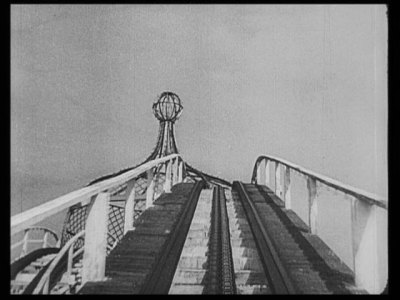
There are some fantastic scenes of the fun to be had on The Golden Mile especially on The Big Dipper (built in 1923 and still going strong) as Elvey’s camera bravely follows the actors up, down and around in a vertiginous display. But the director doesn’t overplay the location and keeps the emphasis firmly on the characters.

I want to see the bright lights tonight...
When it comes to evening’s end Mary goes home alone, repulsing her partner’s advances on the door step and it is Fanny who falls…

The next day she confesses all to Mary and reveals that Allan is to whisk her away to Llandudno. I’ve seen some reviewers be dismissive of this jewel of the Welsh Riviera but, having lived there, I can confirm that it is a cut above most resorts in the North West with a fine Victorian front and some excellent hotels (you can just glimpse the Grand Hotel where PM Macmillan once stayed and where I worked during two university summer breaks a long time ago…). Elvey takes his crew out to Wales and it’s good to see a brief glimpse of the Great Orme (home to the oldest copper mine in Europe) and the elegant bay that stretches around to the Little Orme (see what they did there?).

Llandudno, "Queen of the Welsh Resorts"
It is indeed the kind of place a well-to-do young man might take a working class woman and hope not to be recognised…

But Fanny’s plan to have her tracks covered by a postcard posted from Blackpool goes awry with the untimely drowning of poor Mary. Her friend’s death is almost secondary though, as the full “scandal” of her week with Allan is revealed and their families become concerned about the necessary “consequences”.

Peggy Carlisle and Estelle Brody
Fanny’s mother (played with bitter decisiveness by Marie Ault) want nothing less than marriage. Old man Jeffcote (Norman McKinnel, who also played the part in Elvey’s earlier film) is similarly-minded, even though it means he cannot unify his business with that of the Mayor, Sir Timothy Farrar (Arthur Chesney) who’s daughter Allan was engaged to marry.

Mrs. Jeffcote (Irene Rooke) has an altogether more pragmatic take and doesn’t see why her boy should have to marry beneath himself for this indiscretion. Whilst Fanny’s father  Chris, (Humberston Wright) – a man physically broken by a combination of his dedication to work and timidity – fears most for his daughter’s happiness. Long ago he could have taken shares in his mate’s enterprise but he was too risk averse… he doesn’t want his daughter’s life to be lived with the same compromises and the same regrets.

John Stuart and Gladys Jennings
All have different motivations and overlayed on this moral maze is the confused romance between Allan and Beatrice. It’s hard to take to Allan who, so close to his wedding, was happy enough to indulge in a week with Fanny and then, when faced with the consequences, expects to walk straight back to where he was. Beatrice (Gladys Jennings) does at least have some moral backbone, refusing to forgive Allan and insisting that he should make Fanny an honest woman.

Such sensibilities are not too difficult to relate to even over this distance. Class remains a massive issue in the UK and we still struggle with the idea that women can enjoy sexual freedom in the same way as men. Then as now the “moral” standpoints of various characters can be nothing of the kind, most are out for what they can get and are only trying to use convention to advance their own cause or to ignore the inconvenience.

Estelle Brody and John Stuart
Ultimately you side with Fanny’s father and his old friend Jeffcote: he may be a workaholic business demon but he recognises Fanny’s strength of character just as much as he despairs of his own son’s.
This is no black and white melodrama but a complex tale that defies expectations even over a century after it was written.

I’ll not give away the ending as this film deserves to be watched without preconception. The performances are exceptional especially from Norman McKinnel and Humberston Wright. But Estelle Brody gives a performance “out of its time” with naturalistic subtlety taking the plaudits: honestly, she’s far too good fer the likes o’ ‘im!


Elvey’s direction is inventive and sure footed with some sublime moments following the masses slowly whirling around Blackpool Tower Ballroom the spotlights playing across them as confetti falls almost in slow motion from the ceiling. The disorientation of a good night out… you can have your fun but mistakes can be made…

I watched the excellent Milestone DVD which comes with a very effective modern soundtrack from Sheffield band In the Nursery along with a more traditional piano score from Philip Carli. It's curious that this very British production is only available from the United States but they've done us proud.

Monday, 23 July 2012

The Lodger (1927), Nitin Sawhney, LSO, Barbican, London


The latest in the BFI’s Hitchcock restoration project, this screening of The Lodger took place at London’s Barbican Centre with the London Symphony Orchestra performing a new score from Nitin Sawhney.

Robin Baker, Head Curator at the BFI explained that none of the original scores remain and so this presents the opportunity to commission new music which can redefine and reconnect these films for modern audiences.

Sawhney has impressive credentials and has scored a number of films - he's even been nominated for an Ivor Novello Award for Film and TV Composition. Here his music featured a large formation from the LSO as well as his own band who provided piano, percussion, cello and vocals. Playing in front of the mighty LSO must take some courage and I had particular admiration for drummer Martyn Kaine who had to make everything swing but musicianship was excellent from all parties.


The soundscape was lush and closely tracked the emotional flow of Hitch’s first thriller. The only issues I had were with the songs interspersed in the score which jumped the narrative gun on one at least one occasion and threatened to prick the bubble… Other than that though, the music was pretty sensational including the lovely vocals - ambitious and as powerfully emotional as the film.

The Lodger seems heavily in debt to German expressionism and yet with that earthy music hall comedic touch that lightens even the most sinister Hitchcock. I overheard one audience member saying that she wasn’t sure whether some of the acting was deliberately funny but my silent film rule of thumb  would be that if something is funny,  it’s generally meant to be: we haven’t changed that much.


The acting matches the expressionist agenda but there’s a whole range in this film from the Golden Curls girls naturalistic post-show chatting to the more tortured emoting of victims, suspects and the unlucky in love. It’s “arch” and there’s a very knowing – very British – mix of horror and humour.

The film kicks off with a scream as the latest victim of the serial blonde assassin, The Avenger, is cut down by the killer. Hitchcock then shows us the excited reaction to the killing across London, fuelled, as ever, by the press – “Murder – wet from the press!” screams one of the inter-titles (strikingly rendered in expressionistic style by E. McKnight Kauffer).


Only a few decades after Jack the Ripper, Londoners responded to fear of serial killer in their midst through a mixture of outrage and humour… people pull faces and imitate the killer’s appearance (scarf pulled over face)… even Joe the Policeman  jokes that the killer likes the golden hair, just like him.

After the “Story of the London Fog” is established the film shifts to the interior world as we encounter the Buntings with mother (Marie Ault), father (Arthur Chesney) and their daughter Daisy (June Tripp here referred to as Miss June). They are in the basement of a townhouse not far from the Houses of Parliament and are entertaining Joe Chandler (Malcolm Keen), a policeman who is romancing Daisy.


This relaxed domesticity offers a stark contrast to the frenetic goings on of the outside world. Joe offers Daisy pastry hearts and flirts with her… yet we get the feeling she’s not entirely convinced. But Mum looks on pleased with her daughter’s reliable beau…


Their cosy routines are disturbed by a knock on the door and Mrs Bunting goes upstairs to find the strangest fellow standing on their threshold. A tall stranger, with scarf wrapped over his face, has come looking to rent their spare rooms. This lodger is revealed to be Jonathan Drew (an unearthly Ivor Novello) who is mysteriously withdrawn and looking for short term accommodation in spite of his dress and treatment of money marking him out as a man of wealth.


Hitchcock piles on the clues that begin to implicate Drew in the Avenger killings… his scarf is worn in the same manner, he nervously hides a mysterious briefcase in his room and then asks for the portraits of blonde woman to all be removed… (quite why there were so many is not revealed…).

On top of this he is indeed a “queer fellow” as one of the characters observes, intense and detached and not conforming to social norms. Clearly he is hiding something but we don’t know what.


He disturbs the household but begins to respond to Daisy’s warmth and willingness to take him at face value. Daisy’s a “mannequin” and with broader horizons than her family and boyfriend… Drew is something new and interesting. They start to relax in each others’ company and play chess in his room. She glances at this strangely handsome man whilst he gazes intently at her blonde locks… It’s like an off-beat version of the Thomas Crown chess game.


But we have doubts about Drew and when he leaves the house late in the evening, Mrs Bunting wakes and peers out of her window as he enters the night. There’s great light and shade in this sequence with Drew descending the darkened staircase and the dim light of the street lights illuminating Mrs B as she begins to wonder if this man may be even stranger than he appears.

And, as every Tuesday, there is another murder that night…


Drew attends one of Daisy’s fashion shows and buys her one of the dresses she parades. This is too far for the Buntings and father returns it with some straight talking. Drew creeps out towards the bathroom where Daisy is bathing and we’re treated to a proto-Psycho moment as Daisy’s supreme vulnerability is set against the presence of a potential killer.


By now Joe has also had enough and confronts Drew only for Daisy to side with the new man. Distraught, the policeman begins to put two and two together as it looks increasingly likely that the lodger is the killer…
I won’t give any further details of the plot… you really have to experience this one to be “thrilled”.

This English expressionist film feels more “influenced” than Hitchcock’s next film, The Ring and is more mannered in acting terms with Novello, cast firmly against type. He’s not as naturalistic as Lillian Hall-Davis in the latter film but his haunting and strangely conflicted, performance serves this story well.

The other performers contribute to an overall feeling of the mildly grotesque, especially the gurning Keen.  Marie Ault has more nuance and arguably plays the character we most identify with…safe in our domestic routines but having to take a chance on a stranger to make ends meet. June Tripp is also good as the heroin who puts her love on the line for a long shot…


The Lodger is currently available on a dirty old DVD but I’d hold off for the restored version to become available. The BFI have again done a fantastic job, especially given the source material – there was no negative and this was the most damaged of the “Hitchcock Nine”.

The screen shots here pre-date the restoration – it is quite something. Roll on the next one…