Film writer David Thomson has described late period silent
film as a medium just bursting to express itself through talk and watching this sparkling romantic
comedy you could also add the desire to laugh and sing. Lewis Milestone’s picture is bursting
with virtual sound and has an irresistible rhythm that Stephen Horne accompanied
quite superbly on piano, accordion, flute and sheets of paper… of which more
later!
This was the UK restoration of the San Francisco Film Preserve 4k restoration which I had missed in last year’s Cinema Ritrovato
in Bologna. It’s a revelation not just in terms of wit and Lubitsch-style “coding”
– thanks to scriptwriter Hans Kraly a frequent collaborator – but also in the
way it allows for the showcasing of the beauty and talent of Corinne Griffith. In her introduction
the BFI’s Bryony Dixon called for a show of hands for those who had heard of
the actress before and a handful of us raised our hands. Many more will now
have her imprinted in their minds for the next few days.
She has a spirit all of her own and shows plenty of
emotional skills as well as comedic timing in a partnership with baby-faced
Charles Ray – looking nothing like his 39 years and one bankruptcy – whose timing
and grace had already served him well in a career dating back to 1911 and included
Thomas Ince’s The Coward (1915) and The Busher (1919) in which he
competes with one Jack (John) Gilbert for the hand of a young Colleen Moore.
 |
| Corinne Griffith in front of the cameras that loved her so... |
Griffith was – also surprisingly – only four years younger
and had been in the business since 1916 and starred in films like Black Oxen
(1924) with a really young Clara Bow, as well as The Divine Lady (1929)
for which she earned an Academy Award nomination. Her reputation has no doubt
suffered as so many of her films are now lost, I make it 55 out of 72, but she was a
major star and producer who was not only one of the most beautiful
actors in Hollywood but also clearly among the most financially astute.
Bryony gave a fascinating insight into the actors’
relationship with men and money which culminated in her fourth divorce and an attempt
to pass herself off as her own (fictional) sister to avoid paying alimony to
her departing husband – points for effort but she could afford it and died a
wealthy woman. A life well lived and in this context perhaps an unlikely pastry
chef with operatic qualifications which is how her character Toni LeBrun begins
the film.
It's a midnight flit as she leaves a note for her aunt
and uncle and runs away from Vienna to join the “opera” having been encouraged
by a letter from the Palais de Paris in Budapest… Sadly the venue is not so
fine as its name suggests and is little more than a gentlemen’s dance hall with
scantily clad women kicking up the dust for their leery clientele. She arrives
with her opera diploma and finds the owner, a super smart Madame Bauer (Maude
George – close cropped hair and plenty of "coding"…) more interested in her legs
than her voice.
 |
| Maude George's Madame has a plan! |
Toni takes things at face value though and is soon being
kitted out by the wardrobe mistress Rosa (the exceptional Louise Dresser of The
Goose Woman and more) in the most unoperatic of revealing costumes. She
complains leaving Madame Bauer to offer her a seemingly more modest chiffon
dress only for her to cue the stage lights during Toni’s performance which
causes a mighty uproar amongst the sleazeballs in the stalls. Also watching is
predatory nobleman Henri D'Avril (Lowell Sherman) whose boredom is swiftly
transformed as Milestone’s camera pulls in to reveal the double image of the up-lit
girl in his opera glasses.
Things get worse when the amorous aristocrat expects to
have his post-theatrical meal in Toni’s company but she is too quick for him with
the aid of Rosa, and, as tens to happen in an environment without employment
rights and strong HR, both get fired. Rosa extends a helping hand though as she
is due her annual leave and takes her new friend with her to Monte Carlo…
Now, if you have any remaining disbelief, I suggest you suspend it for it turns out that the humble dresser, Rosa, is, in fact a Baroness who gets just enough pension from her former husband, to live the life she used to in the expensive hotels of the Principality of Monaco and signs Toni in as her daughter, ennobling her and within a few days, adopting her as one later intertitle confirms.
 |
| Rosa reveals her nobility. |
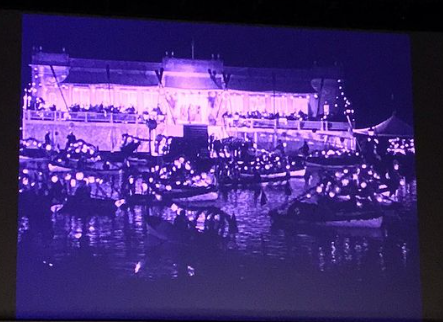
Now, as they enjoy the luxuries of the Eden Hotel – with its
rather fine gardens… the story changes pace as Richard Dupont (Charles Ray),
naughty but nice nephew of Colonel Dupont (Edward Martindel), a friend of Rosa’s,
spies Toni and soon comes a courting. Griffith and Ray have a very smart
interplay and this is a romantic screwball comedy in waiting as the two engage
in a courtship based on misunderstandings, cheeky games and good old-fashioned
coup de foudre with all of the hurdles to acceptance this usually implies.
There’s a lovely bit of business when Richard spots Toni
playing the piano and singing, he peers across at this beauty who is naturally
annoyed until – after she switches the light off to hide – he imitates and the
two engage in something like l’amour de morse code, before the rooms on both
sides of the hotel follow suit. Love, and lights, are in the air.
Richard is a songwriter when his duties as wealthy playboy permit, and he writes a song for Toni which as he plays to her, causes her to melt in his arms in a sure sign that their musicality is compatible. Later when his uncle decides to make his own proposal he also plays the song only for his phrasing to leave Toni cold. Yes indeed, the two youngsters seem destined to be together and the only tiny thing stopping the inevitable is the sleeping draught they both end up taking during a sequence that asks the question, how interesting is a proposal really?
 |
| Griffith and Ray make sweet music |
Turns out it’s not quite the only thing though as soon,
and what are the chances, Richard’s posh relatives arrive including his Uncle
Henri, recently returned from Vienna… can you see where this is going?
The Garden of Eden is so smoothly directed by
Milestone that it manages to serve the plot complications and keep the ball rolling
without annoying even the modern audience. Griffith had fabulous timing and Ray
is appealing in the gung-ho way of all noble, would-be songwriters who fall for
women out of their class. Audiences now and then knew what to expect from this
kind of film and Milestone delivers with emphatic efficiency and purpose aided
by swoon-worthy design direction from William Cameron Menzies.
 |
| The jury of his peers, aunts and uncles... |
Of course, whilst this 4k restoration looked gorgeous on
screen it was greatly uplifted by Stephen Horne’s timing and invention. There’s
one moment which I think may have surprised the audience when the Colonel sits
down to play the song and the sheet music has been placed on the strings of the
grand piano, Stephen had anticipated this and, diegetically, his playing also
included paper on the piano strings. That’s experience! Sadly, the sheet music
gave no clues as to what was being playing and so Stephen had to improvise the
music that persuades Toni of her love just as he did the rest of the score… it’s
a kind of magic. Another outstanding afternoon of live music, informed introduction
and classic film at the BFI…
There’s more high-quality Corinne on the National Film
Preservation Foundation site with a lovely restoration of her 1922 film A Virgin’s
Sacrifice – you can screen it right here!
Details of the restoration of The Garden of Eden can be found on the San Francisco Film Preserve website - they also stream films from time-to-time and so it is well worth signing up for their newsletter! It is also to be hoped that they add this to the films they have released on Blu-ray through Flicker Alley such as the splendid new Louise Brooks early film collection... of which more later! But a Corinne Griffith box set would be most welcome too!