Showing posts with label Hugh Thompson. Show all posts

Tuesday, 26 July 2022

Classical comedy... Phil-for-Short (1919), with John Sweeney, BFI


Oh, my husband’s all right – but he’s not vital.


These notes are based on my introduction to the screening of this film on 17th July, I’d like to thank the BFI for the opportunity, John Sweeney for his amazing accompaniment and the audience for not booing me off stage. A splendid time was had by all.


Women's films were changing


This film was released on 2nd June 1919, just two days before Congress passed the 19th Amendment in the US which finally granted some women the right to vote and could be seen as part of a broader trend of films that focused on female stars taking charge of their own destiny.


Cinema had always had tomboys with Mary Pickford and others not just cheeking the men but outwitting them but there was a definite moment being created after the Great War opened up a new drive for relative equality. Films such as Come out of the Kitchen, The Amateur Adventuress and the entire oeuvre of Texas Guinan showed more confident leads actively taking on men at their own game and leading their own agendas.


Famously, there were more women working in Hollywood in 1916 than 2016*, over half of silent films were written by women and there were more directors, not just Lois Weber, Mabel Normand and Nell Shipman. It wasn’t to last after male corporatisation led to the establishment of the Hollywood we all know; Universal, once home to 30 female directors, didn’t have another woman director after Weber left in 1919, until 1982…
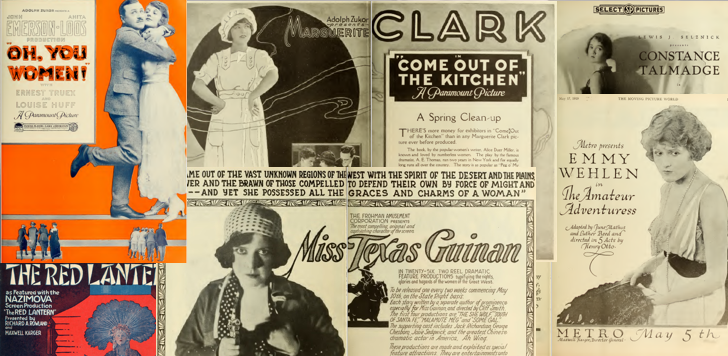
      

Summer releases in 1919


Clara Beranger


It needs no cursory glance at the current releases and those of even six months ago to prove that there are more writers among the feminine sex than the male persuasion. The heart throb, the human interest note, child life, domestic scenes and even the eternal triangle is more ably handled by women than men because of the thorough understanding our sex has of these matters…

Moving Picture World, 24th August 1918


Clara Beranger co-scripted Phil-for-Short with Forrest Halsey and was a fierce proponent of women’s role in the industry for the reasons outlined above.  Not only were more women watching films at this point, but the industry relied on their input.


Clara was able to peruse her own agenda and she also scripted Miss Lulu Bett (1921), screened last month at the BFI and another film tackling the role of women post war and suffrage. Both Lulu and Phil ultimately decide their own course of action and they are true to themselves.


Clara Beranger in 1918


Evelyn Greeley


The studio PR suggested that Evelyn was the most proposed-to woman in America? Well, she may or may not have been but she was married three, possibly four times in the end. Her past is obscured by the usual studio hype but she was certainly not an all-American girl having been born in Austria before emigrating with her family aged ten.


She began on stage before small roles in short films from 1914 onwards – she was 25 – before being signed up from 1917-19 by the World Film Corporation with whom she featured mainly alongside Carlyle Blackwell up to Phil-for-Short, billed as her first solo starring role. Her final film was in 1922 with Blackwell, Bulldog Drummond, after which she retired with the first of those husbands presumably to start a family.


She’s very good in this film though, energetic and very naturalistic, greeting every misfortune with a pause and then a smile as she figures out a countermeasure. The education she has been provided by her academic father seems to have not only informed but enlightened her approach; she’s a woman of action, decisive and morally courageous.


Whilst reviews seem to have been mixed, but no one seemed to complain about her ability.


Evelyn Greeley hiding from proposals...

I don’t want to be a man?


One of the reasons for negativity is almost certainly the fact that Phil by name means Phil by nature. Evelyn dresses as a boy for a good portion of the film and initially out of necessity as she has to pick up the responsibility for keeping the family farm running. Later she disguises herself as a boy in a bid to escape the local moral majority and to solve certain romantic difficulties.


This was definitely a challenge for some, with Variety, according to Nasty Women curators Maggie Hennefeld and Laura Horak, condemning it as a “a sissy play, too nice for our boys; we want them to be manly,” after a local screening attended by a Boy Scout troop in Wilmette, Illinois. What would our Robert Baden-Powell have said? I do hope he saw the film.


Possibly the filmmakers saw Ossi in drag in Lubitsch’s cheeky, I Don’t Want to be a Man (1918) but there’s no way an American film could be as daring… and whilst this is hardly the only example of cross-dressing in early Hollywood, Phil is a challenge because of her sex and not sexuality.


I work like a boy, why shouldn't I dress like one?


Stronger woman, weaker men


Phil stands out as practical, inventive and a leader; all very male characteristics for the older generation. She has to deal with reality as her aged father is still buried in the myths and legends of his books and, lovely and liberating though he is, she works the farm and is happy to step up.


Then the man who takes her fancy, John Alden (Hugh Thompson, wonderful as a stuffed shirt), has decided he hates all women after discovering his fiancée was a gold digger.  He doesn’t know himself any longer but Phil, educated in the emotional meaning of classical philosophy, knows what to do. For what it’s worth, I don’t see John as emasculated just confused and bruised by his experience. More than anything he needs a friend like Phil who can manage his mood…


Then there's the more general complaint from John's sister, who's husband is "alright" just not "vital" with the meaning focused on his lack of vitality, not so much unmanly as submerged in manners and the day-to-day. Men need liberating too.


Charles Walcott and Hugh Thompson


High society and lower morality


Within the film as well as without there are some very old-fashioned responses to the ancient ideas of Greek freedoms of movement, thought and free will (gosh). The moral majority base their high ground on the old days but they’re completely at a loss in explaining away the really old ways… especially the aptly named McWrath family (emphasis on Wrath, nice one Clara!), Donald the village banker, corner stone of the church and his disapproving mother.


Outside of the village, Phil has to deal with John’s wealthy bourgeois family who, whilst they like her culture also have issues with an amoral violinist making merry with John’s sister and being the very epitome of a gaslighting womaniser.


Wherever she goes, Phil tries to find a way forward. A classical education needn’t be as bad as Britain’s Prime Minister has made it seem… and she is liberated in thought as well as action by the clear-sighted pursuit of moral balance.


The McWraths respond


Is it all Greek?


Phil’s so-called after a poem by the much-misunderstood Sappho who as Hennefeld and Horak point out was often referenced in silent films as part of a general attraction to Greek literature with the hints of her precise hidden depths that the Old Fogey’s object to here.


As with “Greek Deployments” by the likes of DeMille, there’s an excuse for under-the-counter meaning and shorter frocks justified in the name of higher art and here, whilst we do have dancing in diaphanous skirts, we also have Phil berating saucy male onlookers and Donald’s appreciative leer cut short by his mother’s disapproval. The hypocrisy of inappropriate male gazing is made clear and the dancing, whilst hardly balletic, is more about freedom than allure.


This film plays with so many angles and Greeley is wonderfully peppy, hardly pausing for breath justifying her love of Greek movement and expression or deciding on cross-dressing as her own “twin” to escape from unwanted suitors including her late father’s doctor - a man old enough to be her censor.


The search for beauty is perhaps the search for truth?


Moving Picture Classic, June 1919


Entertaining intertitles


I love the film’s witty intertitles and the design of the title cards is as deft as the film’s overall tone, overlaying text on images and the live action in a very effective way that doesn’t take you out of the action but smooths the flow. There’s wit and there’s wisdom and the BFI audience laughed with and not at… the sense of the moment still ruining true after 103 years.


Here’s why Phil is so called.


That joke isn’t funny anymore?


Critical opinion in the trade press was split and, as ever, the challenge for the modern viewer is to understand why.


It is too bad that Evelyn Greeley… did not lead off with a stronger picture… Miss Greeley has a pleasing personality and is a sufficiently accomplished actress, given the right sort of role, but only occasionally does she have the opportunity to appear at her best in this unconvincing story.

The Film Daily, 11th July 1919


This picture offers Miss Greeley splendid opportunities for her starring debut, and her natural ability will see her up the ladder of fame. Considerable ingenuity was exercised in compiling this scenario to fit the piquant charm and saucy roguishness of the new fledged star…This picture will please young people.

The Billboard, 7th June 1919


This is a thoroughly daft but enjoyable film but it succeeds precisely because of Greeley’s open-hearted playing. Phil is a real pick-you-up leaping every moral hurdle in a single bound and connecting comedically and emotionally.


John Sweeney enriched the film with his seemingly effortless array of classical lines mixed with the authentic moods of period and narrative that make his work so highly valued. As usual his improvisation fitted seamlessly with the orchestra on screen, from Phil’s dance and romance to the light and shade of the lightened drama. I’d previously only seen Phil on the small screen, streamed from last year’s silent festival in Pordenone, but this, this was the way to properly see and understand this charming production.
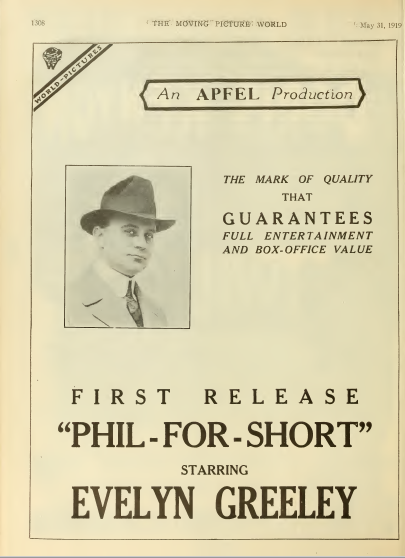
 

Directed by Oscar Apfel, the Mark of Quality...


A Nasty Woman?


Inspired by a remark made by the grandson of a one-time Yukon bordello owner, there has been an ongoing project to research and revive interest in unsung women filmmakers who broke new ground in the early years of cinema.


One of the outputs is a magnificent new box set from Kino which includes this film and 98 others. It’s out in August and it’s on my Christmas list if anyone’s thinking of a gift?


I wouldn’t say that Phil is a nasty woman though but she is a liberated one. Imagine how good it felt to watch her in 1919 newly enfranchised and with new choices starting to open up.


PS You can find out more about Nasty Women on the Women Film Pioneers Project website.


There's also a piece about Phil and other NW films from project co-director Maggie Hennefeld, also of the University of Minnesota, on the Flow Journal site.


*Silent Women: Pioneers of Cinema (Supernova Books, 2016), Melody Bridges, Shelley Stamp et al.

Thursday, 10 March 2016

The revenant… The Grub-Stake (1923)


“… no one who has not gone for broke, all out, all of the way… knows what it means to watch the unreeling of twelve-thousand feet of film which carries his colours to victory or defeat.” Nell Shipman

A revenant is a “visible ghost” returned to haunt the living and in Nell Shipman’s case the spectre both inspires and amazes. This was a woman who not only overcame impossible financial odds to make this film but who relocated her crew, cast and zoo to the frozen wastes of Ohio before climbing 6,000 feet to film the climax in which she dangles herself off a sheer rock face. DeCaprio you’re a wimp!

The hills are alive
By the time Shipman and partner/co-producer/nominal co-director Bert Van Tuyle came to make this film they were on their uppers and their company was in deep financial trouble. They sold their house in California, their car and even their piano to help finance The Grub-Stake as well as raising contributions from 300 subscribers. Their final budget was $180,000 which for an undertaking of this scale was hopelessly inadequate but Shipman had a vision and she wanted it realized.

Nell’s spirit comes through in her written words and as the above quote shows, she had a sense of humour to match her drive. She needed it as this was the biggest risk imaginable for the “Girl from God’s Country”, as she was named after two successful films featuring her battling the elements of Ohio.

Nell Shipman: in the studio and out of doors
As she suggests below, Nell's script for The Grub-Stake has everything in it and the kitchen sink – which her character Faith Diggs uses to run a home laundry business. It’s a high energy film which cuts quickly and moves at pace, possibly reflecting the challenges of its low ratio of film shot to film required – just 50,000 feet from which to edit those precious “12,000”.

The breathless finale was filmed atop Lookout Mountain – at 6,727 feet the highest in the region and more than a couple of thousand up on Ben Nevis, Britain’s champion peak – having to lug equipment up on the backs of protesting pack horses. Honestly Nell, you could have picked an easier location but no she went high and it is rewarded as the views make for a stunning backdrop as she hangs onto a tree root on the side of a sheer cliff face. It’s a stunning conclusion that sets the emotions and the pulse racing – to all her other attributes add stunt-woman and her editing (who else) is superb.

Nell hangs on tight
As Nell later said: “…it had a sockeroo finish! It brought to customers that dimple we aim to create so it may cup their shed tears…”

The plot is how you hipsters say, “bat-dropping” crazy, and shows Nell’s lively mind in overdrive creating an improbable world just around the bend from our believable own. Nell plays Faith Diggs a woman who combines work in an artist’s materials shop with life modelling and a home laundry service.

Skipper watches the ships and waits...
She does all this to care for her ailing father, a retired mariner named Skipper (Walt Whitman – the other one) who spends his days looking out of his window at the tall ships in the harbour. He puts his light in the window to illuminate Faith’s way home and already you can see the richness of Shipman’s ideas with any florid over-invention being counterbalanced by a lightness of tone in the intertitles.

But Shipman’s acting provides the clearest signal of her intent. She stands tall as the model wrapped in white cotton, standing as a partially-exposed mummy in front of a class of eager scribblers, her face mock serious yet soon gurning in horror as she has to shuffle out to deal with a customer.

Bare shoulders!
Bizarrely that customer is the film’s villain popped into pick up some brushes and paint for a friend up in the Yukon – the script is full of such long shots and intricate connections and this won’t be the last we see of those brushes… Mark Leroy is a gambler and business man played by Alfred Allen (who Wikipedia wrongly makes 36 at the time of the film when he was actually 56 and he looks it!) but Faith can’t see that only a charmer who takes an interest in her.

Faith loses her two art jobs after the proprietor returns to find her bare-shouldered. She traipses the streets looking for work and runs into Leroy again just as she is on the point of selling her improbably long hair. He invites her round on the pretext of photographing said locks but when she arrives she reveals they’ve all been chopped for cash. No matter, he didn’t really want to take her pic… he has more business-like concerns.

Well, would you trust this man?
Looking to make a new start for her and Skipper, Faith jumps at Leroy’s offer of a “grub-stake” – an advance on adventure based on a share of the returns, but rebuffs his attempts to take an early payback in kind. They travel north by ship and in a moment of calm madness, faith accepts a marriage proposal from the middle-aged manipulator… let’s say Faith is green; let’s say she trusts too easily and that she has, indeed, too much faith.

Dawson Kate evaluates the greenhorn's fashion sense
Reality bites once they arrive not once but three times… Leroy provides Faith with a new dress and invites her to a “party” at the local dance hall. The folk there are mighty friendly, especially the men but not Dawson Kate (Lillian Leighton) the “he-woman” (according to the intertitle) who runs the saloon with a rod of iron and a heart of rare softer metal. He soon reveals to Faith that firstly this ain’t no party, secondly hubby already has a wife… and thirdly Leroy has bought Faith here to trade as a sex-worker.

Overhearing the truth Faith is shocked to the core but then she hears that Leroy’s set his manservant (Ah Wing) to poison her father…

Malamute Mike and his best friend
At the start of the film we’re shown an old but intrepid frontiersman atop a hill with his faithful hound but by the time we see the man again he has become the town drunk, Malamute Mike (George Berrell) trailing around the string he used to tether his four legged friend in the belief that old Tucson is still there. He’s kicked out of the dance hall just in time to head to Skipper’s house and to slow down the poison plot long enough for Faith to come to the rescue.

Leroy duly thwarted, the trio have to flee before he finds out. Mike, drunkenly-deluded that he found some gold high in the mountains and at the end of the rainbow… decides to take them there. They take Leroy’s dogs and sleds and head for the frozen North.

Faith climbs higher
Now Shipman’s love of nature takes over and there are glorious segments in the snow. Faith has to forge on alone after their sled runs out of snow and ends up going higher and higher, lost in the upper perma-frosts forests as Mike goes for help from Kate’s son Jeb (Hugh Thompson), who lives in their cottage practicing his art and is indeed the person for whom Leroy bought the materials for right back at the start.

Faith discovers the bear necessities
There follows an interlude in which Faith survives the cold in just a linen shirt and winter dress, wandering lost until seeking refuge in a cave already occupied with a friendly brown bear… The sequence shows Faith communing with all manner of creatures – more bears, raccoon, badgers, marmosets, deer and wolves. All are at peace with this gentle soul although in reality the wolf sent to snuggle up as Faith sleeps, lunged at Nell’s face and later had to be put down.

Jeb arrives from nature
Spring seems to have sprung and one day as Faith sits watching two bears play-fighting in the stream Jeb arrives and almost rescues her before being told there is no need.

Now the stage is set as the two youngsters fall for each other, Jeb spots Mike’s marker for the gold and they find his old dog still in his old shack! Lots of things fall into place whilst the tension is ramped up as Leroy comes looking for the girl and the gold!

Jeb and Faith bond over nature and the arts
“Fact is, viewing the scenario from the wrong end of time’s telescope, The Grub-Stake bears a strong resemblance to a Soap Opera!” Nell Shipman

She was not wrong but the opera is well produced and the soap not so soft once the action kicks in and a battle begins culminating in that real-life cliff-hanger. Before that Shipman battles Alfred Allen in a no-holds barred scrap that she looked like she could easily win.

Location shooting on frozen Priest Lake - same spot as the image at the top!
The Grub-Stake is packed full of Shipman’s determination and charm but whilst it initially did well its distributor, American Releasing Corporation – who hadn’t even paid an advance – went broke. Other, better, offers came in too late after Nell had signed the deal – almost as green as Faith.

Nell again“…this picture was a real grub-stake gamble for a proprietor who must strike it, must pan out!”

Y'see Leo... you have to work with the bear; don't fight it!
Luckily British rights were secured – not that Nell saw any of the money – which ensured that the BFI ended up with the only extant copy. This was used by Idaho Film to create the From Lionhead Lodge DVD which is part three of their Nell Shipman Collection which comes complete with surviving shorts from the Little Dramas of the Big Places series and a short documentary narrated by Shipman’s grand-daughter and great grand-daughter in 1987 – the family creative spirit lives on. There’s also a suitably homely accompaniment from John Hayes and Eberle Umbach.

My Amazon Shipman shipment
The disc is available sporadically from Amazon (I may have grabbed the last copy!) whilst there also an excellent biography by Kay Armatage, The Girl from God's Country: Nell Shipman and the Silent Cinema, from which I gleaned so much interesting background and lifted the quotes above – also available from Amazon.

Watching and reading about Nell was another inspiration from Silent Women: Pioneers of Cinema Edited by Melody Bridges & Cheryl Robson and available from Aurora MetroBooks. It features much on Nell including a fascinating and exciting chapter from film-maker Karen Day whose documentary on Nell I can’t wait to see in full!

Tuesday, 20 October 2015

Before the Falls… Sherlock Holmes (1916) Neil Brand Ensemble, BFI London Film Festival

Watson and Holmes: a very civil partnership
It was interesting to see the names of Mark Gatiss and Steven Moffat – current creators of the modern-day Sherlock, on the list of thank-yous from the restoration team for one of the very first screen representations of the original.  This version was arguably as much a re-working of Arthur Conan Doyle’s original stories as their modern version as it drew content from three stories A Scandal in Bohemia, The Final Problem and A Study in Scarlet whilst adding something of its own.

It was based on the hugely-successful 1899 play written by and starring William Gillette which, as Bryony Dixon pointed out in her introduction, not only had a long run in the USA but also ran for some five years just over the water in London's Lyceum Theatre where once it counted a young Charles Chaplin in the cast.

Great mind at work
Gillette was 62 when the film was made but he still carries of the part of the Master Detective with a rare charisma and intelligence even if he is a little too old to be a romantic interest for Marjorie Kay (17 at the time) as Alice Faulkner (a sort of goody-two-shoes version of Irene Adler).

Gillette is credited with introducing some of the standard visual elements of Sherlock, over his 1,300 stage performances and this recently-recovered film is no doubt all the more precious for preserving such an iconic performance for this enduring and malleable character: we all like to believe in detectives with super-intelligent.

Gillette and Kay
Here he seems to drift into scrapes almost as if he wants to prove he can get out of them – not unlike The Doctor as Mr Moffat would confirm… But he’s always thoroughly prepared whether in wearing a bullet-proof vest made of metal, planting spies in the enemy camp or using his junior butler Billy (here played by Burford Hampden but once by Charlie…)  as the last line of defence.

The film was originally presented as a series and the version uncovered and restored (full details are here) is from a French print which broke this down further into four parts with nine sections. This adds to the slightly disjointed feel of the narrative but it’s Sherlock Holmes; then, as now, it doesn’t all have to add up!

Alice defends her sister's honour in front of the Prince's men
It is very well directed by Arthur Berthelet who does well to lift the narrative away from its stage origins. There is some location shooting in London-looking streets and some interesting camerawork including medium range shots that fade into close-ups at crucial moments and out again.

Berthelet closes in on the action with a repeated disolve...
The story is convoluted and bitty – as you’d also expect from a serial... as you'd expect from Holmes  – and  is really only there to provide opportunities for the Great Detective to show how great he is.

Briefly… Alice Faulkner’s late sister had an affair with a prince and had kept some rather incriminating correspondence which his relatives are very keen to recover. Baron von Stalburg (Ludwig Kreiss), the prince's assistant, and Sir Edward Leighton (Hugh Thompson), a high British official, are trying to negotiate their return before the author’s impending marriage but Alice is refusing to budge.

Sherlock confronts Madge and James
Unfortunately for her, a good-for-nothing family called the Larrabees hear of her situation and try to take advantage… Led by James Larrabee (Mario Majeroni) and Madge Larrabee (Grace Reals) they’re a nasty lot - a little too histrionic for their own good - but, fortunately not too clever.

Holmes,who has been enlisted by the Prince to retrieve the letters, easily outwits by the Larrabees aided secretly by his agent Benjamin Forman (Stewart Robbins) posing as their manservant:  how very cunning Holmes! They decide to call for help from master criminal Professor Moriarty (Ernest Maupain) – who’s hatred for Holmes they hope will guarantee his support.

Guess who?
Yet even with  Holme’s arch enemy now involved can these criminal minds combined win over Holmes' powers of deductive pipe-smoking, intuitive reasoning and, indeed, disguise!

We don’t see too much of Doctor Watson (Edward Fielding) until later in the series when Holmes is sharing his house after an unexplained fire at his own apartments… but the template has recognizably been set.

Subtle gesturing from Mr Gillette - perfect for the big screen
Gillette is as razor-sharp as his name suggests and is a magnetic presence on-screen a natural who underplays so well you'd think he'd been in front of the camera for years whereas this was his only film. He blasts most of cast off screen with a performance of well-honed wit: the calculated confidence born of a thousand or more previous performances.

This was the first screening in Britain since the recovery and for longer than a lifetime: a special occasion that did not disappoint.

The Larrabbees are no match for Brand, Buchwald and Davenport!
A large part of this was due to the joyful accompaniment provided by Neil Brand (piano), Günter Buchwald (violin) and Jeff Davenport (percussion and sound effects). They playing a semi-improvised score based on Neil Brand's melodies as originally commissioned for La Cinémathèque Française. Every bell-ring and thump was precisely on target and the music was as elegantly period-appropriate as Mr Holmes' smoking jacket and as invigoratingly well constructed as his ultimate trap for Professor Moriarty!

There is soon to be a Flicker Alley DVD/BluRay release which - I think? - includes the boys' music as well - one for the Christmas list! Available from Amazon or from Flicker Alley which also has a downloadable press kit explaining more about everything!

Because the Cat just refused to be trained...
Before the main film we were treated to A Canine Sherlock Holmes (1912) a terrific little romp involving a smarter than average dog who does most of his master detective's leg work. Still very funny and an indication of how well-established the Holmes template was by this stage.

A Holmes for all times
Marjorie Kay performs well and went on to work as a nurse in the Great War and from there into stage work and opera. There's are some interesting biographical snippets on the I Hear of Sherlock Everywhere site as uncovered by Chris Redmond.

Young Miss Kay considers her next move