Showing posts with label Valeska Gert. Show all posts

Monday, 11 November 2019

The root of all evil? Alraune (1928) with Stephen Horne and Martin Pyne, Barbican


So good to be back at the Barbican for a rare silent screening and with expertly inspired accompaniment from the two-man band of Horne and Pyne: four hands, ten instruments?

Directed with sure-footed competence more than style by Henrik Galeen, Alraune doesn’t rank with the best of Weimar cinema but it is still a very interesting film and one I’ve always wanted to see projected with live accompaniment. There are long passages when little happens but human interactions and the music sustained the film in these quieter moments. Variously known as Unholy Love, Mandrake, or A Daughter of Destiny, Alraune is missing a few key segments and again the accompaniment stepped in to offer thematic uplifts as well as emotional context throughout.

The music was eloquently varied, featuring more than just the duo’s prime instruments of drum and piano. Martin’s vibraphone, played with bow as well as soft mallets, lead the line in plaintive and eerie interplay with Stephen’s piano and as the two switched instruments they worked superbly well in support of the events on screen. There was magic in the air on and off.

On screen the magic stemmed from the Germanic Middle Age legend of the Mandrake root (the Alraune of the title), which – and listen carefully here - if left to absorb a hanged man’s “essence” in the ground under his execution, was capable of giving life either by enabling pregnancies or helping witches produce children without the aid of a living sperm donor. Such progeny were said to have no souls and sound far more trouble than they’re worth but, you know, there’s always someone ready to give it a go: to mess with Nature.

First of all, find a hanging man.
Step forward our mad scientist for the day, former Golem of this parish, Paul Wegener who plays Professor Jakob ten Brinken who has become interested in the nature versus nurture debate and this has somehow led him onto the legend of the root. By using the mandrake, he hopes to engineer a human being in order to establish “whether the parents’ genetic make-up, has a purely random effect on the offspring.” Can he create something pure and free from hereditary conditioning? I think you know where this is heading.

The professor grows the Mandrake as required and gets his nephew Franz Braun (Iván Petrovich) to help him find a lady of the “lowest order” - Die Dirne (The Whore) played by Mia Pankau - to act as the incubation chamber for the new being. Just as the woman arrives at the Professor’s apartments, turning in shock to see him emerge in white coat, the film jumps forward almost two decades… some sense lost through censoring perhaps?

Oh, mother... Mia Pankau
Alraune ten Brinken (Brigitte Helm) is the fully grown experiment, now at boarding school and is first seen toying with fly as it attempts to escape from a glass of water, she reaches out, not to rescue but to push it back; not the behaviour of a well-educated young woman. There is more to come as she leads her classmates into acts of rebellion, she dances, wears cologne and plants a stage beetle on the mother superior’s robes.

Clearly Alraune has out-grown school and to facilitate her escape has lured a young man, Wölfchen (Wolfgang Zilzer) into loving her: he is to steal money from his family and they are to run away. Once on their train to freedom she orders champagne and starts flirting with a likely lad who spies her from the corridor. Wölfchen tries to fight him off but there’s to be no respite as a troop of circus performers join the train. Alraune is immediately impressed by the magician’s sleight of hand especially when in one sexually obvious moment he lets a mouse run up her skirt; she leans back and looks him straight in the eye when even Bad Maria might think twice.

Paul Wegener and Brigitte Helm

At the circus things move on and Alraune is seen sharing a cigarette with the lion tamer (Louis Ralph) standing so close that she can light his fire with her own as it were. Chided for her wanton troublesome-ness Alraune walks into the lions’ cage challenging the beasts to come and have a go if they think they’re cat enough. The animals don’t move until the Tamer rushes in with his whip.

So, a heartbreaker with nerves of steel and a twisted sado-masochistic streak… is this what the Professor wanted to find out? How would a woman born from the human stew of a prostitute, a murderer and the mysterious root vegetable work out?

He’ll soon be able to find out as he finally catches up on his “daughter” after years of searching. He whisks her off to polite society where she plays tennis with Der Vicomte (handsome John Loder out of The First Born) who soon proposes… But, he’s not the only man to have fallen for Alraune and the Professor blackmails her into staying under his “care”.

He's behind you... 
From this point one it’s a battle between the scientist and his creation and we all know how those usually turn out or do we? The film has more than a few tricks and turns up its sleeve … there’s an irony in the impact of the Professor’s own true “nature” on the “nurture” of his subject perhaps?

 
Alraune is worth watching purely for Brigitte Helm’s performance alone. I love her physicality and dancer’s contortions: she seems almost too frail to be an evil thing and yet there’s considerable strength behind her movement as the Professor will find out. She has the range too and whilst it’s fun to watch her evil contortions we also see hints of a growing humanity… or do we? Paul Wegener is pretty good too, mad science-ing with consummate abandon and obsessing intensely about his creation, Frankenstein with a mid-life crisis and unrealistic expectations.

But, as with all the very best silent film screenings, it was the mix of film, music – excellent audience! – and, of course this wonderful venue! There’s more to come at the Barbican in the New Year and here’s to more screenings like this!!


Tuesday, 2 July 2019

Misery loves objectivity... The Joyless Street (1925) with John Sweeney, BFI Weimar Cinema Season


This was the first time I’d seen Die freudlose Gasse on the big screen and, after my last viewing of the EditionFilmMuseum DVD, I’d connected it very strongly with the austerity programmes of the former Tory-led coalition under the joyless headline “plus ca change”. Well, French was never my strong suit but over the last five years, things have just got so much better haven’t they?

Anyway, back to 1925 and post-war depression in greater “Germany”, specifically Austria and a film that having once been ten reels long is now in an ongoing state of restoration. Even now it feels like a Diagon Alley version of the Melchior Street it’s supposed to be with understandable narrative disruption caused by using five different sources and retrospective sequencing. That said, it’s never made more sense to me than tonight, sat in the front row after a week in Bologna and yet with John Sweeney holding the story with the thematic continuity of his 151 minutes of improvisation. There’s such variety in Mr Sweeney’s playing and none of tonight sounded like what he played for Sir Arne’s Treasure or Les Vampires just a few days ago in Bologna.

Where the sun never shines... the locals queue in Melchior Street
Pabst’s film is based on Hugo Bettauer's novel and takes what is essentially a crime story and develops its socio-political aspects. Screenwriter Willy Haas described the source book as "a miserable crime novel" and said that what appealed to his director was "... the harsh social portrayal of inflation, the bankruptcy of the old-established patrician circles...the corruption, the moral decay..." The Joyless Street therefore focused on the "social" and a realistic portrayal of poverty and the consequences of mean-spirited capitalism and the greed that drove western-European economies.

Pabst cast a combination of one of the creators of cinematic acting and a relative newcomer who’d only made one feature film. Asta Nielsen was cast as Maria Lechner the daughter of a disabled father who lives in near poverty and then becomes entangled in the lives of the financiers running and ruining the economy for profit. Then into her forties, even Asta was a stretch for the part of an innocent younger woman but her skill carries her through some memorable and powerful scenes even when the lighting and unforgiving close-ups can't.

Asta Neilsen, Hertha von Walther and Greta Gustafsson soon to be Garbo
Standing next to her in the forlorn queue for the butchers is Grete Rumfort, played, of course, by one Greta Gustafsson, fresh from Gosta Berling and not quite 20 years of age. This was the film that clinched her ticket to Hollywood and it's not hard to see why Mr Goldwyn was so impressed. She's superbly photographed by Pabst and you can see the beginnings of the force of nature that would captivate millions, she’s sublimely eye-catching if markedly less centred than she will become, jumpy even.

Legend has it that Pabst used slow motion to help counteract the impression created by the young actress's nerves and this combination served to create an impression of graceful edginess. Even if Stiller was on hand to help manage his protege, can it be a coincidence that Herr Pabst managed to enable defining performances of such power and beauty from both Garbo and Louise Brooks?

Greta.
The film features many strands and an ensemble of rich characters. Werner Krauss is monstrously greasy as Geiringer the Butcher who rules Melchior Street by restricting the supply of meat to only those he favours: the wealthy or those women prepared to pay in kind. He meets his match in the local brothel when offered Grete; he can’t cope with her at all and it’s a telling moment when the bully is flawed by beauty. 
  
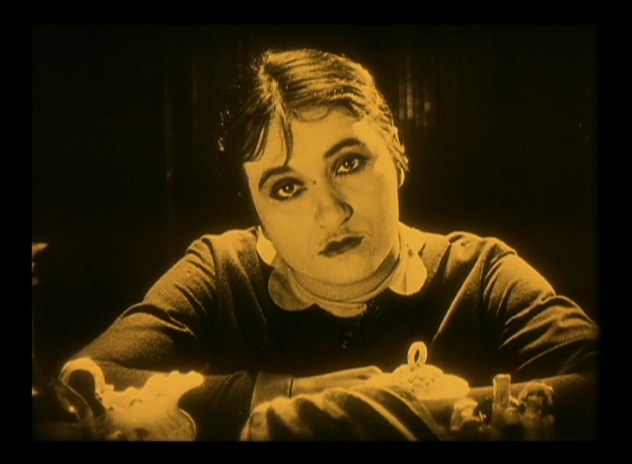
Running that house of ill-repute is the other ruler of the Street, Mrs. Greifer who is played by the extraordinary Valeska Gert, a dancer and cabaret artist who brings a great knowing energy to the screen – even breaking the fourth wall on occasion, yelping in silence at the audience: more Poly Styrene or Ari Up than Gloria Swanson! Mrs. Greifer runs a fashion boutique which acts as the front for a relatively high-class brothel. Women of the street are drawn into Mrs. Greifer's, seemingly labyrinthine premises driven by hunger and desperate poverty to subvert dignity in the service of selfish and, as it turns out, hypocritical males.

Valeska Gert meant it!
Amidst so much economic disruption, greedy speculators act to make things worse by manipulating the stock market and the people of the street suffer whilst the bankers waltz around in opulent hotels and drink champagne in Greifer's salon.

Further up the social scale, the Rosenow family are untouchable, with Max (Karl Etlinger) leading the stock market scams. His daughter Regina (Agnes Esterhazy) loves his assistant Egon Stirner (Henry Stuart) and this is where it gets complicated. Whilst Egon’s love appears to be true… this doesn’t stop him from having designs on the Rosenow’s lawyer’s rather striking daughter Lia Leid (Tamara Geva) AND… he’s also in a somewhat serious relationship with Maria who writes him love letters and is convinced that they have a future together.

All of this makes Egon The Eager, pivotal to the entire story and makes him a disappointing man for a happy ending with Regina or anyone else. Regina tells him that he’s too poor for her – presumably Maria is too poor for him? – and that the only way he can have her is to "... become as rich as I am, or I as poor as you."

Maria's boyfriend Egon with other lovers, Lia and Regina... what's a boy to do?
This leads Egon into willing complicity with her father’s idea to make half a million by spreading the rumour of a strike at the Petrowitzer mine which will push the value of the stocks down and then, at their lowest, reassurances will be made that send the value skyrocketing; guaranteeing a killing for those in the know. This will include Don Alfonso Canez (Robert Garrison) who is in town to make just such a profit but not, of course, Grete’s father, Councillor Rumfort (Jaro Fürth). He decides to take voluntary redundancy and to bet it all on the stock market.

When the fix comes in, Rumfort loses everything having bet on Coal stocks remaining low and the family is forced into taking a lodger as Grete struggles to keep the money worries away from her broken father. A lodger is soon found in Lt. Davy (Einar Hanson) an American serviceman in Vienna to help with reconstruction, he hands Grete $60 and she has to use it to pay her father’s stock market loses…

Asta
The plot has all the hallmarks of a novel as source but the main thing for Pabst is to foreground the social injustice with the complexities of personal and social betrayal rather less important than the fact they happen. The direction of the women’s’ lives is driven by the need to provide and both Maria and Grete move nearer and nearer to the club Frau Greifer runs with the former becoming Don Carlos’ “girl” for rent which is how she ends up in the cheap hotel next door the night Lia Leid has gone there for an illicit rendezvous with Ergon…

There are some excellent sequences in the club as Grete comes closer to following the same path; she can’t quite bring herself especially after one of the club’s waiters, Kellner (Gregori Chmara) has a rush of blood and tries to force himself on her. This is when you can see Pabst’s use of slow-motion; whether it was used to make Garbo look “smoother” or to heighten the moment of fear, it is certainly effective.

Gregori Chmara chases Greta slowly...
Even this reconstructed version is missing some content but it makes sense overall and the emotional force of the story is clear as day. As the men go wild for Grete the people in the street outside decide that enough is enough and the film ends with a call to action and for solidarity in the crisis. Nearly a century later we are still grappling with the gap between rich and poor and struggling to recover from a banking crash that has led directly to Trump and to Brexit. Who knows what will happen next?

Stylistically Joyless Street is post-expressionist and part of the “New Objectivity” movement with its resigned cynicism balanced by a desire to seize the moment. Pabst was, according to biographer Lee Aywell, the first to take up this stance with his expressive style focused on the everyday and not fantasy. Melchior Street is accentuated reality of a very stylized kind; entirely studio-based and yet gritty as any exterior; the gutters may have been papier-mâché, but the grief was all too real.


Tuesday, 18 June 2019

Playing with fire… Diary of a Lost Girl (1929), BFI Weimar Cinema Season


Well, this was it, I long ago decided to not watch my DVDs of this film as I wanted to see it first on the big screen and Herr Pabst and Louise Brooks did not disappoint. Diary is not another Pandora’s Box but it is a film that gives Brooks the chance to show her acting range and Pabst the opportunity to focus on her remarkable expression and, yes, the rest of her; perhaps the sexual superpower of the silent era (awarded retrospectively), with a character in search of herself and not a purely natural spirit like Lulu.

After watching Mother Krause and Kuhle Wumpe earlier in the BFI’s Weimar season, this is a more focused and ultimately more politically liberal and mainstream tale although we still have the seemingly obligatory suicides… they needed to do something about those windows and accessibility to dangerous prescription drugs. Pabst's film is certainly part of die neue Sachlichkeit, but it's more polished than those two films but that’s not to say it doesn’t cover the darker side of life. Writer and Brooks/Pabstpert, Pamela Hutchinson, gave a fascinating introduction, quoting the actress in saying they were attempting to show the “flaming reality” of “sexual hatred” and this film does indeed burn right up until a telling last moment.

“I think in the two films Pabst made with me… he was conducting an investigation into his relations with women, with the object if conquering any passion that interfered with his passion for his work…” Louise Brooks

Louise Brooks
The thing that flames the fiercest is of course Louise Brooks and whether she’s playing an ingenue, a reform school girl, prostitute or woman grasping her destiny, performs with grace and an almost casual conviction. Pabst’s camera closes in over and over on her astonishing believability lost as much as his audience in the emotional intelligence as well as the structure of her expression: killing us softly with her smile. One first viewing this film does not have the script or story power of Pandora and yet the performance is all of the same quality: this is It squared.

Pabst may well have been fighting to overcome sexual instinct but he was keen to maximise his new found asset and had it in mind to cast her as Lola Lola in what would become The Blue Angel, but whilst he lost out on the rights to that, he also could never really make a Dietrich out of Brooks who, having burned her Yankee bridges by refusing to overdub The Canary Murder Case, decided Europe wasn’t for her after one more film, Prix de Beauté with Pabst’s script involvement and direction from Augusto Genina, which, along with Beggars of Life, completes an impressive top four from her brief career.

A crown of innocence: Josef Rovensky and LB
Who knows what could have been but, we have what we have and this film added so much delightful substance to my impression of Brooks as an actor proving that Pandora’s Box – which I’ve seen dozens of times – was no one off and that she and her director could almost match it even with subject matter drawn from Margarete Böhme’s sensationalist 1906 novel which dealt with a woman’s fall into prostitution – a story Böhme claimed to be based on truth. All a far cry from a Frank Wedekind play. It’s a simpler story but one that provides an interesting fall and rise for Brooks to contend with. Her character Thymiane is the daughter of a well-to-do pharmacist, Robert Henning (Josef Rovensky) who’s only weaknesses are a fondness for young housekeepers and trusting his assistant Meinert (Fritz Rasp) rather too much.

Brooks later said that Fritz Rasp was one of her more alluring co-stars...

Meinert takes advantage of Thymiane – forcibly - and she gets pregnant. At the same time her father is seducing his latest housekeeper, Meta (Franziska Kinz) with the previous one Elizabeth (Sybille Schmitz, later to star in Vampyr) having already been dismissed. There’s perhaps a line between the two men and their relationships with younger women especially given what is to come for Thymiane and later for Meta…

Thymiane has the baby but refuses, understandably, to marry a man she doesn’t love. The baby is placed into care and the young woman is sent to a reform school as her father is encouraged by Meta who knows her power.


The story takes a dark and more expressionist turn as Thymiane enters a highly disciplined reform school run by a director played by the extraordinary Valeska Gert and her husband, the equally odd Andrews Engelmann. These two create an evil pairing although Gert gives her nastiness an extra twist with her curious enjoyment in watching the girl’s exercise… all I can say is Hedy, you and your pearls may have been beaten to the punch by a couple of years and in the weirdest of ways.

Thymiane escapes the school with her pal Erika (Edith Meinhard) aided by her pal the penniless Count Osdorff (Andre Roanne) who has been disinherited by his Uncle (Arnold Korff) for being a likeable if listless waster. Thymiane discovers that her baby has died and in desperation moves in with Erika at a brothel in sequences that still carry coy intent directly or indirectly. The madam (Marfa Kassatskaya) kits her out in high heels and evening dress and in a moment of transcendence offers the young woman a glass of champagne which she gulps down – a baptism of Bollinger.

Brooks and Edith Meinhard
Soon, after collecting on her first customer, Thymiane lying unhappily in bed as a wad of notes rest next to her… Thymiane advertises herself as a fitness/dance instructor and Brooks herself  would return to dance teaching in the thirties and, much later, would turn tricks in New York before finding salvation in writing after rediscovery. Her first customer features a bizarre turn from a weirdly bearded Sig Arno who follows her callisthenics before getting too excited and being shooed away with a lighter wallet.

The “lost girl” has found a new direction and yet things cone to a head when she spots her father and, Meta, now his wife, slumming it in a low-rent night club. Father and daughter are heartbroken but Meta rushes her husband away before any rapprochement is possible. Her father dies in misery and her inheritance offers Thymiane the chance to finally change direction… what would Lulu do? Nothing at all like Thymiane whose character gets the chances denied her more elemental “twin” in an ending I must admit I didn’t see coming at all…


Ultimately, I am amazed that given the intense interest in Brooks ,that Diary gets screened so rarely; it’s a fine companion to Pandora and helps give a more complete picture of the actress; she was no one-hit wonder, just A Wonder and, with Pabst’s help and a very strong supporting cast, made her mark here too.

Thank you, BFI, PH, GWP and LB! There’s still more Pabst to come in June with The Joyless Street (1925) details on the BFI website along with the last few weeks of this splendid Weimar season.

Sybille Schmitz
Josef Rovenský  and Franziska Kinzas
Sexy Fritz Rasp (apparently)
Andrews Engelmann
The excellent Valeska Gert
Edith Meinhard
Sig Arno, dontcha know
Trapped?
Pabst was pleased with this tracking shot of Brooks running up the stairs, it's mirrored by her slow trudge near the ending...

Now I can watch these...