Showing posts with label Robert Garrison. Show all posts

Monday, 24 August 2026

Crime & Punishment… Schatten der Weltstadt (1925), Horne & Baldry, Bonn Silent Film Festival 2026


When night sets on the big city

And lights and make-up and laughter mingle

Then, from streams and deceptive pomp emerge

The shadows of the metropolis, the shadows of the night…


Have to say that the “F” in FOMO reached a peak this year for the Bonn Silent Film Festival as I not only “MO” on a two-part screening of the magnificent SFI restoration of Gösta Berling Saga (1924) but also a rare screening of L’Inferno (1911) as well as many goodies including this stylish Weimar thriller with accompaniment from the many hands of Stephen Horne and Elizabeth Jane Baldry… if only I’d been there. I say it every year and there will be no stopping me in 2027!


A man dies in the agony of a heart attack, grabbing the dark-stylish hair of a would-be younger conquest, falling down with frozen grip as her silent scream is given startling verbal reality by our harpist (probably not pianist…). It is but one moment in a two-hour tour-de-force accompaniment from Elizabeth and Stephen which sees them intertwining phrases and melding tonality of strings plucked or hammered with hand or keys. I can’t imagine how it feels standing on the precipice of even a practiced and prepared for cinematic trio: piano, flute and accordion interplaying with harp, percussion and voice, all relating to the action on screen.


But Stephen and Elizabeth Jane are pitch-perfect musical adventurers, sure of each other’s contribution just as they are of their ability to match the momentary moods and themes of the film unfolding in front of them. A fourth element is always the audience and, whilst I played my part in our living room, it’s the immediate ambience that provides a call and response as compelling as the narrative. In the live stream from the festival, you can feel this almost tangible atmosphere. You are, very quickly caught up in the mix and the focus on film which is the ultimate magic of live cinema… contrapuntally rubbing circles on our stomachs and patting ourselves on the head, two things are true at the same time even moving in different time, space and direction.


Ellen Richter

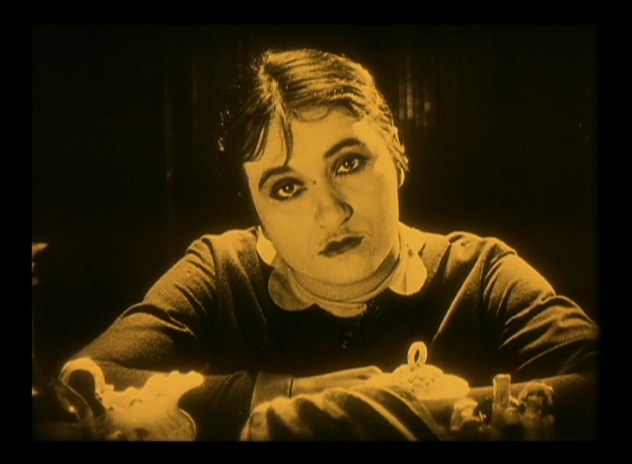
It's all about the hair though. Ellen Richter was a one-woman industry by this time in Germany with her own production company, Ellen Richter-Filmgesellschaft, managed with her husband Willi Wolff, who directs her in this film as most of her others. Ellen was once described as a forgotten star but is now resurgent with recent screenings at key festivals including Moral (1928) and others at Le Giornate del Cinema Muto 40th Edition. She’s a German diva with sharp features, eye-drawing presence and jet-black hair that is often pulled back to allow the focus on eyes as deep as the Danube of her native Vienna and which beguile as they inform. And clothes, she wears these with the grace of a Borelli or Bertini exuding a Germanic athleticism which saw her feature in many action adventures.


Her physicality is on display here as she goes in search of her husband’s killer into the dark underbelly of Paris but first she must play her part in the demimonde of the wealthy as Olly, the wife of a just-promoted prefect, Henry Bernard (Alfred Gerasch). The film’s opening already gives us a hint of the degradations to come as a well-dressed man is propositioned in the street after the theatre and a young woman, presumably poisoned by the skin game throws herself in the Seine in the establishing shots bookended by portentous poetry.


No wonder! Making a career with a wife like that…


Horrid Henry: Alfred Gerasch

We then join the couple at the lavish party they’re giving to celebrate Henry’s elevation and it soon becomes apparent that a price is being paid for his career and by Olly. The inference is clear, she has been abused for her sex as much as the desperate women of the streets and, as leering men of influence pass inappropriate comments we see her being approached by her husband’s benefactor, the government minister (Philipp Manning). One man, a journalist Felix Granier (Walter Janssen) complains about the language and assumption that an attractive wife is a professional asset… and we soon learn that he is Olly’s lover, her refuge from her brutal husband and the deals he makes using her body as collateral.


But enough is enough and when the minister makes his way to Olly’s boudoir to collect his reward she cannot go through with it and, as the shadows of the musicians and the dancers at the party play against the curtained windows the old man has a heart attack and promptly dies. Henry tries to cover up the location of the death and sends the dead man away in a cab pretending he’s dead drunk… It’s not a particularly clever ploy and the police soon come knocking only to find the new prefect dead with a pair of scissors deep in his back. Olly enters the room and seems shocked but these guys know a good actress when they see one.


The story moves on in swiftly in detailed ways and the trial of Olly follows in a magnificent studio set - designed by the art directors Otto Erdmann and Hans Sohnle – which emphasises the pomp and process with Olly isolated on the stand, distant from her judges and jury with a circle of lights illuminating the search for the truth among the murky testimonies below. By this stage Olly is almost defeated and reluctant to tell a story that no one will believe over and again but gradually her situation is revealed and she shows the scars of her husband’s beatings. She is acquitted due to lack of anything other than circumstantial evidence but this is not enough to stop the media portraying her as a murderer who got away with it.


The most hurtful of this group is Felix who hasn’t the stomach to see through the whole trial and still won’t see her as she begs his mother (Frida Richard) to understand that she is innocent. In the face of this intransigence and the police’s indifference, she resolves to find the murder herself. She gets her first clues on returning home to find that a rough looking gentleman of the streets, Emil, aka Egghead (Robert Garrison) had wanted to see her urgently. We encounter Emil at her court case where he was so worked up by Olly’s evidence that he shouted out support and a caricature is printed in the paper below the acquitted.


Emil knows something but has been forcefully removed by a man who we later discover is Boxer Karl, but Olly’s maid gives her enough detail for her to head off to spend long weeks searching for the man who can save her reputation and identify the true killer of her tormenter.


The third act involves her perilous journey through darkened streets at risk from criminal and cop alike until she finally finds out Emil’s name and likely location at the Black Stork. This is the deepest dive-bar you can imagine; two women waltz with a cat as a violin and accordion play on and Boxer Karl’s gang look on… there’s Egghead, Elegant Hugo and Cocaine Max (who later went into advertising I believe). And it has to be said that Harald Paulsen performs a mini masterpiece as the relentlessly cruel boxer, never giving an inch and driving the narrative uncertainty with convincing menace, flashing fists and a sharp blade.


Olly in the Underworld

Will Olly manage to outwit both the forces of the legal and criminal enterprise… it’s another job for Richter the adventurer and allows Richter the clothes horse, plenty of scope as she pulls the audience with her to the end.


If crime dramas primarily pursue the purpose of keeping the viewer in exciting suspense and astounding him with a witty and unexpected ending, the film corresponds to this intention throughout. 

The Grazer Tagblatt


The film was another successful one for Richter and Woolf with the latter showing plenty of Weimar style and featuring some expressionist scenes (even though there’s nary a mention in Lotte Eisner’s Haunted Screen) with oppressive staircases, guilty apparitions in court and her bedroom curtains and a demimonde of the darkest hue. I like the use of eggagerated flashback to show how the prosecution frame the murder and the different takes – a technique we’d take for granted now, especially after Columbo and Murder She Wrote!


Richter’s success continued into sound but being Jewish, she was banned from acting after the election of the Nazi government in 1933. She and Woolf moved to Vienna and then ended up in New York after the annexation of Austria in March 1938. They returned to Germany after the war and although she started another production company although her husband died in 1947 (according to Wikipedia) there’s no evidence I can find that she resumed her career either side of the camera, living mostly in Dusseldorf until her death in 1969, aged 78. Still, we have this film and other precious examples of her glittering career and can understand how and why she was so successful during the good times.


Which is where I came in and Stephen and Elizabeth-Jane, helping to reanimate her star power in front of our very eyes.


Harald Paulsen is Boxer Karl

No animals were harmed in the making of this film

Cocaine Max

Hair death grip 

Feathers!


Tuesday, 2 July 2019

Misery loves objectivity... The Joyless Street (1925) with John Sweeney, BFI Weimar Cinema Season


This was the first time I’d seen Die freudlose Gasse on the big screen and, after my last viewing of the EditionFilmMuseum DVD, I’d connected it very strongly with the austerity programmes of the former Tory-led coalition under the joyless headline “plus ca change”. Well, French was never my strong suit but over the last five years, things have just got so much better haven’t they?

Anyway, back to 1925 and post-war depression in greater “Germany”, specifically Austria and a film that having once been ten reels long is now in an ongoing state of restoration. Even now it feels like a Diagon Alley version of the Melchior Street it’s supposed to be with understandable narrative disruption caused by using five different sources and retrospective sequencing. That said, it’s never made more sense to me than tonight, sat in the front row after a week in Bologna and yet with John Sweeney holding the story with the thematic continuity of his 151 minutes of improvisation. There’s such variety in Mr Sweeney’s playing and none of tonight sounded like what he played for Sir Arne’s Treasure or Les Vampires just a few days ago in Bologna.

Where the sun never shines... the locals queue in Melchior Street
Pabst’s film is based on Hugo Bettauer's novel and takes what is essentially a crime story and develops its socio-political aspects. Screenwriter Willy Haas described the source book as "a miserable crime novel" and said that what appealed to his director was "... the harsh social portrayal of inflation, the bankruptcy of the old-established patrician circles...the corruption, the moral decay..." The Joyless Street therefore focused on the "social" and a realistic portrayal of poverty and the consequences of mean-spirited capitalism and the greed that drove western-European economies.

Pabst cast a combination of one of the creators of cinematic acting and a relative newcomer who’d only made one feature film. Asta Nielsen was cast as Maria Lechner the daughter of a disabled father who lives in near poverty and then becomes entangled in the lives of the financiers running and ruining the economy for profit. Then into her forties, even Asta was a stretch for the part of an innocent younger woman but her skill carries her through some memorable and powerful scenes even when the lighting and unforgiving close-ups can't.

Asta Neilsen, Hertha von Walther and Greta Gustafsson soon to be Garbo
Standing next to her in the forlorn queue for the butchers is Grete Rumfort, played, of course, by one Greta Gustafsson, fresh from Gosta Berling and not quite 20 years of age. This was the film that clinched her ticket to Hollywood and it's not hard to see why Mr Goldwyn was so impressed. She's superbly photographed by Pabst and you can see the beginnings of the force of nature that would captivate millions, she’s sublimely eye-catching if markedly less centred than she will become, jumpy even.

Legend has it that Pabst used slow motion to help counteract the impression created by the young actress's nerves and this combination served to create an impression of graceful edginess. Even if Stiller was on hand to help manage his protege, can it be a coincidence that Herr Pabst managed to enable defining performances of such power and beauty from both Garbo and Louise Brooks?

Greta.
The film features many strands and an ensemble of rich characters. Werner Krauss is monstrously greasy as Geiringer the Butcher who rules Melchior Street by restricting the supply of meat to only those he favours: the wealthy or those women prepared to pay in kind. He meets his match in the local brothel when offered Grete; he can’t cope with her at all and it’s a telling moment when the bully is flawed by beauty. 
  
Running that house of ill-repute is the other ruler of the Street, Mrs. Greifer who is played by the extraordinary Valeska Gert, a dancer and cabaret artist who brings a great knowing energy to the screen – even breaking the fourth wall on occasion, yelping in silence at the audience: more Poly Styrene or Ari Up than Gloria Swanson! Mrs. Greifer runs a fashion boutique which acts as the front for a relatively high-class brothel. Women of the street are drawn into Mrs. Greifer's, seemingly labyrinthine premises driven by hunger and desperate poverty to subvert dignity in the service of selfish and, as it turns out, hypocritical males.

Valeska Gert meant it!
Amidst so much economic disruption, greedy speculators act to make things worse by manipulating the stock market and the people of the street suffer whilst the bankers waltz around in opulent hotels and drink champagne in Greifer's salon.

Further up the social scale, the Rosenow family are untouchable, with Max (Karl Etlinger) leading the stock market scams. His daughter Regina (Agnes Esterhazy) loves his assistant Egon Stirner (Henry Stuart) and this is where it gets complicated. Whilst Egon’s love appears to be true… this doesn’t stop him from having designs on the Rosenow’s lawyer’s rather striking daughter Lia Leid (Tamara Geva) AND… he’s also in a somewhat serious relationship with Maria who writes him love letters and is convinced that they have a future together.

All of this makes Egon The Eager, pivotal to the entire story and makes him a disappointing man for a happy ending with Regina or anyone else. Regina tells him that he’s too poor for her – presumably Maria is too poor for him? – and that the only way he can have her is to "... become as rich as I am, or I as poor as you."

Maria's boyfriend Egon with other lovers, Lia and Regina... what's a boy to do?
This leads Egon into willing complicity with her father’s idea to make half a million by spreading the rumour of a strike at the Petrowitzer mine which will push the value of the stocks down and then, at their lowest, reassurances will be made that send the value skyrocketing; guaranteeing a killing for those in the know. This will include Don Alfonso Canez (Robert Garrison) who is in town to make just such a profit but not, of course, Grete’s father, Councillor Rumfort (Jaro Fürth). He decides to take voluntary redundancy and to bet it all on the stock market.

When the fix comes in, Rumfort loses everything having bet on Coal stocks remaining low and the family is forced into taking a lodger as Grete struggles to keep the money worries away from her broken father. A lodger is soon found in Lt. Davy (Einar Hanson) an American serviceman in Vienna to help with reconstruction, he hands Grete $60 and she has to use it to pay her father’s stock market loses…

Asta
The plot has all the hallmarks of a novel as source but the main thing for Pabst is to foreground the social injustice with the complexities of personal and social betrayal rather less important than the fact they happen. The direction of the women’s’ lives is driven by the need to provide and both Maria and Grete move nearer and nearer to the club Frau Greifer runs with the former becoming Don Carlos’ “girl” for rent which is how she ends up in the cheap hotel next door the night Lia Leid has gone there for an illicit rendezvous with Ergon…

There are some excellent sequences in the club as Grete comes closer to following the same path; she can’t quite bring herself especially after one of the club’s waiters, Kellner (Gregori Chmara) has a rush of blood and tries to force himself on her. This is when you can see Pabst’s use of slow-motion; whether it was used to make Garbo look “smoother” or to heighten the moment of fear, it is certainly effective.

Gregori Chmara chases Greta slowly...
Even this reconstructed version is missing some content but it makes sense overall and the emotional force of the story is clear as day. As the men go wild for Grete the people in the street outside decide that enough is enough and the film ends with a call to action and for solidarity in the crisis. Nearly a century later we are still grappling with the gap between rich and poor and struggling to recover from a banking crash that has led directly to Trump and to Brexit. Who knows what will happen next?

Stylistically Joyless Street is post-expressionist and part of the “New Objectivity” movement with its resigned cynicism balanced by a desire to seize the moment. Pabst was, according to biographer Lee Aywell, the first to take up this stance with his expressive style focused on the everyday and not fantasy. Melchior Street is accentuated reality of a very stylized kind; entirely studio-based and yet gritty as any exterior; the gutters may have been papier-mâché, but the grief was all too real.


Tuesday, 5 June 2018

A million miles, for one of your smiles… The Ancient Law (1923), with Meg Morley, Phoenix Cinema, London


This was the UK premier of a new restoration from the Deutsche Kinematek and, possibly, for the film itself: a real coup for the Phoenix and ace programmer Miranda Gower-Qian. Finding a German film sympathetic to the Jewish community in 1923 is not too surprising perhaps – the community was arguably more integrated than in other parts of Europe - but there had long been undercurrents of anti-Semitism even before the Great War and its aftermath. The Weimar arts community was liberal and forward thinking and hadn’t yet been shut down by the dangerous populism filtering through a society deeply in debt and poltically-fragmented.

Directed by EA Dupont – later to direct Variety, then Piccadilly and Moulin Rouge after his escape to Britain – Das alte Gesetz is a highly accomplished film that deals with the push and pull between those who want to integrate and those who want to stay separate.  Assimilation can split families but so can self-exclusion, it is still an every day tragedy and one that gives this pitch-perfect story significant power still. There’s additional resonance from the fact that so many of the cast and crew were Jewish… actors enjoying the freedom to ply their trade denied their more orthodox forebears with far worse to come.

Avrom Morewski and Robert Garrison
This restoration was completed from several non-German copies (as with Pandora’s Box and many others… the original negatives have long since been purged) and first presented at this year’s Berlin Film Festival and today the Phoenix was presenting the premier hours before it was unveiled at the San Francisco Silent Film Festival.

Set in 1860’s Vienna and – apparently the basis for The Jazz Singer – the story focuses on tensions between orthodox society and the ambitions of a Rabbi’s son to become an actor. Rabbi Mayer is superbly played by Avrom Morewski and his son Baruch by Ernst Deutsch - such a feature of later talkies.

Ernst Deutsch 
The family lives in the Ghetto and are happy to stay amongst their own people as they follow a life of religious and traditional diligence. Baruch seems happy to be a part of things but during the festivities of Purim where the young dress up to act the part of religious figures, Baruch can’t resist and plays one of the leading roles much against tradition and to his father’s displeasure.

Baruch wants to be an actor, he wants to leave the Ghetto and is inspired by Ruben Pick (the excellent Robert Garrison) who travels afar and amongst wider Gentile society. Ruben sees the wanderlust and ambition in Baruch as a good thing whereas Rabbi Mayer believes the only way is to stay. There’s a great shot of Pick leaving the Ghetto, a low-angle showing him walking off down a path stretching to the far distance, he walks for some time and then a gust of wind suddenly floats a cloud of dust across the path behind him: the cinematography from Theodor Sparkuhl is crisp and inventive - this is a very good-looking film and the restoration is quite lovely.

Margarete Schlegel - told you...
Baruch is in love with a local girl, Esther (the striking Margarete Schlegel) and promises to return for her once he has made his name and fortune: it will break his mother (Grete Berger), he is determined to leave even after his father locks him in the house. He finds a way and his father’s desperate cries reflect the film’s subtlety – unlike The Jazz Singer perhaps, we have sympathy for all the characters, throughout. Plus, there’s no minstrelling… this film is just more authentic and nuanced. 

Baruch has no money and finds work mucking out the horses and writing programme notes for a travelling band of performers with whom he eventually gets a chance to act. His Shakespeare is not to everyone’s taste – far from it – but it attracts the attention of the Arch Duchess Erzherzogin Elisabeth Theresia (the always watchable, Henny Porten) who takes a shine to more than just his acting talents… She engineers him his big break at the Royal Theatre managed by the fearsome Heinrich Laube (Hermann Valentin) upon whose memoires the story is originally based.


Henny Porten and Ernst Deutsch

Proper cultured, urban types really love his work and Baruch is soon playing Hamlet and Don Giovani and it’s during a performance of the latter that Ruben persuades the Rabbi to come and see his son. It’s overwhelming… and the impact so great that the old man enters a decline his broken heart unable to resolve his love with acceptance.

Can there be a meeting between minds old and young, before it’s too late, and will the struggle even end there?

Phoenix-debutante Meg Morley played up a storm on keyboards, presenting flowing accompaniment of impressive warmth and narrative flexibility. This was the first time I’d heard Meg play electronic keyboards and the added bass allowed a jazzier feel more akin to her day job, with music that – for me - channelled Keith Jarrett, Jacques Loussier-baroque and a flavour of Klezmer. Very assured and full of likeable content, her improvisations flew by just like this absorbing and gently stunning film.

The Ancient Law is just being released on Blu-Ray DVD by FlickerAlley and is already on my birthday list.