Showing posts with label Liv Ullmann. Show all posts

Monday, 6 February 2023

Childhood’s end… Ingmar Bergman, Volume 4 BFI box set, out now.


‘After the strokes had been administered, you had to kiss Father’s hand, at which forgiveness was declared and the burden of sin fell away.’ Ingmar Bergman recalling his childhood.


The BFI’s digital odyssey covering the epic and unique career of Ingmar Bergman reaches it’s crescendo with his final films, but not his final works as he continued on television and stage until 2007. This set includes both versions of his semi-autobiographical masterwork, Fanny and Alexander, the TV series (filmed first but released after reworking for cinema in 1984) and the film he intended to be his last big screen statement in 1982. Both are daunting but as soon as you set yourself down with snacks and suitable libations, you quickly become lost I the sheer human simplicities he addresses and the audacious connection he always seemed to have with us as viewers.


Fanny and Alexander drew on some of his upbringing with his father a Lutheran pastor would indeed hit his children with a carpet beater but there was love too, painful shades of grey with a God of love and hate. Bergman sets the story in the 1900s, with a vivid Christmas celebration introducing us to the family and even though there will be torment there is also so much joy in this film along with magic, the world seen through the eyes of his ten-year old protagonist, Alexander played with incredible assurance by Bertil Guve. In his booklet essay, Philip Kemp – who else are you going to get to write about this one? – also notes the Dickensian aspects to the story, maybe Swedish children have as much connection with these tropes as the British?


The budget was Bergman’s biggest. the most expensive film made in Sweden up to that point, at over $6m, with more than 60 speaking parts and some 1,200 extras. It took a year of pre-production and a mountain of editing to produce the longform TV version and the ruthlessly edit it down to the three hours plus cinema version. It won four academy awards and was recently ranked as number 53 in the Sight and Sound Hundred Best Films poll…


Alexander directs: Bertil Guve 


The film begins with young Alexander moving cut out characters in a toy theatre, before searching for the rest of his family in their huge, richly-decorated house; a director in search of his characters? Here’s also a boy with a rich imagination, seeing a statue’s arm move as he hides beneath the dinning room table.


What follows is as rich and magically real as a Dickensian Christmas with Bergman dealing with the extraordinary behaviours and imaginations of his players in a casual way, oddness just happens and we’re expected to deal with it. The story begins and ends with the warmth of the Ekdahl family and the imperious, heart-warming matriarch Helena as played by the remarkable Gunn Wållgren, a woman who manages to convey world-weary yet still youthful energy. Helena looks on her family and is concerned and delighted in equal measure.


She has three sons, Carl (Börje Ahlstedt) fearful and in debt, the other theatre restaurant manager Gustav (Jarl Kulle) warm yet careless in love and the third Oscar (Allan Edwall), the manager of the family theatre. Oscar is the oldest and his mother’s most reliable son, happily married to the beautiful but much younger Emilie (Ewa Fröling) and father of Alexander and his sister Fanny (Pernilla Allwin). Rehearsing Hamlet, Oscar suffers a stroke and the children’s world is to be turned upside down. In time Emilie is married to the handsome Bishop Edvard Vergérus (Jan Malmsjö) who offers her love and a new more spartan existence for the family. Things do not go well… his puritanical authority soon brings the children and especially Alexander, into fierce conflict and the beatings begin as Bergman releases the spirit of his father on screen.


Gunn Wållgren
 

Max von Sydow was to have played the part of the Bishop Edvard Vergérus, but a mix up between an over-zealous agent and a frugal SFI meant by the time he said yes to Bergman it was too late and he  cast Malmsjö instead as the conflicted cleric. As it turns out he was inspired casting, a light entertainer usually, here his dramatic shifts were perfect for the stepfather who ultimately is frightened by his wilful, new son although, according to Kemp, the boy took some time to get over the fact that he was more used to seeing the actor singing Puff the Magic Dragon. His smile and good humour make his unyielding will to punish and constrain all the more unpleasant: it’s a nightmare.


The struggle between Alexander and the Bishop is the heart of the film and plays out in unexpected ways, everything does in fact and with twists and turns that my prose can’t do justice too. It’s the most intense and cinematic ride… a glorious drama with a cast alive to the depths of meaning expected from Bergman. As Oscar says in his Christmas speech at the theatre, see below*, sometimes the little world succeeds in reflecting the big one so that we understand it better… as with the best of Bergman, all art in fact, you don’t leave it, it stays with you, meaning infused consciously and subconsciously to eventually filter through over days, months and years. In different circumstances the film will take on new aspects and I watched with my daughter, wife and 91-year old mother-in-law, a PhD in English Literature and MAs in English and Film. She wrote about Fanny and Alexander at length when studying, but refused to let me crib from her essay… but we had some great conversations.


Much as he seemed to have enjoyed the whole project, Bergman was well into his sixties and he later said in a TV interview, Farewell to Film, ‘my body is tired and it hurts, and you realise these are signals, warnings to take it easy… Altogether this is a good place to stop.’ From this point onwards he would focus on TV and theatre, alternatively less pressurised and also more gradual experiences than cinema. But what a legacy he left in all three disciplines.


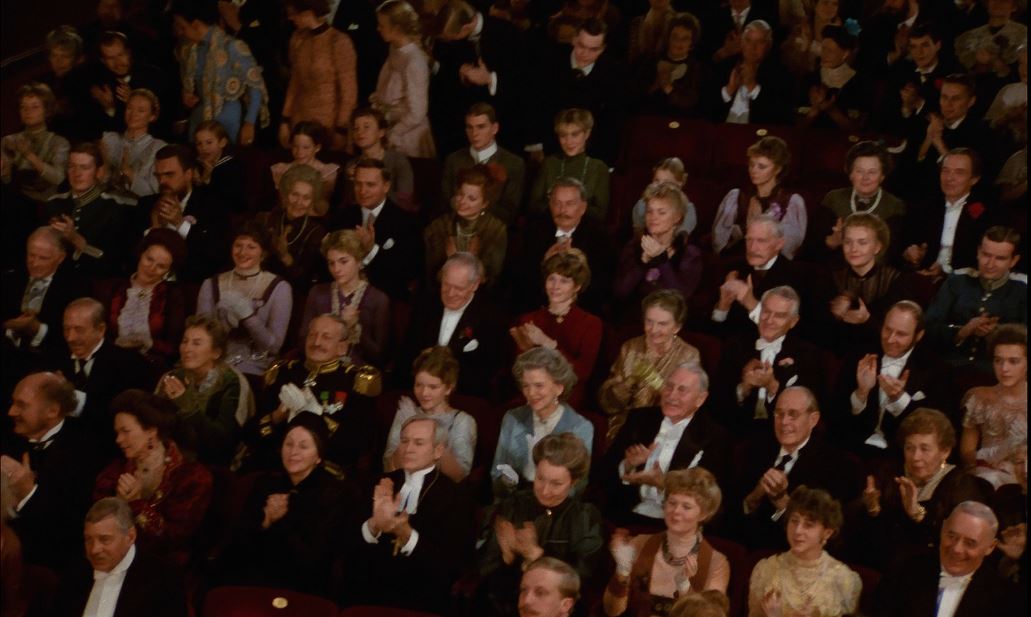
The family that plays together, stays together...


I’m also quite pleased with myself for having spotted that one of the actors in the theatre is named, Tomas Graal (Heinz Hopf) a reference perhaps to two silnet films from 1917 featuring Bergman’s mentor and friend, Victor Sjöström, as Thomas Graal, a scriptwriter, with both directed by another epic Scandinavian, Mauritz Stiller. You could spend weeks in the two versions of this huge film and still find new connections and meanings.


The other films on this six-disc set are:


Cries and Whispers (1972), I saw last year when the BFI re-released it in cinemas for its 50th Anniversary. It’s one of Bergman’s greats, and one of the first in colour, a cross-over success that led Francois Truffaut to suggest that maybe his other films would have been more popular with the vibrant red that dominates this raw tale of illness, familial love and honesty. It strikes chords with such force though and Bergman felt that with this film and Persona, he had gone as far as he could in touching wordless secrets that only cinema could uncover.


Wordless secrets eh? Bit of a challenge for the amateur blogger but safe to say Bergman dealt in these issues successfully and used cinematic language to the fullest of his ability to address feelings and relationships that we all recognise and which we all struggle to articulate.  This doesn’t make him a paragon just exceptionally observant.


There’s so much more in these films and these BFI sets are to be treasured.


Liv Ullman, Ingrid Thulin and Kari Sylwan


Scenes from a Marriage (1974) Berman doesn’t terrify with his honesty much more than in this film featuring his long-term partner, the genius Liv Ullman.


Autumn Sonata (1978), Bergman directs Bergman, aka When Ingmar met Ingrid… a powerhouse film!


Fårö Document 1979 (1979), the ten-year follow-up to the documentary Bergman made about his adopted home.


From the Life of the Marionettes (1980) a TV movie about the events before and after a murder in a strained marriage.


After the Rehearsal (1984), another TV film, this time about a controlling director putting on a performance of Strindberg's A Dream Play.


Ingrid Bergman in Autumn Sonata (1978)


All look sparkling and restoration-fresh with After the Rehearsal  the only one to have been only available in standard edition, it still looks grand. Special features include a 100-page perfect bound book featuring new essays by Geoff Andrew, Catherine Wheatley, Leigh Singer, Andrew Graves, Philip Kemp and Ellen Cheshire.


You can order the set from all good home entertainment online retailers but especially the BFI Shop, in person or online.


*My only talent, if you can call it that in my case, is that I love this little world inside the thick walls of this playhouse and I’m fond of the people who work in this little world. Outside is the big world and sometimes the little world succeeds in reflecting the big one so that we understand it better. Or perhaps we give the people who come here a chance to forget for a while…


Friday, 15 April 2022

Hearts in darkness… Cries and Whispers (1972), BFI Anniversary Release, Liv Ullmann Season


Today I feel that in Persona—and later in Cries and Whispers—I had gone as far as I could go. And that in these two instances when working in total freedom, I touched wordless secrets that only the cinema can discover… Ingmar Bergman


There’s no doubt that Ingmar Bergman sought out the inconvenient truths of our existence and, unblinking, showed us at our weakest and most human. As he sat beside Sven Nykvist’s camera, he looked at his performers straight in the eye as they acted to interpret his writing in ways that even he couldn’t have imagined, sometimes and perhaps often. For all the talk of authorship, he needed actors he could trust to rise to the occasion and go beyond whether through instinct, training or dazzling natural ability.


In one of his most stunning works, he brought together three of his acting muses and created a four-hander of such force that it’s more than capable of bruising audiences today. This restored Cries and Whispers is being released across country to mark its 50th anniversary as well as forming part of this month’s season of Liv Ullmann films, which, launched by the great woman herself, dominates April on the Southbank. Ullmann talked of the joys of our being able to, once again, experience film collectively and, in the case of this one, it’s good to have people you care about with you.


Bergman asks, are familial ties enough, does love come unconditionally and even at the end, can we still pull away from totally committing to others. The story was inspired by a persistent dream the director had of four women dressed in white in a red room and there’s a striking use of colour with each character framed in close-up saturated with red light. Red for love and fear; fight or flight, denial, anger and acceptance? All of these things, for those caught in the most difficult moment of their lives. Bergman wrote in his book Images that “red represents for me the interior of the soul. When I was a child, I imagined the soul to be a dragon, a shadow floating in the air like blue smoke—a huge-winged creature, half bird, half fish. But inside the dragon, everything was red.”


Ladies in red... (oh, come on!)

Bergman also wanted to write a tribute to his mother yet the lead character who carries the most grace, is called Agnes, and her eldest sister Karin – his mother’s name – is full of confusion and regret. All of the women represented parts of his mother’s character though so, as is usual with Bergman, nothing is black or white.


Agnes is played by the wonderful Harriet Andersson, one of the director’s earliest collaborators and almost twenty years after Summer with Monica, in early middle age and offering a quite terrifying portrayal of a woman confronting her imminent death. Karin has cancer and not long to live, and Anderson’s performance is intense, her eyes wide with the adrenal certainty of her certain demise, she cries out but is far braver than she could ever know. If you’ve reached an age of morbid understanding, something you can only live through, it’s impossible to not respond without being mindful of your own fears, your own enduring grief.


Harriet Andersson

Agnes is cared for by her maid,  Anna wonderfully played by Kari Sylwan, who’s interior responses provide some of the more comforting moments of the story in which Agnes’ sisters are both constrained by an inability to commit to their sister’s final moment. This of course is wonderful grist to the mill for actors of the quality of Ingrid Thulin as “uptight” Karin and Liv Ullmann as “immature” Maria… things are far more complicated than those two operative words suggest and the watched hangs onto their every word and action looking for the simple truths most other directors would use to flavour this narrative.


The story is told in past and present tense as well as fantasy so it is very much like a dream floating gently off the screen, especially with those anchors of emotional certainty removed and these two sisters struggling to connect with each other and themselves. There’s no doubt their love for their sister, they wait in the red room adjoining her bedroom, concerned at every cry as the doctor assures them that Agnes is getting close to the end but they’re held back by denial and grief. There’s nothing unnatural, it’s important to say that as this is film for thought, the cinema of self-reflection as we all have to confront this reality once life resumes outside in the night and daylight.


Ingrid Thulin

In silent film there was an obsession with “photographing thought” with few greater exponents than Bergman’s mentor Victor Sjöström, and indeed Ingmar himself with the aid of his incredible performers. There’s an intimacy that reflected the fact that three of the leads were long-term collaborators with the director and there’s also the presence of two of his daughters, who both play Maria’s daughter at different ages, Linn Ullmann and Lena Bergman. Liv Ullmann also plays Maria’s mother in flashback, adding to the compressed family feeling… what was it Philip Larkin said about parents?


As Maria faces the end, her sisters face each other and their failed relationships with two thoroughly inadequate husbands, Karin’s Fredrik (Georg Årlin), an officious older man and Maria’s Joakim (Henning Moritzen) who is emotionally disconnected too. Karin is so repulsed by Frederik she mutilates herself to avoid having sex with him whilst Joakim tried to kill himself after learning of her affair with Doctor David (Erland Josephson). Needless to say, both are still around as their wives face the family crisis.


As the priest (Anders Ek) says when Agnes finally succumbs, she had more faith than him and as the truehearted Anna reads her mistress’ diary, she learns of her capacity for happiness which, as for us all, maybe only fleeting but is life’s greatest achievement after all.


Ingrid Thulin and Kari Sylwan


Cinematographer, Sven Nykvist, captures every thought and whisper and the film is beautiful to view. He deserved his Oscar and this film deserves to be seen on the big screen so, I urge you to head to the Southbank and elsewhere for the full experience. Few films are this heartfelt or as richly rewarding.


Details of the 50th Anniversary re-release screenings are on the BFI site.


Liv Ullmann


Sunday, 10 April 2022

An Audience with Liv Ullmann and Persona (1966), BFI Liv Ullmann Season


It was because my face could say what he wanted to say. That made me the one he wanted to work with ... because it was my face and I also understood what he was writing…


The very last audience question for Liv Ullmann came from a French woman who had written a dissertation on her work with Ingmar Bergman to earn her Baccalaureate, “you made so many films with Ingmar, how did you manage to stay happy?” The answer was simple and got the biggest laugh of a very enjoyable conversation between film writer, Christina Newlands and the revered Norwegian actor and director; I’m a happy person, all my friends could tell you that. Over and again Ullman has stressed that the secret to her “method” was indeed, acting and the art of pretending; using your dreams and emotional back catalogue to drive your characters.


She described herself, a Norwegian, directing an Australian actress, Kate Blanchet, in an American play, A Streetcar Named Desire and witnessing her embellish the ending in a way she’d never seen before, as Blanch looks forward to the next stage in her life with strength and not resignation. Before that she’d given numerous examples of the power of her own imagination enabling her to play an experienced woman aged 19 or a middle-aged actor in Persona, an older woman with a younger man in Cries and Whispers (both she and he were 35) and other roles Bergman realised he could fulfil through her even , perhaps, if he couldn’t write the character to fulfilment on his own.


Liv in Persona

Very occasionally she went against his instruction such as in Faithless (2000) the film he scripted, allowing the old man in this partly autobiographical story, to forgive his younger self’s cruelty to a lover by having him look directly at younger actor during the harrowing reveal. Bergman refused to forgive himself but Liv Ullman, not for the first time, gave him what he deserved even when he was so specific as to call the main character “Bergman”.


One suspects that it was this very ability to give the director what he didn’t always expect or think he wanted that made him describe them as “painfully linked” after directing her for the first time in tonight’s feature Persona. Initially she thought he was proposing and they did have a relationship for five years which led to his fathering of writer Linn Ullmann with Ullmann, but what he meant was that the two of them were intertwined in term of creative imperatives. He’d had this feeling before perhaps, having relationships with actresses Harriet Andersson (1952–1955) and Bibi Andersson (1955–1959) who, in addition to being a close friend of Liv’s by this point, was also her co-star/other-half in Persona


Live Ullman live… and utterly charming, self-depreciating and yet full of honesty and wisdom. The comments she made about the performance of her star in Faithless, Lena Endre, are very similar to those she made about the star of Sofie (1992), Karen-Lise Mynster: “I was thinking to myself, ‘try not to think what you would have done!’ … then suddenly she was doing so much more that I had never even thought of… it was the first time in my life that I was proud to be an actress. Because I saw that it didn’t come from make believe, it came from feeling.”


Persona


This was “a once in a lifetime opportunity” said the person introducing from the BFI and she was not wrong. This felt not just like a masterclass in acting and cinema but also in life and how to live it. A standing ovation all round reflected the warmth in the room and there may just have been something in my eye.


I think you should play this part until it’s played out, until it’s no longer interesting. Then you can drop it, just like you eventually drop all your other roles.


Liv introduced Persona in the evening’s main (screening) event this time in conversation with series programmer Sara Lutton. She had met Bergman who had told her he wanted to cast her in his next film but then Ingmar pulled a sicky which he often did when he’d changed his mind about a project. After some time in hospital, he emerged with the script for Persona which was also to star Liv’s best friend, and former Ingmar lover, Bibi Anderson. The result remains a disturbing classic, as likely to make the top-ranked films of all time Liv quipped, as her “musical” Lost Horizon is a contender for the worst – she is nothing if no humble and funny.


Liv and Bibi Anderson. Those high heels?


Persona is still striking with fierce, conflicting and bare-knuckled emoting from Bibi and Liv all masterfully captured by Bergman with the aid of Sven Nykvist’s cinematography and Ulla Ryghe’s pin-point editing – absolutely amongst the MVPs as the personas start to move across the screen between and around the players… There’s also an experimental score from Lars Johan Werle that certainly impressed members of Pink Floyd for far less successful experimentation on Ummagumma. His music creates an atmosphere of disturbance and is used sparingly alongside more deliberate visual avant-gardism which punctuates the film, cut up and montage, flash frames of silent film, erotica, burning nitrate… the fourth wall takes the occasional battering.


The story concerns a famous theatre actress Elisabet Vogler (Liv Ullmann) who is suddenly struck mute during a performance of Electra and is in hospital for assessment by a doctor played by Margaretha Krook, who can find nothing wrong with her physically or mentally. From the doctor comes the above quote, as she sees Elisabet as play acting for whatever reason… is the nature of the play significant, does she have deeper issues with parenting and her father? Her husband, when he makes a brief appearance certainly seems much older… but the film is so rich in possible interpretation we’re all like the boy at the avant guard opening, reaching out to a bright and blurred image of Elisabet, or is it someone else?


Bibi Anderson


The doctor assigns the friendly nurse Alma (Bibi Andersson) to look after Elisabet as she sends her to her house on the island of Fårö (locations included Bergman's property there at Hammars). Alma gently fills in the gaps in the silence and is ostensibly a more straightforward personality – well she’s still talking and introduces herself in plain terms at their first meeting, 25, engaged, interested in film and theatre but not going to either as much as she’d like… an open book apparently


But, amongst the atmosphere of rocky seaside calm, Alma and Silent Lis develop a deeper entanglement with Alma falling into the unfathomability of the actresses’ state of being. They are more than just face to face, and are beginning to connect beyond the surface, intermingling I unspoken ways beyond the mask of flesh and feature…


Is it possible to be one and the same person at one time – I mean two people? God, I’m being silly.


There’s so much interpretation of the film, as with Antonioni’s L’Avventura, there’s no definitive narrative based on the evidence of the film, the “meaning” as illusive as a lost woman or, indeed, a lost identity. That secrets endure after 57 years says much for the film’s continued popularity, a puzzle still and one that retains significance. Persona has certainly impacted David Lynch, with Mulholland Drive most obviously owing a debt and many more, although I was surprised that Abba were among the influenced with Knowing Me, Knowing You (aha!) profiling Anna and Agnetha just like Bibi and Liv.


Liv said that as they worked, Bergman would always sit right next to the camera making him another unspoken partner in the action. The three friends who made this picture operated on a level of open connection few of us experience in our working lives… the results are extraordinary and mark that rare film which means exactly what you want it to if you’re willing to push yourself inside the screen. Go on, take off your mask.


The Liv Ullmann series runs until the end of April and more details are on the BFI site.


The tremendous cry of our faith and doubt against the darkness and silence is the most terrifying proof of our abandonment.


Tuesday, 22 January 2019

Restless legs… Bergman – A Year in a Life (2018), screenings at BFI and across UK from 25th January


Lars von Trier tries to sum Ingmar up with something like “he was a shit but I love him!” and I suppose it takes one to know one. In truth Mr Bergman can certainly be filed in the “complex character” section of cinema genius but that’s a pretty packed category; he was “lonely in his soul” as someone who knew him in later life put it which is an odd thing to say about a father of nine who had many overlapping relationships, married five times and who seems to have slept with every Harriet, Bibi and Liv he ever directed. Fassbender may have been addicted to amphetamines but, it’s claimed, Bergman was hyper-sexual.

More than anything else though it seems that Bergman was exceptionally talented and for this he may be forgiven with the usual caveats. He was incredibly driven and occasionally merciless, in his third theatrical production of The Misanthrope, he ripped into his cast after they had deviated from his direction and singled out up and coming actor/direct Thorsten Flinck for personal humiliation that still brings a tear to this otherwise confident man.

Bibi and Bergman
Bergman admitted that his work came first and, in addition to occasionally losing count of his children, he also confessed to not knowing their birthdays or even birth-years… he had other priorities and in 1957 this saw him release two of his masterworks, The Seventh Seal and Wild Strawberries as well as a five-hour long theatrical production of Peer Gynt, his first production of The Misanthrope, and two radio plays, oh and he also wrote the script for Lars-Eric Kjellgren’s Night Light. His quality of output was unfeasibly high and he established himself as a world figure who would gain an almost untouchable rank in his home country and beyond.

Excerpts from a 1971 interview with US talk-show legend Dick Cavett are shown in which the still sprightly Cavett describes how nervous he was with the great man, so much so that he called him “Ingrid”… he can laugh about it now, just about.

Elliott Gould is effusive in his description of Bergman’s direction, saying he was a director who put so much trust in his performers telling Gould that “I will never mislead you”… Barbra Streisand, then in a power coupling with Elliott, watched with awe. Liv Ullman, one of Ingmar’s wives who I refuse to believe is 80,  describes the director as her best friend, welling up with tears a decade after his death… light and shade and, yes, through a glass darkly.

Bergman's shock revelation to an astonished Dick Cavett...
Perhaps the most astonishing revelation, for me at least, having little familiarity with his life story, was Bergman’s support for Adolf Hitler and the Nazi cause. Quite possibly he fell victim to the dictator’s powers of performance and undoubted eloquence but it wasn’t until 1947 that he turned away, announcing that he would never again embrace politics. Given his preference here, we can all agree on that being a good thing.

Instead, Bergman’s work was focused on his own experience whether the specifically autobiographical Fanny and Alexander (1982) or based on his own “key moments” as with Wild Strawberries which featured one of my silent heroes, Victor Sjöström, as a director realising his work has left his life behind when it is all so late. Here Bergman had a man of substance like his own and, in spite of his worries that the 77-year old would struggle he needn’t have worried. I’d happily watch a whole documentary on these two and the making of that film.

His brother Dag is featured in a previously unseen documentary, which Ingmar refused to allow screen during his lifetime – there’s clout for you – and it’s not hard to see why. Dag felt that the younger Bergman boy was more of a conformist swot than he and, indeed, more Fanny than Alexander… either way they shared a tough upbringing with their father a strict and very conservative parish minister.

Ingrid Thulin and Victor Sjöström in Wild Strawberries (1957)
Again, all grist to the amateur screen psychologist but it’s the testament of the many who worked with him that is most revelatory with some conflicted emotions generally being over-written by admiration for work-rate and incredible quality control.

Director Jane Magnusson pulls together so many diverse voices into a coherent and compelling narrative that presents the personality of Bergman with an emotional richness that doesn’t shy away from his darker tones.

The BFI’s Bergman expert Geoff Andrew, who programmed last-year’s retrospective at BFI Southbank commented that while the anecdotes are offered by many who knew him are illuminating, “…none, however, are perhaps quite as revealing as Ingmar’s own testimony.” Indeed it his candour that gives weight to those other voices and convinces you that we’re seeing an authentic record of his life and personality.

Bergman in later life, still working...
Not surprisingly Bergman – A Year in a Life (2018) won the European Film Academy Documentary Award - Prix Arte and it is that good.

The film opens at BFI Southbank, HOME Manchester, ICA and selected cinemas UK-wide from 25 January 2019 and this Friday's screening at BFI with include a Q&A with director Jane Magnusson. Details of the full list are on the BFI site.

You can also watch the new BFI trailer. Fascinating and disturbing all at the same time: a man absolutely driven but not always towards the empathy so deeply evident in his films... How does that happen in a person of such intelligence?