
‘After the strokes had been administered, you had to kiss
Father’s hand, at which forgiveness was declared and the burden of sin fell
away.’ Ingmar Bergman recalling his childhood.
The BFI’s digital odyssey covering the epic and
unique career of Ingmar Bergman reaches it’s crescendo with his final films,
but not his final works as he continued on television and stage until 2007.
This set includes both versions of his semi-autobiographical masterwork,
Fanny and Alexander, the TV series (filmed first but released after
reworking for cinema in 1984) and the film he intended to be his last big
screen statement in 1982. Both are daunting but as soon as you set yourself
down with snacks and suitable libations, you quickly become lost I the sheer
human simplicities he addresses and the audacious connection he always seemed
to have with us as viewers.
Fanny and Alexander drew on some of his upbringing
with his father a Lutheran pastor would indeed hit his children with a carpet
beater but there was love too, painful shades of grey with a God of love and
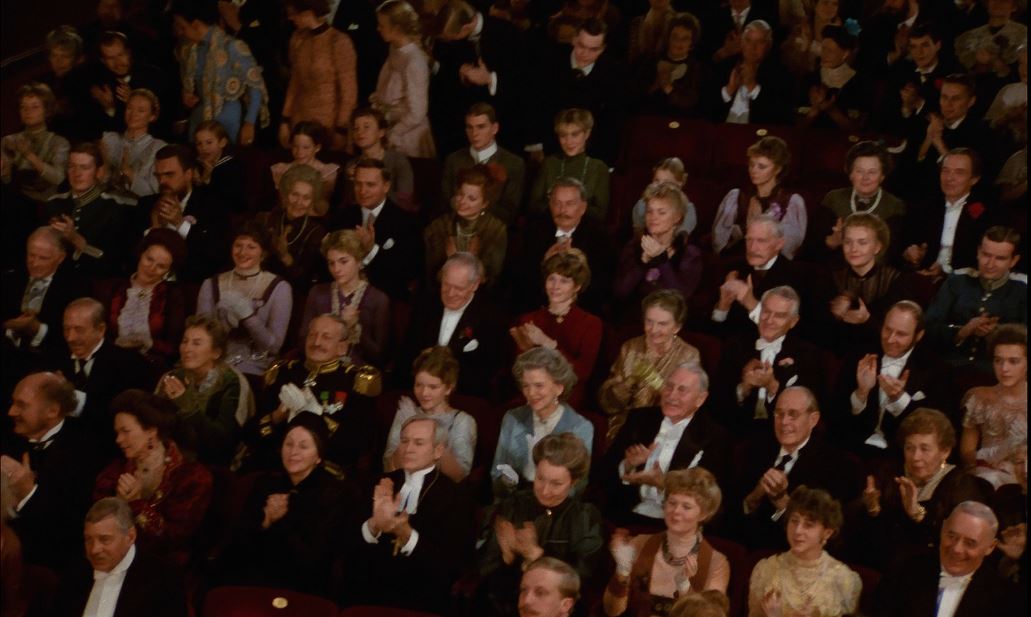
hate. Bergman sets the story in the 1900s, with a vivid Christmas celebration
introducing us to the family and even though there will be torment there is
also so much joy in this film along with magic, the world seen through the eyes
of his ten-year old protagonist, Alexander played with incredible assurance by Bertil
Guve. In his booklet essay, Philip Kemp – who else are you going to get to
write about this one? – also notes the Dickensian aspects to the story, maybe
Swedish children have as much connection with these tropes as the British?
The budget was Bergman’s biggest. the most expensive film
made in Sweden up to that point, at over $6m, with more than 60 speaking parts
and some 1,200 extras. It took a year of pre-production and a mountain of
editing to produce the longform TV version and the ruthlessly edit it down to
the three hours plus cinema version. It won four academy awards and was
recently ranked as number 53 in the Sight and Sound Hundred Best Films poll…
 |
| Alexander directs: Bertil Guve |
The film begins with young Alexander moving cut out
characters in a toy theatre, before searching for the rest of his family in
their huge, richly-decorated house; a director in search of his characters?
Here’s also a boy with a rich imagination, seeing a statue’s arm move as he
hides beneath the dinning room table.
What follows is as rich and magically real as a Dickensian
Christmas with Bergman dealing with the extraordinary behaviours and
imaginations of his players in a casual way, oddness just happens and we’re
expected to deal with it. The story begins and ends with the warmth of the
Ekdahl family and the imperious, heart-warming matriarch Helena as played by
the remarkable Gunn Wållgren, a woman who manages to convey world-weary yet still youthful energy. Helena looks on her family and is concerned and
delighted in equal measure.
She has three sons, Carl (Börje Ahlstedt) fearful and in debt, the other theatre restaurant manager Gustav (Jarl Kulle) warm yet careless in love and the third Oscar (Allan Edwall), the manager of the family theatre. Oscar is the oldest and his mother’s most reliable son, happily married to the beautiful but much younger Emilie (Ewa Fröling) and father of Alexander and his sister Fanny (Pernilla Allwin). Rehearsing Hamlet, Oscar suffers a stroke and the children’s world is to be turned upside down. In time Emilie is married to the handsome Bishop Edvard Vergérus (Jan Malmsjö) who offers her love and a new more spartan existence for the family. Things do not go well… his puritanical authority soon brings the children and especially Alexander, into fierce conflict and the beatings begin as Bergman releases the spirit of his father on screen.
 |
| Gunn Wållgren |
Max von Sydow was to have played the part of the Bishop
Edvard Vergérus, but a mix up between an over-zealous agent and a frugal SFI
meant by the time he said yes to Bergman it was too late and he cast Malmsjö instead as the conflicted cleric.
As it turns out he was inspired casting, a light entertainer usually, here his
dramatic shifts were perfect for the stepfather who ultimately is frightened by
his wilful, new son although, according to Kemp, the boy took some time to get
over the fact that he was more used to seeing the actor singing Puff the Magic
Dragon. His smile and good humour make his unyielding will to punish and
constrain all the more unpleasant: it’s a nightmare.
The struggle between Alexander and the Bishop is the heart
of the film and plays out in unexpected ways, everything does in fact and with
twists and turns that my prose can’t do justice too. It’s the most intense and
cinematic ride… a glorious drama with a cast alive to the depths of meaning
expected from Bergman. As Oscar says in his Christmas speech at the theatre,
see below*, sometimes the little world succeeds in reflecting the big one so
that we understand it better… as with the best of Bergman, all art in fact,
you don’t leave it, it stays with you, meaning infused consciously and
subconsciously to eventually filter through over days, months and years. In
different circumstances the film will take on new aspects and I watched with my
daughter, wife and 91-year old mother-in-law, a PhD in English Literature and MAs in
English and Film. She wrote about Fanny and Alexander at length when studying,
but refused to let me crib from her essay… but we had some great conversations.
Much as he seemed to have enjoyed the whole project, Bergman
was well into his sixties and he later said in a TV interview, Farewell to
Film, ‘my body is tired and it hurts, and you realise these are signals,
warnings to take it easy… Altogether this is a good place to stop.’ From
this point onwards he would focus on TV and theatre, alternatively less pressurised
and also more gradual experiences than cinema. But what a legacy he left in all
three disciplines.
 |
| The family that plays together, stays together... |
I’m also quite pleased with myself for having spotted that one of
the actors in the theatre is named, Tomas Graal (Heinz Hopf) a reference
perhaps to two silnet films from 1917 featuring Bergman’s mentor and friend, Victor Sjöström, as
Thomas Graal, a scriptwriter, with both directed by another epic Scandinavian, Mauritz Stiller. You could spend weeks in the two versions of this huge film and
still find new connections and meanings.
The other films on this six-disc set are:
Cries and Whispers (1972), I saw last year when the BFI re-released it in cinemas for its 50th Anniversary. It’s one of Bergman’s greats, and one of the
first in colour, a cross-over success that led Francois Truffaut to suggest
that maybe his other films would have been more popular with the vibrant red
that dominates this raw tale of illness, familial love and honesty. It strikes
chords with such force though and Bergman felt that with this film and Persona,
he had gone as far as he could in touching wordless secrets that only cinema
could uncover.
Wordless secrets eh? Bit of a challenge for the
amateur blogger but safe to say Bergman dealt in these issues successfully and
used cinematic language to the fullest of his ability to address feelings and
relationships that we all recognise and which we all struggle to articulate. This doesn’t make him a paragon just exceptionally observant.
There’s so much more in these films and these BFI sets are
to be treasured.
 |
| Liv Ullman, Ingrid Thulin and Kari Sylwan |
Scenes from a Marriage (1974) Berman doesn’t terrify
with his honesty much more than in this film featuring his long-term partner,
the genius Liv Ullman.
Autumn Sonata (1978), Bergman directs Bergman, aka
When Ingmar met Ingrid… a powerhouse film!
Fårö Document 1979 (1979), the ten-year follow-up to
the documentary Bergman made about his adopted home.
From the Life of the Marionettes (1980) a TV movie
about the events before and after a murder in a strained marriage.
After the Rehearsal (1984), another TV film, this
time about a controlling director putting on a performance of Strindberg's A
Dream Play.
 |
| Ingrid Bergman in Autumn Sonata (1978) |
All look sparkling and restoration-fresh with After the Rehearsal the only one to have been only available in standard edition, it still looks grand. Special features include a 100-page perfect bound book featuring new essays by Geoff Andrew, Catherine Wheatley, Leigh Singer, Andrew Graves, Philip Kemp and Ellen Cheshire.
*My only talent, if you can call it that in my case, is
that I love this little world inside the thick walls of this playhouse and I’m
fond of the people who work in this little world. Outside is the big world and
sometimes the little world succeeds in reflecting the big one so that we
understand it better. Or perhaps we give the people who come here a chance to
forget for a while…



+colour.png)





