Friday, 16 August 2024

Bohemian rhapsody. The Organist at St. Vitus' Cathedral (1929), with Maud Nelissen, Bonn Silent Film Festival 1924


This is a delightful film that bears many hallmarks of late silent film technique all set against the beguiling backdrop of Prague and was streamed online with fluid magically-real accompaniment from Maud Nelissen who has provided the same service at previous screenings for San Francisco last year and HippFest this March. It was only celebrated Czech director, Martin Frič’s second feature film but already he seems entirely on top of storytelling, performance and pacing… The story is a grower that shocks us early on and then gradually winds up – boiling the audience frog – leaving us with a genuinely anxious closing ten minutes as we hope that redemption and kindness will prevail in a work that has already shown that this is hardly a guarantee. This is not Hollywood after all.


The film is a symphony of gothic Prague with sumptuous views across the largely still extant medieval city, a masterpiece of Bohemian style with the “City of a Hundred Spires” on view in languorous location shots that almost use the performers as a means of establishing scale. Most spectacular of all is the cathedral which, built over many centuries on an outcrop alongside the castle complex, still looms over the city to this day.


Having opened with rapturous views and ringing bells, we understand the pure glory the organist must feel as he moves from his humble house in the ancient wooden streets every day to play at the cathedral. Karel Hašler plays the otherwise unnamed Organist and gives an absorbing and powerful performance as you might expect given his standing as not only an actor but also as a director both on screen and on-stage, writer, musician, performer of many styles since his debut in 1897. His is the face that could sink a thousand ships; intense, brooding and yet strangely vulnerable and as with the gothic edifice that gives his life so much meaning, he too lives the most structured of lives, his discipline and artistic purpose the rigid keystones of enigmatic yet pure artistic endeavour and faith.


Karel Hašler

Into this life comes a very old friend and chaos threatens his very existence. Appearing at his door on one rain-sodden evening the old man is surprised to find a man (Otto Zahrádka) he believed imprisoned on his door. He invites him in but not before local chancer and part-time extortionist Josef Falk – another very fine performance from Ladislav H. Struna who shares Hašler’s brooding protean qualities and plays with a very modern style; in this case presenting as threatening but also with his essential humanity ever present, a sophisticated approach and one that enriches the narrative no end.


The Organists old pal is at his wit’s end with no future save incarceration and he has escaped purely to hand over what money he has along with a note to his daughter Klára (Suzanne Marwille) who knows not of his crimes and is a nun… but not without a purpose in this context. After handing over his last worldly goods the man shoots himself and drops to the floor dead; the Organist in shock hides his body in the basement but only after the watching Falk has interceded sensing opportunity and stolen the old man’s letter as collateral for bribing the shocked old man.


The Organist goes to tell Klára the news but he cannot bring himself to tell her of her father’s self slaughter and hands over the money leaving her alone with her thoughts. Klára’s grief makes her leave the monastery and she goes to live with the Organist, cleaning up his house and winning him over: she has apparently exchanged one Father, possibly two, for another and the two form a new bond as she re-enters the secular world.


Suzanne Marwille

Now, in these kinds of circumstances, there’s usually a rich-boy painter spotting supernatural beauty with eagle eyes and a ready easel and so it proves with Ivan (Oscar Marion) who first spots Klára's beauty as he stands on his horse staring at her in eth grounds of the monastery and is delighted to find her in the twisty gothic streets he is painting near the Cathedral. Now, if the Organist and the Extortionist are portrayed in forceful naturalistic ways, the two potential lovers are – initially at least – more idealised, she intense grace and supernatural longing and he almost comedic in his lustful and artistic ways. Both represent archetypes and objects of desire whether as potential lovers but also as pure idealists who will have to face cruel reality at some point.


This process happens gently at first and there’s a lovely sequence when Klára goes shopping and Ivan sets off in pursuit. She buys a still-wriggling fish from a vendor as he loiters with artistic intent and when she drops it on her way home, he struggles to pick up the poor wriggling creature but manages to take it back to her house, keenly expecting some romantic reward.


From this point onwards though, the film turns darker as the Organist’s attempt to protect the young woman is threatened by Falk’s increasingly desperate attempts to extract money from him. Will new love save the day or is the Organist doomed by his own decency especially after an altercation with Falk leaves his right hand paralysed and he can no longer play the music that is his life… If it were German or especially French, the film might take a different course but you’ll have to see it for yourself for the genuinely tense closing sequence and, good luck!


Bridges as well as towers in Prague

I must mention the cinematography of Jaroslav Blažek who not only captures the city but also the intricate workings of the performers in frequent close-ups, bits of Dreyer here and Germans too in the darkened, naturally lit street scenes. There’s also frequent overlays showing the inner conflicts, the bells clanging over the city in faith and hope and transitions from closed to open spaces that would be breath-taking on the big screen.


The form also benefits from Maud Nelissen’s melodic and subtle accompaniment that switched effortlessly between the diegetic sounds of the organ and the narrative emotions we’re all experiencing “outside of the film”. She is very good at getting to the heart of a film like this and has scale as well as intricate emotionalism to flavour the film’s approach.


All in all, a cracking start to this year’s viewing of Bonn online - details here, be quick only days to go, the streaming continues until 21st August and films only stay online for three days, enjoy them whilst you can! Once again I failed to make time to go in persona nd once again I can only thank the Festival for streaming some of the content. A wonderful film, I hope to see it in the celluloid soon!!


Oscar Marion


Sunday, 11 August 2024

For Teresa Gimpera… The Spirit of the Beehive (1973)


It’s difficult to feel nostalgic after what we’ve been through these past few years but sometimes, when I look around, something tells me that our ability to live life to the full has vanished along with it.


I was saddened to read of the death of the Spanish actress, Teresa Gimpera, aged 87 and a wonderful screen presence in every film I have seen her in. I first saw her in Vincente Aranda’s 1969’s Las Crueles (The Exquisite Cadaver) along with Carlos Estrada, the sublime Capucine and Judy Matheson, so excellent in her first starring role, which is an existential classic from this rich period of European and Spanish cinema; part giallo but also a refined exercise in the search for meaning during the fading years of the Franco regime.


The Spirit of the Beehive is a similarly enigmatic film and again with every reason to be so. Director Víctor Erice’s first feature, it is the most potent mixture of the cinema of beauty with a carefully surfaced commentary on the nature of contemporary Spain; women’s role, men’s insularity and the hope we make from fantasy; so much honey as we buzz through our daily rigours fulfilling duty at work, school and home.


Set during the aftermath of the Spanish Civil War in 1940, when the rest of Europe was still fighting the fascists even as Franco’s victory sank in, the film commences with a truck speeding across the Castilian plain towards a village where children eagerly await the news of what the film will be. It’s James Whale’s Frankenstein (1931), one of the first great horror classics for a community that has just witnessed the unnatural recreation of their political and cultural life.


Teresa off to post a letter

The film takes its time, Erice is remarkably composed for a first timer, here and throughout as the mechanics of setting up a cinema in the local hall are followed, the screen, the chairs, the brightening eyes of the eager audience as the screen flickers to life and the children look on in awe trying to comprehend what they are now watching.


We cut to a man tending beehives Fernando (Fernando Fernán Gómez) and the voice over of his wife Teresa (Teresa Gimpera) as she composes a letter to a long-lost lover or friend. The colours of the beehives are matched to those of the interior of the house and the window consist of small panes of glass embedded in a criss-cross of lead inlays. The house is like a beehive and so is the territory of the film as the characters cross each other’s paths busy on their way, all interlinked. Teresa is shown on her bike heading across the plain down to post her letter at the station. The train arrives in Lumiere style and she, face clean of make-up, catches the eye of a young soldier in a window seat and the two look at each other, more reminded than attracted?


Fernando makes his way back to their house, a well-to-do building that has seen better days, their maid tells him where his children and wife are and, after reading and smoking his pipe, he stands at the window able to hear the dialogue from the cinema next door as Dr Frankenstein ponders the universe and the meaning of what he is about to do… Or is it just us, Erice providing an aural cut towards the interior of the film-watching ahead of the visuals?


The focus duly shifts back to the screening to young Isabel (Isabel Tellería) and her even younger sister Ana (Ana Torrent) as Frankenstein’s monster (Boris Karloff) emerges out of the rushes for is fateful encounter with Little Maria (Marilyn Harris) at the pool. We know what’s happening but Ana does not and asks her sister for reassurance about the girl and the monster – are they still alive or, like so many they have known, have they just disappeared into death?


I’ve seen him alive, in a place I know near the village…


That evening the girls discuss the film and Isabel reassures Ana that the Monster is alive and well living at a shed next to a well over the fields.


The remarkable Ana Torrent, still working at just 57.

Downstairs Fernando writes about the glass beehive he keeps in the house: “… the constant agitation of the honeycomb, the mysterious, frantic commotion of the nurse bees over the nests, the bustling bridges and stairways of wax, the invading spirals of the queen, the endlessly varied and repetitive labours of the swarm, the relentless yet futile effort, the feverish comings and goings undermining the next day’s work, the final rest of death far from a place that tolerates neither the sick nor tombs.” Someone had seen these workings and been not just saddened but frightened – a society without mercy.


Fernando falls asleep in his study, the darkness turns to a yellow light and as he enters the bedroom to get changed, Teresa pretends to still be asleep. So far these two have not spoken to each other and what we know is what they have written to others. The children are the only ones in direct communication at this point and they head off to join their swarm at the small village school. To say the film gives a child’s eye view of things is an understatement and the two girls – everyone used their own first names in the film to avoid confusing them – are exceptional, especially Ana through whom we experience subsequent events with the blurred unreality you’d expect from a Bunel* or a del Toro. She was just seven.


The girls go across the flat fields to the shed and inspect the well, Isabel further elaborates on the continue existence of Frankenstein’s monster, he is now a spirit, not that they are quite sure what that is exactly… Erice keeps us hanging on for more defined meaning and through the events that follow we see events intermingled between the shadowy yellows of the house and Ana’s sense of incomprehension and wonder. Thus, meaning is smuggled from beehive to village and the grown ups with their obscure motivations and their unintelligible concerns.


Fernando Fernán Gómez

Through it all the house moves closer together as the fantastical mixes with the all too real… people do indeed disappear but Ana will keep trying to connect to their spirit. It’s relatively easy to see the allusions especially if you imagine watching this as a young Spaniard at the time but the film works on its own merits on the level of Ana’s story, the quiet desperation of the family drama and the impact of American cinematic culture on a self-defeated Spain at the very beginning of Francoism, from a culture waiting for freedom near the end.


The cinematography of Luis Cuadrado is a wonder capturing the atmospherics, location and expression with fluid grace and precision – it’s one of the best-looking of films and, whilst I wasn’t keeping count, one that takes place mostly in silence with the only clues to meaning on screen. When Teresa slips a blanket around her husband as he sleeps exhausted at his desk – trying to put into words the almost unsayable – you know there’s a thawing between them. If Ernst Lubitsch was Spanish and filming in the early 70s…


There’s an interesting paper from Kevin Hagopian of Penn State University* in which he draws the line between Luis Buñuel’s Viridiana (1962) and the new wave of Spanish filmmakers that followed. He showed how to use magically real cinema to critique the fascist state and more were to follow including Erice and, I would say, Vincente Aranda with Las Crueles and the remarkable Teresa.


She is remarkably still and silently present in all of her scenes, bookending the real-world drama as she writes and reads her letters and hides her desperation from husband and children. There’s so much to be read into her quietness and as her husband obsesses with the bees she confronts the possibility that their lives may have been damaged for ever. Yet, in the end, she finds a way forward and there’s an optimism that is mirrored by Ana as she calls into the night. Straddling the new wave of boundary pushing cinema from the more commercial to this very epitome of art-house, Teresa Gimpera was one of the faces in the evolution of Spanish cinema and her depth and range allowed the sub-texts to flow even through the seemingly formulaic genre films.


Now I must seek out more of her work starting with her other Aranda collaboration on the madcap Left-Handed Fate (1965) which has a new Mondo Macabra Blu-ray which includes a profile of Teresa – The Muse of Pop Cinema! She had such a long and varied career and whilst she may well have been the pop-art muse she was also a very gifted actor and the spirit of the beehive lives on even as we're all caught up inside.


*It's here on the State University of New York website.


Sunday, 28 July 2024

2 and ½? Three Women (1924)


This posting is late, for which I can only apologise, but I found myself in crisis and desperate to see the restored version of the film Lubitsch made directly after it, Forbidden Paradise (1924) only to discover, from reading this very blog, that I’d seen it in 2018. In the cut and thrust of silent film watching these things can happen, an overdose of Ruritanian comedies, too much Pola (is that even possible?) and perhaps a Touch of the Lubitsch’s can all contribute but you never lose that Lubitsch Feeling which is why his extremely coherent body of work can confuse your random-access memory?


I was pointed towards Forbidden Paradise after reading the director’s biographer Joseph McBride* on this run of early Hollywood films. He is disappointed in Three Women in comparison with the more experimental and engaging film that followed it, Ernst’s third in his first full year in America and fourth overall after starting with Rosita in 1923. McBride notes “intermittent felicities…” but marks down Three Women’s “clumsy construction, uncertainty of tone and lack of inspiration…” in comparison to the excellence of The Marriage Circle, the first of the 1924 hattrick.


Watching this good-looking release on the Kino-Lorber Blu-ray I wouldn’t have expected to agree with most of these sentiments based on the pacey and touch-filled opening sequences but the narrative does lose its way and we also get precious little screen time for the third woman, Marie Prevost whose presence does lift the last third of the film, it’s just a shame she isn’t given more to do. This is a Lubitsch though and it’s like a rushed early Beatles album or an off-colour Vermeer; it’s still very good and entertaining.


Pauline Frederick

Based on the 1914 novel Lillis Ehe (Lilli's Marriage) by Yolande Maree (originally Iolanthe Marès) part of a popular series of “moral” novels set in the Berlin demimonde and clearly appealing to Lubitsch’s interest in the compromised classes. Here there is bad behaviour amongst the civilised high society now relocated to New York City, as human frailty feeds human greed and innocence is taken advantage of and corrupted by the dishonest and cruel although one wonders how Lew Cody can’t be spotted a mile off so slight are his charms in comparison to say Adolphe Menjou?


Anyway… what we do have going for this film is the formidable Pauline Frederick as Mrs. Mabel Wilton and the film kicks off with her character carefully weighing herself on the scales against a stark black backdrop which allows us to focus on her ongoing concerns about getting old… a proto-Smouldering Fires moment for the fabulous-looking 40-year-old. Still, it’s how you’re made to feel and especially by a society that favours sheen over substance.


Have you any idea how much wealth is represented by that woman you have just held in your arms?


Mabel attends a vast charity ball for the Eastern Red Cross Committee at a “Waldorf Astoria” impressively designed and choreographed by Lubitsch complete with slides, merry-go-rounds and jollity on a grand scale. An eye-catching attendee is penniless but for some reason desirable Edmund Lamont (Lew Cody) who dodges his creditors and makes a beeline for Mabel after helping her off the slide and being advised by his pal/also creditor Harvey (Willard Louis) about her three-million-dollar fortune.


Lew Cody


Cue some “touches” as the $tar-struck Edmund looks on Mabel’s jewellery, focusing item by item as Lubitsch reveals his heart’s desire even as he begins the process of seducing his target. There are pretty young women all around him but he only has eyes for Mabel’s diamond necklace, gold rings and dazzling bracelet. Gradually the images run together and it’s all Edmund can do to stop himself from fainting. Greed! He offers her a nightcap and accompanied by Harvey, who acts as a somnambulant chaperone after polishing off all the chocolates – another trademark visual ellipse - the three head to Mabel’s home. Her ardour is finally cooled by a letter from her daughter Jeanne (May McAvoy) who reminds her that she’ll be 18 in a few days… her mother suddenly feels very old and stares at the mirror.


So far so good, and there are a lot of delicious moments at Jeanne’s party in Berkeley, California as lovelorn Fred Armstrong (Pierre Gendron) tries to find the right moment to give his sweetheart the $500 bracelet he’s had to pawn his watch for and pledge his troth. His progress to this goal is interrupted and thwarted by split-second misfortunes as Lubitsch plays out a dance of frustration with said watch repeatedly being pulled from and returned to Fred’s pocket… as his last chance is lost when she opens her mother’s present of a diamond bracelet.


Why have you come without my permission?


Her mother’s present depresses Jeanne with its crass over-compensation for lack of attention and even when she returns home she’s unwelcomed by Mabel who is far too busy being romanced by the man who she’s just gifted $100,000 for sure-fire investments to. This inattention soon becomes heavily ironic when, after saying she was too busy to spend time with Jeanne, Lamont also makes his excuses and sees the daughter instead. As Mabel mopes alone at home, Harvey spots his pal with a younger woman at a nightclub only to realise that it was Jeanne the next day whereupon he informs Lamont of the daughter’s worth as the betrayals mount up.


May McAvoy and Pierre Gendron

Now, there are various ways this could all play out and this is where the story diverges from could have been a more satisfying and believable analysis of mother-daughter relationships, faithless gold-diggers and their good-hearted molls – Marie Prevost could have rescued things – but this descend into unlikely melodrama.


Frederick and McAvoy give things a good shot and what we do see of Prevost is, of course, eye-catching, but it was still early days for Lubitsch in this new environment and a lot more was in store.


Back to Lew Cody… he does his best but he doesn’t quite convince as sophisticated enough to win the affections of either let alone both women, and I’m quite sure Marie Prevost’s character would have him exactly where she wanted him. All this said, Cody has his own style and was apparently a great raconteur, highly popular, a pal of Buster’s and the husband to be of Mabel Normand. Given a better scenario his character and its arc could have been much more compelling.


Three Women is still well worth watching though and I would love to see it on the big screen as opposed to just the splendid Kino-Lorber Blu-ray which comes with a stirring new score from Andrew Earle Simpson and an excellent commentary track from Anthony Slide.


It’s available direct from Kino or other online retailers selling US worldwide.


Marie Prevost abides...


 *How Did Lubitsch Do It? by Joseph Mcbride (2018, Columbia University Press) Buy it on Amazon!!


Sunday, 21 July 2024

In the navy… Remembrance (1982), BFI Flipside #48 Blu-ray


Well, I’m in the navy see, and that’s work of national importance. That’s why we can’t go on strike, that’s why we sign on for fucking years… I’m proud of what I do!


I missed this first time round, busy in the college bar and having an easier time of it than many of my generation. My cousin became a marine a decade later but I did know people who were in the Navy at this time, some who served in the Falklands that preceded this release by a few months. I still remember the chill I felt as Ark Royal and the other ships headed off to a war I never expected to be fought. My college hosted HMS Glamorgan’s rugby team the year later and they were a different breed, out-drinking and out-playing is with ease, men of the world.


Remembrance never set out to be as political as it turned out but… the elements were always there given references to Northern Ireland and John Altman’s outburst to a drunken teacher at a middle-class party reproduced with minimal swearing above. In truth this is always the bottom line for the armed services and for the young men who make up the majority of the recruits and it was always writer Hugh Stoddart and director/producer Colin Gregg’s intention to make a story that focused on their first big sacrifices: their time, family and friends.


The result was one of the first films produced by Channel 4 and featured a now astonishing cast of soon to be highly successful, cast members from Timothy Spall to John Altman via, in his first substantial part, Gary Oldman but there are many more who have made their living on stage screen and TV since this film.


Mr Oldman feels a little worse for wear...

The film has a lot of characters, all of whom feel real, well-written and well-acted by this young collective, and its narrative keeps you guessing as the story slips forwards and backwards between elements that will eventually coalesce into a poignant whole. It begins with a group of lads laughing and joking as they watch an old cinefilm of themselves at the Royal Albert Hall for the annual Festival of Remembrance. As they watch they recognise faces and their younger selves until the Army gymnastics team perform and one of them spots and unfamiliar face…


Cut backward and we see an inebriated youngster walking on his hands in the dark, he’s ten-pint drunk staggering around in search of even more cheap lager. Gary Oldman is almost unrecognisably youthful but protean as ever, is the individual who we later learn is called Daniel and he displays one of the most convincingly painful depictions of what we used to refer to as “paralytic” back in those days of 35p pints. He finds his way into a disco bar on the notorious Union Street drag between Plymouth and naval base at Devonport, home to thousands of off-duty sailors and dozens of pubs, strip joints and cheap restaurants.


He quickly upsets some of the older regulars who berate him for being out beyond curfew and, following his brief and emphatic suggestion that they go away, wait for him to pass out. He staggers over to a baby-faced jack tar, Mark (David John) who invites him to join him and two young women, even though he’s nearly as incapable. The two talk, as drunken men do, and Oldman’s character talks about his dream of becoming an acrobat and there’s a haunting keyboard motif accompanying his reveries on this subject each time provided by Brian Eno’s track Aragon (from Music for Films (1978)*), which carries the sense of stillness both of the skilled athlete but also the moment in time when decisions are made.


The not-so-nasty John Altman


The young man also says he can dance and after encouragement from Mark goes onto the dance floor and does indeed dance attracting the attention of the watchers at the bar who then thrown glasses onto the dance floor. The in-house bouncer steps in and drags the by now sick youngster outside where he administers an horrific beating – the lad is too drunk to defend himself - witnessed by local preacher/down and out Joe (Kenneth Griffith) who does all he can, he prays and watches.


The next day Mark’s hangover is made all the worse by the arrival of his sister and parents for his last day before his next tour and then by the knowledge that his temporary friend was now in a coma in hospital. Gradually he gets involved trying to remember what the two had talked about and even visits him as the newspapers have reported that there was no wallet on him and no name tag. Meanwhile others plan a revenge mission the next night on the bouncer even those that started the glass throwing.


But there’s more going on in Plymouth than this unfolding tragedy, and we meet Mark’s pal Vincent (the excellent Pete Lee-Wilson) who likes his friend’s sister but hates his parents, one of whom is now married to the man who runs the bar in which Daniel was injured. Vincent and his parents have yet to come to terms with their separation and his, resulting in some of the film’s most emotional moments.


A golden age of rail, sailors plus McEwans and Carlsberg

There’s also a young married couple, Douglas and Christine played by Timothy Spall and Kim Taylforth sister of Gillian Taylforth – the Eastenders connections are very strong here including the fact that Oldman’s older sister Laila Morse plays Little Mo. Christine is heavily pregnant and her husband will be at sea on the due date, another painful separation.


More pain could well be felt by John Altman’s character Steve who has started seeing the girlfriend of one the toughs from the older ratings who is intent of engaging in irrational debate about the situation. All is set for another lively night on Union Street and there will be blood…


This new 2024 restoration by the BFI marks the first time Remembrance has been available in this format and it’s so surprising that the film has not received more attention over the years given the quality of cast and crew. Still, now it’s here and I would recommend it very highly.


The 80s, they say if you can remember them you weren't really there...

Special features


  • Newly remastered from original camera materials by the BFI and presented in High Definition
  • Gary Oldman on Remembrance (2018, 3 mins): an introduction recorded for a screening on Film 4
  • Vivid Memories (2024, 21 mins): newly recorded interview with director Colin Gregg
  • Working Away (2024, 21 mins): newly recorded interview with screenwriter Hugh Stoddart
  • Acting The Part (2024, 13 mins): newly recorded interview with actor John Altman
  • David Rose in Conversation (2010, 11 mins): extracts from a career interview with the former senior commissioning editor for Channel 4 Television, conducted by Sir Jeremy Isaacs
  • Raleigh: The First Few Weeks (1986, 19 mins): following the daily lives of new naval ratings, from their arrival at training establishment HMS Raleigh, beginning the first phase of their training and onwards to the day of their passing out parade
  • Royal Navy Amazon (1980, 1 min): a made for TV advert used to bolster the recruitment of ordinary naval ratings
  • Galleries – a collection of materials including an early handwritten draft of the screenplay


Illustrated booklet with a new essay by screenwriter Hugh Stoddart, new writing on the film by Johnny Mains, an essay by the BFI’s Dr Josephine Botting and full film credits. This is limited to the first pressing only and so you better get in quick!


You can order Remembrance now from the BFI shop and other reputable retailers.


*Ironically perhaps, the middle-class party attended by John Altman’s character features first a Genesis track sung by Phil Collins and then a solo track. Collin’s the epitome of MOR rock/pop success was also the percussionist on the Brian Eno track that acts as the film’s and Daniel’s theme, more than anything, Collins was one of the finest drummers of his era and Eno tended to work with the best (and U2).


Saturday, 20 July 2024

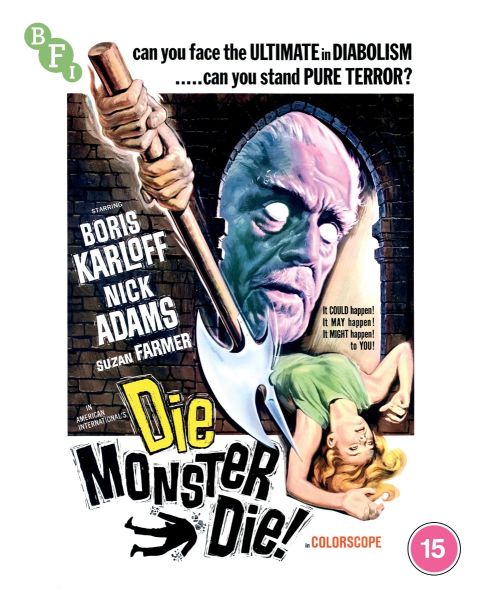
Weird science... Die, Monster, Die! (1966), BFI Blu-ray


It looks like a zoo in Hell!


I first saw Camberwell’s William Pratt in a silent film from 1920 called The Deadlier Sex who were in this case represented by Blanche Sweet. Born in 1887, Pratt had already adopted the stage name Boris Karloff and this was to be his first significant role in a feature film. 46 years on and he features far more prominently in Daniel Haller’s colourful take of alien horror, one of the true masters of the genre and leaping from the screen even in the wheelchair his health dictated he use; the film’s strongest performer even in his late 70s… Boris carries so much atmosphere.


Adapted from H.P. Lovecraft’s 1927 story The Colour Out of Space, the film has so many Hammer trappings and yet was made for Alta Vista Productions, distributed by AIP in the US and Anglo-Amalgamated in the UK, who clearly wanted something along those proven box office lines. Don Banks’ music and DOP Paul Beeson’s use of shadows and light are used to create a near constant sense of unease, especially in the scenes filmed on set. There’s also rather a lot of mist floating atmospherically in the estate of the Witley family mansion, which was Oakley Court, Water Oakley, Berkshire, also used in A Matter of Life and Death, DW Griffith’s Hearts of the World and José Ramón Larraz’s Vampyres (1974).


After a title sequence featuring some very groovy light effects that may well have influenced The Pink Floyd’s road crew for those early gigs at the UFO and the Roundhouse, the film starts with American scientist, Stephen Reinhart (Nick Adams) arriving at a village called Arkham played by Shere in Surrey, where he is greeted with great suspicion by everyone he askes for directions to the Witley’s place. He’s rejected by otherwise friendly shop-owners, denizens at The Sun ale house and even the bicycle shop – he’s got a bike and you can’t ride it if you like going to the Witley Place…


William Henry Pratt 

It's a classic horror trope (see below) but it works, as does the matte painting landscape of scorched earth on Stephen’s route to the mansion, as if something huge and unearthly had smashed into the land. By the time he arrives the aforementioned mist has begun to obscure and scarify the grounds of the mansion as a shrouded figure watches him approach the front door. Stephen is on his way to meet fiancée Susan Witley (Suzan Farmer) with the two meeting when she studied in America, and whilst she is a science graduate she has clearly not picked up on anything unusual happening at her family home.


Cursed is the ground where the Dark Forces live, new and strangely bodied… He who tampers there will be destroyed…


Unusual happening number one is, of course, her father Nahum (The Boris) and number two is her mother Letitia (Freda Jackson) who is mysteriously ill and confined to her darkly shrouded bed. Nahum insists that the young American must leave as soon as possible, his daughter obviously hasn’t mentioned their arrangement before, but at least Letitia is more welcoming.


Soon the razor-sharp Prof. Reinhart starts wondering if his intended’s homelife is atypically complex. We’re a bit more clued in as Nahum and his mirror-shaded assistant/henchman Merwyn (Terence de Marney) descend down the wheelchair lift to his secret cellar of science in which a strange green glow illuminates more classic tropes including skulls, chains – “for Devils”, his cursed late brother Corbin perhaps? - and unearthly sounds. All of this is contrasted with the loving simplicity of Susan and Stephen’s relationship… one we know will soon be under great strain especially when they enjoy a very tense dinner with Nahum.


The sublime Suzan Farmer and, um, Nick Adams

The film moves forward quickly as Letitia and her husband discuss the events leading up to an unfortunate development for their maid and soon poor Merwyn has spontaneously combusted and the young couples have been led by strange unearthly lights (etc…) to the green house where they find an abundance of giant tomatoes and a room full of horrifically mutated animals.


What other horrors await in this house of mystery and will the prophecy quoted above, found by Stephen in the family library copy of a book entitled Cult of the Outer Ones be realised? Just how did the flora and fauna get so big in the greenhouse and what is the strange glowing radiation that affects the servants as much as the crop? You need to watch it and find out, but maybe not alone…


This one of the last straight gothic sci-fi horrors of its kind and its only Karloff in his dignity… who makes it possible.


The new commentary from film historians Vic Pratt and William Fowler is great value and the former’s above quote is spot on with the dignity of the lead actor holding the enterprise above water and the hint of spoofery. The pair are full of detail on Lovecraft and Karloff but also the legend that is Nick Adams, not the World’s greatest actor but someone who mixed at that level, being a pal of James Dean and Elvis Presley. Adams looks far more ’55 than ’65 with his slicked back short hair and straight suit out of fashion step with Suzan Farmer’s Susan whilst he’s also playing in a different film, an action figure with obscured motivation.


But as Vic says, the whole production feels like a transitional one – he even compiles a handy list of 25 standard tropes for horror films that were just about being used in an unironic way. All is redeemed by King Karloff and this is a very well made, colourful and visually satisfying film that will provide you with excellent entertainment on one of the many rain-sodden afternoons we are being gifted this summer!


Horrifyingly frightening features:


  • Presented in High Definition
  • Newly recorded audio commentary by film historians Vic Pratt and William Fowler
  • A Karloff Konversation (2024, 19 mins): Boris Karloff’s biographer, Stephen Jacobs, discusses the film
  • Scenes From ‘Let Me Die a Monster’ (2024, 14 mins): sequences from Ken Hollings and David McGillivray’s as-yet-unmade film-fantasy built around Die, Monster, Die! star Nick Adams, performed in a read-through staged and shot exclusively for this release
  • Nick Adams and Die, Monster, Die! (2024, 7 mins): Hollings and McGillivray recall the career of Nick Adams and how they became fascinated with his film work
  • Sell, Monster, Sell! (2024, 12 mins): film unit publicist Tony Tweedale recalls his work on Die, Monster, Die!
  • The Peaches (1964, 16 mins): a family greenhouse yields strange fruit in this stylish Swinging Sixties short film 
  • Image gallery: an extensive array of promotional stills from Die, Monster, Die!
  • Theatrical trailer with optional audio commentary 


There’s also a fab illustrated booklet with a new writing on the film by Stephen Jacobs, an essay on HP Lovecraft by Xavier Aldana Reyes and writing about ‘Let Me Die a Monster’ by Ken Hollings and David McGillivray; notes on the special features and film credits. This is only available with the first pressing only so get busy.


You can order the set from the BFI and other online retailers from 22nd July!!


Chains... for The Devil!
"Lime and limpet green, the second scene... a fight between the blue you once knew..."

Oh, so you're an actor?!


Sunday, 14 July 2024

The London nobody knows… Hidden City (1987), BFI Blu-ray


Oh, this really is one for the Archivists but also those who delight in finding out the persistently odd parts of our capital; if you’ve ever wondered what goes on under the old Kingsway Tram Tunnel, otherwise silent doors off Holborn Viaduct or the nuclear bunker in Fitzrovia, well, it might be what we see here. There’s an echo of James Mason uncovering similar gems in The London Nobody Knows in 1967 but also an influence on Neil Gaiman’s 1996 TV series Neverwhere, which imagined the goings on of London Below including an actual Angel of Islington as played by Peter Capaldi (there’s typecasting!).


Hidden City is magically real all the more so because of it’s deep-cut locations, the familiar existing side by diagonal alley with the weird, wonderful and mysterious.


All of this is revealed through the search for a particular reel of film which will, possibly reveal a murder or deeper conspiracy, like Antonioni’s David Hemmings meeting the female Doctor Who we were robbed of… Cassie Stuart’s Sharon is that woman and, after losing her job because of Charles Dance’s pompous writer on new media and technological teaching, James Richards, being sent the wrong video for a class, introduces him to a mystery only the two of them can solve.


He is The Assistant and she is the madly intuitive Doctor or, if you prefer, she’s Dr Watson driven to pull Sherlock away from his self-indulgence and violin, towards a mystery – an injustice – decades in the making. It involves the kind of luck and co-incidence that would make the late Paul Auster think twice but it all works within the logic of its own world and an all too rational man who has lost his way and his curiosity. James has seen it all before but when Sharon reveals that he hasn’t actually he can’t resist following her as the pair chase across the London that not that many people know, in search of films that may contain the truth even as they are at risk of being discarded as is the case with Hop Gardens of Kent which they rescue from the furnace to find it contains strange images of a woman apparently being captured by secret policemen and escorted to an unnamed building deep in the backstreets of the over-looked.


The eighties locations are of course fascinating for those of us who remember when there were more disused and mysteriously empty spaces around Holborn Viaduct, further down the submerged Fleet or over towards Kingsway and the long-abandoned tramway under which the film has a hidden archive run by the government (or deepish state) – which contains many things we shouldn’t be seeing. The men who run the collection of secrets are playfully obstructive and the film in question has been thrown out just the day before… leading the companions to a waste-disposal site where there’s also a group of policemen searching for something else in the rubbish.


Characters interact and work against each other all within the playful logic of the film as we get closer to an all too mundane and believable truth. It’s a fascinating ride and Charles Dance, who also features in the whitest of y-fronts at one point which only he could carry off…, is commanding and his aloof, analytical James is suitably intrigued by the earnest promptings of Sharon. Cassie Stuart is very impressive too with a restless energy that keeps the narrative sharp and uncertain – she’s very post-punk.


With Richard E Grant as Sharon’s former boss, who may be implicated and Bill Paterson as Roger’s best friend Brewster – ditto – it’s a well-acted and very meta experience with everything and everyone potentially in on deeper levels of the secrecy. The solution is found with the passion and relentless intuition of those who search the archived London for the truth. It would have made for a great continuing series, Dance and Stuart’s characters could have been the Mulder and Scully of the 80s. The truth is out there, hidden in that which is retained but too often overlooked?


Special features


Illustrated booklet including Poliakoff's original introduction to his screenplay, a new essay on the film by John Wyver, a new interview with Stephen Poliakoff by Michael Brooke, new writing on Barging Through London and Hop Gardens of Kent by Ellen Cheshire and an essay on Public Information films and the National Archives by Sarah Castagnetti and Patrick Russell - First pressing only

Presented in High Definition

Newly recorded audio commentary with writer and director Stephen Poliakoff and film critic Michael Brooke

Treasures from the BFI National Archive (1903-1947, 58 mins): a selection of archive gems, exploring some of the themes featured in Hidden City. The films: Cheese Mites (1903), Barging Through London (1924), Hop Gardens of Kent (1933), The City (1939) and Shown by Request (1947)

Inside the BFI National Archive (2023, 1 min): a behind-the-scenes look at the work of the BFI National Archive


This celebration of the work of archivists and the importance of old media in terms of understanding of the here and now – shooting the past never stops – will delight all of those who enjoy Poliakoff’s work and many more; the extras are indeed special and indeed part of the story in a couple of cases.


You can buy Hidden City now direct from the BFI’s online store or their Southbank shop… essential for your home archive!


Sunday, 7 July 2024

Day by Day in Bologna… Il Cinema Ritrovato XXXVIII

Catherine Deneuve is the cover girl from The Umbrellas of Cherbourg


OK, after catching up on work and sleep, what was my pick from eight days of relentless cinema, meeting some of the finest cinephiles in the world and an unquantifiable amount of coffee, brioche, ragu and, dear reader I must be honest, Aperol Spritz. In no particular order, these are my personal highlights, from a festival you start off with the best of intentions, 6-7 sessions a day for eight days, what could go wrong? Answer: nothing, the Ritrovato experience you get is the one that you deserve and the one that suits you best!


 10.   Kohlhiesel’s Töchter/Kohlhiesel’s Daughters (1920), with John Sweeney, Il Cinema Modernissimo


The funniest thing of the week and a major Lubitsch I had yet to see featuring Emil Jannings acting his age and being charming as part of a couple of chaps trying to woo sisters played by Henny Porter who proves what a superb talent she was, not only with her highly persuasive physicality but also timing. She plays the kind-natured Gretel who wants to marry but, following her father’s instructions, can’t until her elder sister, Liesel (also Henny), weds first. The problem is that Liesel is as bitter as her sibling is sweet and more of a match for either Jannings’ Peter or Gustav von Wangenheim’s Paul by any measure.


It's fast-paced and utterly charming and very much cut from the same cloth as the Ossi Oswalda comedies and those with Pola Negri which the director made before and after. Shot against an alpine background by Theodor Sparkuhl, it was the feel-good hit of the week which I thought I’d missed only to find it re-played on the last day.


John Sweeney’s playing was on another level, i.e., the same at the film’s, and his emphatic flourishes continued to fill the gorgeously restored Modernissimo right till the end of the credits. I trust it won’t be long before we see Lubitsch’s 34th film (including shorts) screening in London with John playing as a pre-requisite!


Emil Jannings und Henny Porten


9. It’s a family affair… Judex (1915-16), accompanied by many hands, Cinema Mastroianni


On the final Saturday as all the mystery and loose ends were tied up I emerged triumphant from the Mastroianni having watched the whole series and thoroughly enjoyed Louis Feuillade’s sense of drama, his eye for dynamic framing, his direction and team building and his ability to keep the narrative ball rolling even when you think he’s backed himself into a dramatic dead end. That’s 12 episodes and one big Prologue with not a second missed for lack of sleep, breakfast or headache… probably!


It's not quite up there with Les Vampires but it does have the essentiality of Musidora playing Diana Monti aka Marie Verdier, a scheming opportunist who becomes more and more dominant the longer the story unwinds. Judex himself as played by René Cresté, is a goodie version of Fantômas, part Sherlock Holmes, maybe part Eugène-François Vidocq – an actual French criminal turned criminalist - certainly an outlier for The Shadow, Doc Savage and even The Batman. Feuillade had been criticised for glorifying his evil masterminds and so here was one of good intent even if he does kidnap and fake the death of the businessman responsible for his father’s death and many others, Favraux (Louis Leubas) before imprisoning him for life in a remote castle.


Judex has worked a long game, disguised as Favraux’s secretary, to infiltrate his business dealings. His plan is soon complicated when he falls in love with the banker’s daughter, Jacqueline (Yvette Andréyor) who is soon targeted by the evil Monti! There’s great support from Vampires’ alumni Édouard Mathé as brother Roger and Marcel Lévesque as the comedic Cocantin whose swimming-costume clad fiancée Miss Daisy Torp (Lily Deligny) helps save the day. The kids are alright too and Le petit Jean (Olinda Mano) and The Liquorice Kid (Rene Poyen) deserved their own series!


Musidora, aka Jeanne Roques


8. Quo Vadis? (1924) with Neil Brand, Eduardo Raon and Frank Bockius, Cinema Mastroianni


This was an attempt to repeat the pre-war success of the Italian epic’s including Enrico Guazzoni’s massive 1912 adaptation of Henryk Sienkiewicz’s 1895 novel, Quo Vadis: A Narrative of the Time of Nero. It was an Italian German co-production followed on with a cast of thousands, gigantic sets (real and constructed) and the combined star power of Lillian Hall-Davis’ nuanced emoting and Emil Jannings’ protean excess. Larger than life and twice as tiring, his Nero offers Lillian’s frail Licia the world and we cower behind her in the darkness as her faith rises up as the only defence against the monstrous ego of the man who is Empire.


It's saucy in a Cecil B DeMille way with snatches of nudity and a-typical sexuality along with elaborate displays of Roman cruelty which peaks in the Colosseum and in a genuinely gripping chariot race that hasn’t been seen in the length or detail for many years until this superb restoration. It’s a thoroughly enjoyable effort that was surprisingly not a success at the time, perhaps too opulent for German audiences and too close to the bone for the newly fascist Italians… I’d love to know more about how it was received in those early days of Il Duce…


Neil  Brand accompanied across the two parts on piano assisted by Eduardo Raon on harp for part one and Frank Bockius on drums for the epic finale on drums… the players were perfectly aligned with the momentum of the film with Rome’s dangerous beauty giving way to death and destruction and ultimate martial revenge by the end of a story that had already been told many times.


Emil harasses our Lil'!


7. He Who Gets Slapped (1924), with Laura Agnusdei, Simone Cavina, Stefano Pilia and Antonio Raia, Il Cinema Modernissimo


Of films I had already seen multiple times, this, The Wind, The Last Laugh et al, I was most interested in seeing this one having missed it recently at the Kennington Bioscope. In the plush Modernissimo it was accompanied by an ensemble featuring Laura Agnusdei (tenor sax and electronica), Simone Cavina (percussion and electronica), Stefano Pilia (guitar and electronica), Antonio Raia (sax, chalumeau/clarinet and “oggetti” … objects?), whose modern stylings overlayed and enhanced the action on screen in new ways.


That said, this is one of the hardest-hitting Hollywood films of the twenties as you’d expect from the mighty Victor Sjöström, certainly the most successful Swedish director in the US who was able to maintain his approach across this and work with Garbo and Gish. Here he brings out the full flavour of Lon Chaney in a film that breaks your heart which as Ehsan Khoshbakht describes in the catalogue as about the act of “de-clowning… only the vile and ignorant laugh at the clown”. As my friend, the poet Ged Griffith, used to say after a few Jamesons, “Life’s a walking shadow, nah-nah, na-nah-nah…”


Lon Chaney: if you don't have a fear of clowns, perhaps you should re-consider?


6. The Searchers (1956), Piazza Maggiore


I only managed two screenings at the big Piazza this year as a result of rain and other distractions but Coppola’s Conversation was not as engaging on the grand screen as John Ford’s masterwork. Rarely has John Wayne been this monumentally frightening, dark eyes staring out across the vastness of the west in search of revenge and the restoration of his culture. There’s some jokey sequences but nothing really dents the full force of this film which continues to evolve in its meaning as the West in general seeks answers to the same issues of invasion, cohabitation and peaceful evolution. This is a film made at a time closer to the tail-end of the Wild West in the 1880s than to now, struggles still just about in living memory for a United States still ill at ease with its diversity.


Screened from 70mm on the biggest screen the film was introduced by Wim Wenders who has made the pilgrimage to Monument Valley, Arizona and wondered at the audacity of filming entirely at this location. It was something to view in a fresh light, immersive and impactful making us feel the filmmakers’ anew with even the plastic seats not distracting from the two hours on mental horseback.


The big country

 5. Chemi bebia/My Grandmother (1929), with Cleaning Women, Il Cinema Modernissimo


Due to unseasonal rain, this screening of Chemi bebia (My Grandmother) was moved from the Piazza Maggiore to the Cinema Modernissimo which only served to amplify the intensity of Kote Mikaberidze‘s film and the extraordinary accompaniment of Finland’s Cleaning Women. Now then modern scores for silent films can be controversial but this film is so out of time with its Dadaist energy that an avant-alt-post-rock-post-jazz-experimental-industrial set played by a group consisting of three cleaning robots (CW01, CW03 and CW04) ended up being perfect.


Chemi bebia defies easy summation and that’s from one of the only two people in the stalls who had seen it before but, essentially, it’s a film highlighting the damaging impact of bureaucracy on the revolutionary project with so many self-serving idiots only responding to the appearance of the Universal Worker (or similar). It’s one of the oddest and funniest propaganda films ever made and even more so with the “cleaners” quirky propulsion. Mop and Bowl on home-made instruments!


4. Scuola D'Eroi (1914) Daniele Furlati and Silvia Mandolini, Cinema Mastroianni


Meanwhile, back in the Golden Age of Italian Cinema, we watched an early film from one of the three great Dive, without which no CR is complete for some. This was not yet the imperious Pina Menichelli of her most successful period but she draws the eye in one of her first major roles dominates the screen whenever her character, Rina Larive is in shot even alongside Amleto Novelli and certainly the more established Gianna Terribili Gonzales.


Directed by Enrico Guazzoni – who made the 1912 Quo Vadis as well as other classical classics … Scuola d’eroi is an Napoleonic epic and I mean epic, straggling decades, family lost and found and with the fortunes of war and love all tangled together. Pina plays Rina, sister of Carlo, Amleto, who during a Napoleonic campaign, having been separated from their father as children and raised by a kindly farmer, get caught up years later in another with the emperor playing his part in recognising the courage of the family and saving them from the machinations of bad-faith nobility.


Daniele Furlati provided suitably spirited accompaniment on piano with Silvia Mandolini on violin, flavouring and enhancing during battles scenes and the moments of highest tension. Italian silent film of this era carried its heart on its sleeve and this was a very affecting screening of a fresh restoration from a nitrate positive held by the Cineteca Milano. It is the only tinted copy currently in existence and close to the original running time.


Pina Menichelli


3. 1904: Un Anno Magnifico, Stephen Horne and Frank Bockius, Piazetta Pier Paolo Pasolini


There are moments in every festival when you settle down and suddenly feel at the heart of the event, watching the perfect film and listening to just the right accompaniment and this happened on this rain-delayed outdoor event on the Thursday with a selection of shorts from 1904, A Magnificent Year indeed! I decided on the Pasolini’s carbon arc projector rather than watching the restoration of The Wind in the Piazza Maggiore – with orchestra! – and was rewarded with such rare delights!


We started with the breakneck gymnastics of Les Cambrioleurs modernes – often wrongly attributed as from a later year – which featured a stunningly synchronised troupe playing cops and robbers by throwing themselves in and out of a set full of trap doors. Clearly a stage act rehearsed tot the finest degree this was still a marvel to observe in real-time with no trickery. There was plenty of time for that with Georges Méliès' Détresse et Charité - The Christmas Angel and Match de prestidigitation but most of these films just used the new media to show actuality, whether it was the British Fleet being inspected at Spithead or A Miner’s Daily Life from RW Paul.


There was plenty of magic though with Gaston Velle’s silhouetted Burglars at Work showing what the camera can do as well as his deliciously hand coloured Métamorphoses du papillon with unknown dancer changing in front of our very eyes. And then, then we had a song as Frank Bockius performed the missing vocals from Henry Bender in a hand-coloured take of over-fed babies he would have performed at Berlin’s Metropol-Theatre. It was a job well done as indeed was the entire accompaniment from both payers with the memory of Stephen’s flute reverberating high into the clear skies as likely to linger as his partner’s percussion and vocalisation!


2. Re-building Jerusalem… Ingmarsarvet (1925), Andre Desponds and Frank Bockius / Till Österland (1926), Neil Brand, Cinema Mastroianni


This list isn’t really in order but the top two are such has been my pre-occupation with Selma Lagerlof and the tsars of these three films, notably the extraordinary ballerina Jenny Hasselqvist. I’ve gone on at length elsewhere but it was such a joy to see Gustaf Molander’s two films based on the author’s Jerusalem and I am so grateful to the Swedish Film Institute for the work they have done in restoring and reconstructing them.


More raving here...


1. Ekeby at last! Gösta Berling’s Saga (1924), Matti Bye, Eduardo Raon and Silvia Mandolini, Cinema Mastroianni

Having waited years to see this film on the big screen, I was also more than eager to see the results of the last five years’ worth of restoration and was in no way disappointed by the clarity and the majesty of this re-ordered and extended version of Mauritz Stiller’s work; perhaps not his best but my favourite anyway. Jenny, Greta Garbo, Lars and, especially Gerda Lundequist all shine as never before and the restoration and broader appreciation of filmmakers and the author Selma Lagerlöf will rightfully benefit.


More detailed appreciation here...


I saw much more though easily missing my 50-film target and apart from the silents enjoyed talkies as diverse as Morocco (1930), En Natt (1931) – Gerda again! - The Lavender Hill Mob (1951), Coeur de Lilas (1932) and Tirez sur le pianiste (1960). There was also a beautiful film of Anna Pavlova (USA-GB/1924-1954) which brought me close to tears with John Sweeney’s accompaniment.


As with life it’s best to celebrate what you saw rather than mourn what you missed and so, with hope in my heart, I look forward to revisiting many of the above and catching up, if the programmers so will it, with the rest.

Grazie mille Bologna and Il Cineteca Ritrovato! Ci vediamo nel 2025!


My copy of a 1924 Danish Gosta booklet