
C. Aubrey Smith’s famous explorer John Brice has an
abnormally large “bump” on his head enabling him to discover the Equator and
the North Pole with greater facility than the common man (or woman) and so it
is with me and locating the Southbank after so many months away. This was not
my first cinema of the pandemic but it *was* the first silent screening with
live accompaniment since March 2020… and, what a way to break the silence with BFI
Curator Bryony Dixon providing expert introduction and Neil Brand accompanying
with all the contextual flourish and narrative instinct you would expect.
As with the best silent screenings, you leave the twenty first century schizoid experience behind you and pattern recognise your way back into the streets and suburbs of your greatgrandparents' or grandparents’ age, all too familiar Edwardian streets in SW20, West Wimbledon* or mock-classical town houses in Kensington or Westbourne Grove, even the St John’s Wood to Kilburn area where Alan Alexander Milne was brought up. The buildings are probably still there, but the people who live inside them have changed a lot but almost all of them would be familiar with the works of Milne that followed this early and short flurry of film activity.
He was involved with writing four stories filmed in 1920
for the company Minerva Films, founded in 1920 by the actor Leslie Howard with his friend and story editor Adrian Brunel. The company’s board of directors included
C. Aubrey Smith, Nigel Playfair and A. A. Milne whilst one of the company's
investors was H. G. Wells. This was the English intelligencia playing with the
new media and, whilst the results in Milne’s case were commercially
disappointing, the two films screened today were very well made, charmingly
well written, played and skilfully directed by Brunel.
 |
| C Aubrey Smith a few decades earlier... |
The first was The Bump (1920) featuring C. Aubrey
Smith as the famous explorer mentioned above. Smith was 57 and the film makes
great play of his cragginess with a sequence notating the origins of the scars
on his face, a shark bite here and a lions’ claw there; he’s explored the world
and has the autographs left by every predator he’s met.
Brice’s reputation is legend and in one well upholstered
parlour, young Lilliam Montrevor (Faith Celli) is fascinated by his daring and
manly pursuits. Her almost-beau, Freddy (Douglas Marshall) compares poorly as
he can only dance and have a good time, he’s never explored or risked more than
shoe leather. Lilliam, Freddy and her parents head off for a dance on Freddy’s
scooter, the most unmanly transport they can imagine.
I’ve met a man at last!
 |
| Faith Celli from 1917 |
At the ball, among the effete fancy dress strides the
imposing dress suit of Mr Brice and having go shot of Freddy after his seventh
proposal (that month!), Lilliam proceeds to introduce herself and hilariously
relives his tall tales of the north pole (wrapping herself up) and the equator
(fanning herself) and even his discovery of the Piebald Gorilla who is seen
relating his own version of events back in Africa.
Milne’s humour is very Oxbridge, even from this remove, and
his title cards are witty in that knowing ironic way we’ve seen from the Fringe
and beyond. Lilliam invites Brice round for tea at their house in, wait for it…
Stuccoway Terrace and a romance seems on the cards.
But then a strange thing happens and the fearless explorer
has to strike out on his own for this expedition and in unfamiliar territory,
he asks for help from local natives all of whom seem to lead him further away…
still, we do get to see even more wonderful London backdrops. Will Lilliam
finally see Freddy and will Brice overcome the discombobulations of the city
streets. It’s like a jungle out there…
Faint heart, never wonne faire laydee
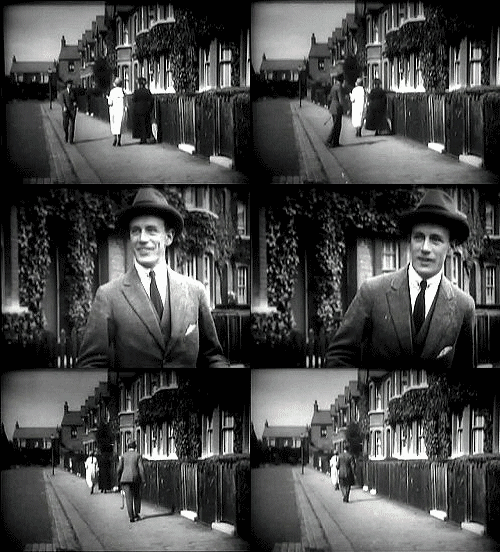 |
| Off in pursuit... Gif from https://lesliehowardsteiner.blogspot.com |
The second film featured young Leslie Howard in Bookworms
(1920) another witty tale of love and adventure this time transporting a knight
and fair maiden to Edwardian semi-detached suburbs. We find said maiden, Miranda
(Pauline Johnson) reading The Wealth of Nations by Adam Smith in her
guardian’s study. She lives with her Uncle Josiah (Jeff Barlow) and her Aunt Priscilla
(Henrietta Watson) who employ a “tame dragon” (Mrs. R. Podevin) as Miranda’s
guardian.
All is peaceful until one day Richard (Howard) a listless
young man wakes up after his usual lie in to spy the neighbour of his dreams
across the road. From that moment on he is a man on a mission, revitalised by
romance and the need to meet this object of his affection but, every attempt to
arrange an introduction is blocked by the Dragon or, in the case of his attempt
to call for a Salvation Army collection, the family maid.
 |
| Pauline Johnsom a good few years later |
He soon learns Miranda’s daily routine and follows her to
the library every day only to find that dragon always between him and the goal.
And then, then he has an idea. He will leave a note in the book she collects
and simply wait for her response. Sounds fool proof doesn’t it, but the trouble
with library books is that everybody reads them. A carefully orchestrated chaos
ensues that leads to a surprising but satisfying ending. Just as you’d expect.
Neil Brand brought his experience and passion to the accompaniment
as a man you could see thoroughly enjoying afternoon tea with Milne, Brunel and
Howard. Can a sense of humour be expressed through music? It surely can and Mr
Brand demonstrated this fact emphatically. It was so good to see and hear him
and Bryony Dixon performing a show, tell and play again.
Before the two half-hour shorts, we were also shown the
first film Lotte Reiniger made in England, illustrating Milne’s poem The
King’s Breakfast (1937). As with all her work you soon forget you’re
watching shadow puppets and get lost in the story and not least the certainty
that butter is indeed better on toast than marmalade.
 |
| The author |
This was an absolute treat and all the rarer for being on
the BFI’s own 35mm prints. Here’s to many more such screenings as theatrical
life cautiously resumes and we edge forward. The BFI still has social
distancing in place, mask wearing for screenings and reduced capacity making
the experience feel safe and risk managed in a way that is not always the case
in some other sectors. AA Milne may have been a humorous man but he served in
the Great War and was injured at the Battle of the Somme, he could spot a
phoney like Brice and perhaps generals without method or even a cause.
Anyway, I thank the BFI for their hospitality, their
diligence and their exceptional content delivery!
See you soon.
PS Bryony also mentioned that her colleague Jo Botting has a book in the works about Adrian Brunel, one to watch out for!


%2Bbrave.jpg)
+again.jpg)
+2.jpg)
+impact.jpg)
+impact+3.jpg)
.jpg)
+exterior+to+interior+2.jpg)
+exterior+to+interior.jpg)
+Ambrose+Barney+smirk.jpg)
%2Barms.jpg)
.jpg)
+smile.jpg)
.bmp)
+track.jpg)


+colour.png)





%2Bagain.jpg)