Showing posts with label James A. Marcus. Show all posts

Thursday, 2 March 2023

More please… Oliver Twist (1922), with John Sweeney, Kennington Bioscope


8 Great reels that make you ask for more. Will Hays says Jackie Coogan Films are the sort the World needs…

Print Advert - Wyoming County Times, 20th December 1923


Introducing the screening of four films from his personal collection Christopher Bird delighted us with an evening of films connected with Charles Dickins and, to a lesser extent Lon Chaney.


First was Mrs Lirriper’s Lodgers (1912), an almost complete film previously considered lost and rescued by Chris from a pile of rubbish at the end of a antique collector’s garden. Painstakingly restored with over 400 manual fixes, the film, based on a story from Dickens, was a delight, telling a moral tale in limited time with the constant thought in our heads that this very nearly didn’t exist but for a collector’s endless curiosity.


Next up were three short 35mm films exchanged for a reassuringly expensive pint of lager – we all have our price and clearly the seller was happy to offload these potentially explosive nitrate curios. Included was a precious glimpse of a young Lon Chaney, looking dashing in one of the few elements of his early films still extant, this from Tangled Hearts (1916). Back to the Dicken’s theme and another previously lost film, Oliver Twisted (1918) starring Fred Evans, aka Pimple, as an actor playing Bill Sykes who seems to stagger over the fourth wall as he feels his way through an approximation of the story from our main feature clutching a wooden club and a three-legged toy dog. To watch Fred at work is to marvel at the consistency of British humour, always daft, always knowing.


Last of the shorts was Hello Hollywood (1927) a fascinating look behind the camera at eth sprawling estates and backlots of the major studios. Lon Chaney was mentioned in one intertitle and we also saw the set of Paris used in The Hunchback of Notre Dame.


You've got to pick a pocket or two...

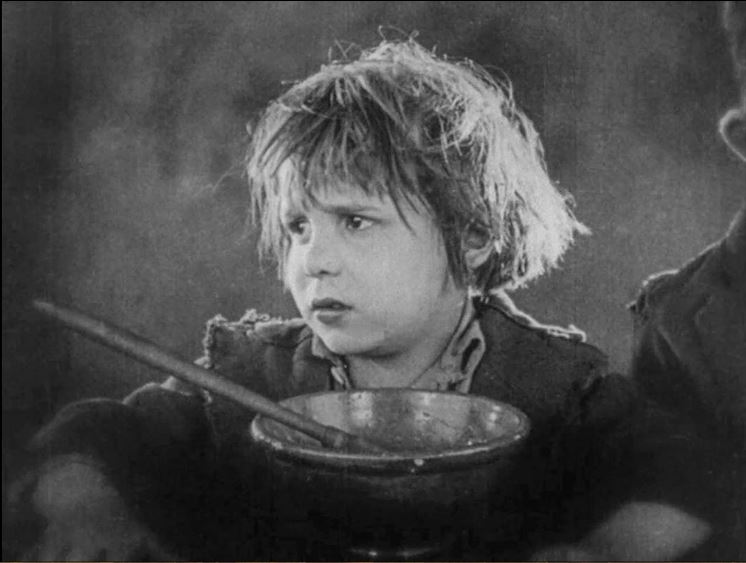
Containing roughly equal parts Dickens and Chaney was the main feature, Oliver Twist (1922) which was shown from a 16mm print again from Chris’ collection. This is another lost and found which on rediscovery in Yugoslavia in 1973, had to have intertitles inserted with help from star Jackie Coogan and producer Sol Lesser for Blackhawk Films restoration. The film is close to complete, missing perhaps a reel out to the original eight, but making total narrative sense and more.


Directed by Frank Lloyd, the film makes light of the complexity of Dickens’ original work – some 370 pages and 170,000 words, rather more than you need for a film. That said, like so many early films, it was based on a story that most people knew very well as the Pimple short further proves, including Nancy’s horrific demise – so fearful that Pimple has to change actress twice.


This feature was made just before Lon Chaney really hit the big time but, as with every one of his films that I’ve seen, he is submerged in character and all you see is Fagin, not a man heavily made up and radically adjusting his body shape to present the image of an older man, twisted by poverty and the evil that men do in picking a pocket or two. It’s fascinating how so many of the characters are recognisable in look and feel even at this early stage but Fagin is not as semitic as the Ron Moody portrayal.


The well meaning and well-to-do see the good in the boy... mostly.

This is not a starring role for Lon though, that privilege goes to eight-year old Jackie Coogan who had already made four features since his debut in The Kid and was looking good on it. It’s rare to find a child actor this accomplished but this is even more striking given the vintage. His expression is flexible and controlled and he knows how to hold himself even when there’s no dialogue or action directly involving him. He too is completely submerged in his role and is a very impressive Twist… not without an instinctive humour that places him apart from the more obviously terrorised Mark Lester! This is a tough role for a junior.


Elsewhere there is sterling work in bringing life to Dickens’ – genuinely iconic – cast of characters from the cheeky tea-leaf The Artful Dodger (Edouard Trebaol), the corpulent Mr. Bumble (James A. Marcus) to the battered but brave Nancy (Gladys Brockwell) and her loathsome man Sikes (George Siegmann); ultimately brought down by his own fears… Dickens was writing well before Freud but very few of his characters can escape from conditioning and context.


On the other side of the tracks there are a series of well-to-do saviours including the Maylie family with Rose (Esther Ralston) and a Mr Brownlow – no, not that one – all seeing the good in Oliver even when fate and his companions sometimes work against his fortune and character.

Jackie Coogan and Esther Ralston on the right


Talking of Mr Brownlow, our version, Kevin, interviewed Jackie Coogan extensively for his Hollywood series and also used the rushes of the full meeting for Lon Chaney: A Thousand Faces (2000), on which Christopher Bird worked as Editor. Two degrees of Kevin Brownlow and beyond. Coogan was very impressed with Chaney’s contribution in spire of his father’s warnings that the elder actor would try and steal scenes… well, good luck to anyone trying to distract from young Jackie and I reckon Lon did a great job.


John Sweeney put in a marathon shift and accompanied the whole programme with the seemingly endless variation of light and tone he has at his finger tips. In spite of the circumstances, Oliver remains good whilst so many around him are made bad through situation and malice, John sort out the enduring truths of Dicken’s social morality and gave them full voice as we watched the shadows on screen. Classic and classy all round.


Another Bioscope super show and with tea and Tunnocks tea cakes, who could ask for anything more?


Wednesday, 22 July 2015

Acadian fire… Evangeline (1929)


Ye who believe in affection that hopes, and endures, and is patient,
Ye who believe in the beauty and strength of woman’s devotion,
List to the mournful tradition, still sung by the pines of the forest;
List to a Tale of Love in Acadie, home of the happy.

In 1755 British soldiers deported a group of French-Canadians, Aradians, who refused to join with the Empire in fighting their French challengers. The communities were forcibly removed from Nova Scotia, New Brunswick and Prince Edward Island – up to 11,500 from a total population of 14,000… one of the first large-scale population redistribution and a large scale operation for the British.

In 1847 the American poet Henry Wadsworth Longfellow, published Evangeline, A Tale of Acadie, is an epic poem that follows an Acadian girl named Evangeline and her search for her lost love Gabriel, set during the time of the Expulsion of the Acadians.


It became the poet's most famous piece and remains one of his most enduring works in spite of the inevitable historical inaccuracies... since when have poets been required to be historically accurate?
Never-the-less thousands of lives were lost and the British were responsible for a high-mountain of human misery.

In 1929 Edwin Carewe made a film version starring Dolores del Rio, shot in Louisiana and more about the poem than the history. The film was silent but featured a Vitaphone soundtrack – don’t you just love transitional technology: always some great innovation but never as prosaically-practical as the eventual winning technology!

Delores sings?
For this Milestone DVD the majority of the sound disks were used which adds tremendously to the atmosphere and authenticity if not the hi-fidelity. You get to hear Miss del Rio (or someone else) sing and as with all things Vitaphone, the soundtrack is not directly synched with the dialogue just music, songs and sound effects. There are a few audio segments missing and so pianist Philip Carli filled in sympathetically for Hugo Riesenfeld’s music.

The impression quickly gained from this film is one of scale as well as poetic emotional sweep: this is definitely a tone poem and not a book adaptation and the rhythms are quite operatic: Evangeline is found singing to herself as she works away in her impossibly sweet cottage whilst her love Gabriel (Roland Drew) sweeps into the harbour not on wings but posed heroically on the bow of a fishing boat.

Roland Drew sweeping...
We see Father Felician (Alec B. Francis) strolling along the harbour surrounded by innocents and accompanied by lengthy dolly shot that introduces the town of Grand Pre in Acadie, then the toothless fiddler Michael (Bobby Mack) who will provide much comic relief even played against the stern Notary Rene la Blanc (George F. Marion).

To the main players, the alpha leader blacksmith Basil (James A. Marcus), father of Gabriel and the richest farmer in the town, Benedict Bellefontaine (Paul McAllister) and his son Baptiste (Donald Reed) who, for all his charms can’t prevent Evangeline’s heart beating for Gabriel even for a second: theirs is a steadfast passion – far more than that as we will see..

Cheers!
Now the sailor is returned it is a time to celebrate and Edwin Carewe directs a cast of thousands with aplomb and there are some gorgeous set-pieces captured by the cameras of Robert Kurrle and Al M. Green. A marriage contract is drawn up and signed in good humour and the community gathers again to witness the wedding of the year.

Meanwhile, the British have been getting set for war with those pesky Frenchies and the time has come to force them off King George II’s soil. The British Governor-General (Louis Payne) impresses the need for the Arcadians to join in the fight but they are reluctant to battle their fellow Frenchmen.

The march to the church
Now, dear reader, this is one of those moments in film historicals when the delicate Brit must look away in shame (my clan were variously Irish and Scottish at this point or Shropshire peasants so I’m taking no blame) but that aside, there’s no doubt this film is as kind to the “Mother country” as it could be. Most of the blame for the bad behaviour is laid at the table of Colonel Winslow (Lee Shumway) whose rogue, hot-headedness leads to the worst of consequences: the reality was far more organised and shameful.

The British army arrives just as Evangeline and Gabriel are being married – with hundreds of heavily-armed red-coats descending on the thousands of peaceful revelers (a bit like an early nineties rave after the Essex Constabulary turn up at 3AM Eternal…). The men are ordered into the church in which they are told they will pay the price for their insubordination: they will all be deported south and have their families broken up and their property destroyed.

Acadia burns as the boats start to take its citizens away
This genuinely-shocking development changes the tone of the film – and things get a whole lot darker form this point on as things kick off in a desperate struggle inside the church only halted by the appeals of Father Felician.

British guns mean that there can be no compromise and the community is dispersed - with contemporary images of mass-displacement all too fresh in the mind, this is, again, unsettling. The Army is relentless, not giving a fig for man, woman or child and the families and the lovers are split and taken away on boats.

As long as waters flow, their love will endure...
The months roll by and we follow Evangeline as she follows her search for her Gabriel: theirs is a true love and one that will endure “as long as waters flow…” You’d have to have a heart of stone not to be pulled in by this one and sometimes melodrama just works in spite of yourself.

Great composition and camerawork...
The film is lovely to look at and has the air of unreality required to match the poet’s phrases. Roland Drew and Delores del Rio make for a lovely lovelorn couple – the latter may not be one of the very best actors but she has an ethereality all of her own and is easily the stand-out performer.

Dolores del Rio
It’s also great to hear her “sing” her song – a theme apparently written by Billy Rose and one Al Jolson.

Evangeline is available from those nice Milestone people and is available direct from their shop – shipping is quick and very reliable!

Buy the Milestone DVD!
