
In her sparkling run through of this major BFI
retrospective of Weimar Cinema, Margaret Deriaz said that in the years between
1919 and 1933, Germany produced over 3,500 films, second only to Hollywood in
scale and productivity. Of all those films it would be hard to find one more purely
quirky than Opium and yet, for all its strangeness the film has plenty of
charms especially when accompanied by Yorkshire's finest, Jonny Best, whose patient minor chords and
plaintive discords did much to liberate Robert Reinert’s original dramatic
flavours.
The film has a distinctive visual style, almost a series of tableaux
in the manner of pre-war Italian film but very vibrant and filled with
ambitious double exposures as well as some superbly-captured performances.
Reinert’s cameraman was Helmar Lerski, a former portrait photographer who used
deep focus and careful lighting to capture every performer in the frame with
absolute clarity. Over and again one actor is joined by another and then
another moving into frame and adding layers of meaning as they react to events.
Another startling shot sees the main character, Professor Gesellius (Eduard von
Winterstein), on a boat moving relentlessly in focus towards a distant shore
filled with opium-induced faeries and sprites (of which more later…).
When the Professor gives a lecture a glass remains in
close-up on his lectern as do his students as he approaches to speak, it’s very
skilled and apt for a film about perception: The Doors of Perspective perhaps? It’s a very powerful style and
whilst it wasn’t the way movies were to go it is still a compelling example of
the experimentation of the time.
 |
| Conrad fades away and Eduard marvels at the depth of field as Sybill stays calm |
This was also that brief period, post-war, when all censorship
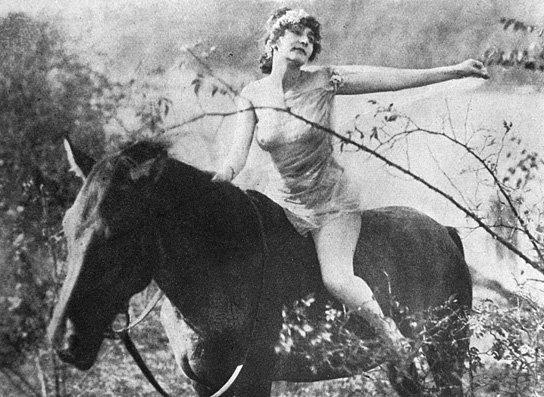
was dropped and so the film’s frequent Faerie nudity adds some extra surprise
as does the take of mixed-race relationships and, yes, drug addiction. The
effects of opium are revealed through double exposures and static montage of
dancing sprites and pools of water, sometimes inverted over the character’s
head. It’s clear that Psychedelia nearly happened here and yet the summer of
love was far from the thoughts of film-makers still trying to make sense of the
Great War.
As film historian Tobias Nagl, quoted in tonight’s hand-out
said: “under the surface, Opium captures the experience and shock of the War… (using)
… a brilliant, hallucinatory cinematic language.” So it is that the sanatorium
the Professor sets up for recovering addicts is so very like those for the shell-shocked
and the physically-destroyed, men who were all but dead already trying to piece
themselves together away from the adrenal rush of fear and mortal dread.
Now some of the audience and I’m naming no names couple in
the second row with horsey laughs… found all this a bit too melodramatic but maybe
they’d been caught up in BFI Weimar Mania (it’s a thing!) and hadn’t quite –
literally – got with the programme.
 |
| "Smokers, get high..." |
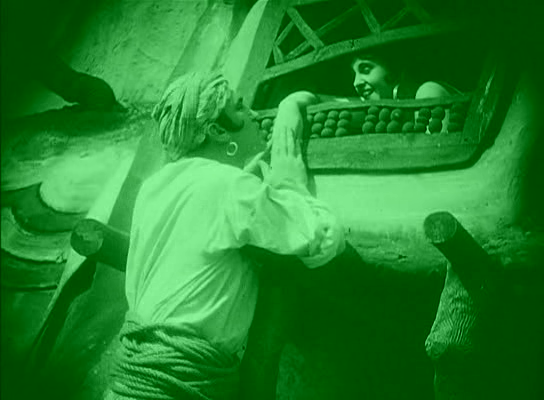
This being 1919 some stereotypical characters are deployed
but the relationships between the “Indians” in brown face, the “Chinese” and
the white men are more even-handed than you might credit. Granted there is a
completely bonkers bad guy, Nung Chiang (Werner Krauss, yes the good Dr
Caligari) who literally pops up onto screen to the surprise his enemies across
the World with a manic grin and acid jazz hands but I think, like so much of
the film, his character is representative and not meant to be a genuine description
of a contemporary drug dealer.
Lotte Eisner shoot me down in flames but, whilst this is
most definitely not an expressionist film, there are elements of the style not
so much in the mis en scene but the performances all of which are designed as
emblems rather than characters. No one plays it straight but then this is a
drug-den of a movie and we’re all out of minds with grief and as the first tentative
buzz of the new democracy kick in. No censorship mein Herr: we’re so out of it,
we see lions in India!
The story is about addictions to love and revenge with Nung
Chiang swearing revenge on Richard Armstrong (Friedrich Kühne) an Englishman
who smoked his opium and then stole his wife in China. There’s a further grievance
for Chiang when Professor Gesellius rescues a young woman, Sin (Sybill Morel)
from his den of multiple iniquities – you name it he’s selling it – and takes
her back to his sanatorium in the West. Sin is mixed race and you can guess who
her father is… but, none of this is known to Gesellius’ wife Maria (Hanna Ralph)
who just happens to be having an affair with Dr. Richard Armstrong Jr. (Conrad
Veidt).
 |
| Eduard von Winterstein, Werner Krauss and Sybill Morel |
Connie’s younger and better fed than I’m used to and is
convulsed with shame after his boss comes back… so much so that he’s not long
for this World, dying on a bed surrounded by almost all of the main characters
in another remarkable tableau with centimetre-perfect depth of field.
His death is considered suspicious and with the Professor in
the frame, Sin takes the blame only to be whisked away from execution by Gesellius.
Which is how we find ourselves in India with all those lions and so many scores
to settle.
Opium is opulent and over-wrought and I’d love to see it
again. The restoration from Filmmuseum München, as premiered at last year’s Berlinale,
is crisp and clear, is as close as we’ve been to the original which is one of
Reinhert’s few surviving films.
Jonny Best took the film in his stride and maintained a
watchful poignance that fitted the sparkling visuals perfectly; this film is an
elegy as much as a beginning and despite appearances there was more unknown than
known emotion on screen.
An excellent start to the BFI Weimar season!
  |
| Just say no. |

Jungle Book, not The Lion King




+colour.png)





