Showing posts with label Fred Niblo. Show all posts

Sunday, 16 January 2022

Blood and Sand (1922), Daan van den Hurk and Tijn van der Sanden, Nederland’s Silent Film Festival


To the Spaniard, the love of the bullfight is inborn. A heritage of barbarism – its heroes embody the bravery of the knights of old…


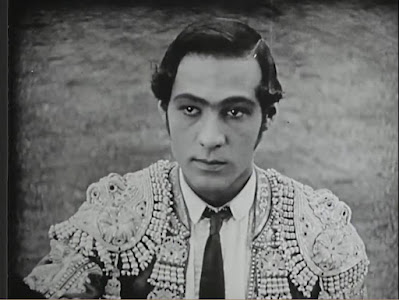
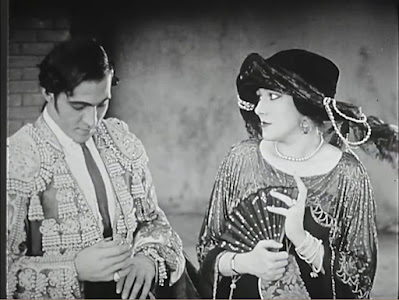
Enter Rodolfo Pietro Filiberto Raffaello Guglielmi di Valentina d'Antonguella for the opening screening of this year’s Nederland’s Silent Film Festival, playing a bullfighter and a Latin lover with a sexuality as exotic in his own way as Pola Negri (don’t mention the funeral) and other Europeans deployed by Hollywood to break boundaries and post-Victorian taboo. Valentino’s Juan Gallardo is driven by desire in life and love, and whilst being a masculine ideal is also at the mercy of his passions when torn between his true love Carmen the wanton Doña Sol, a spoilt, rich man-killing vamp who dominates and discards at will.


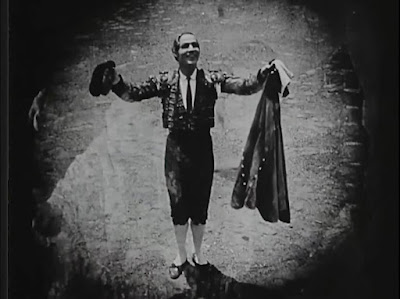
Blood and Sand leaves you emotionally rung with its derivative charm, wearing its Bizet firmly on its embroidered sleeve, elevated by superb performances and, as we now know, Dorothy Arzner’s innovative editing making us feel the heat of the bullfight even when matador, the bull and “the beast with ten thousand heads” are thousands of miles apart. As festival director, Daan van den Hurk said, no bulls were harmed in the making of this film, but it seems so purely because Arzner’s editing of stock bullfighting footage and Fred Niblo’s shots is seamless. The frenzy and the threat feel real as Juan takes on man and beast in a “sport” the film clearly disapproves of.


Daan was also multi-tasking, providing stirring accompaniment with the assistance of flamenco guitarist Tijn van der Sanden whose fleet fingered flourishes added diegetic immediacy to the film as well as dramatic flavouring. I loved the way the two worked together and it sounded fantastic on my new speakers, not as good as live but hopefully one day we’ll all be in the same room.
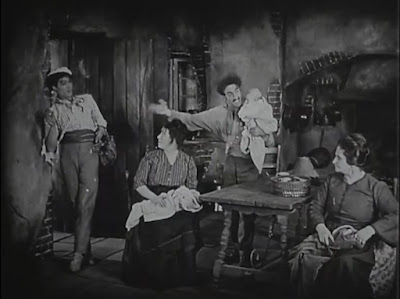
 

Meet the family


June Mathis wrote the screenplay based on Thomas Cushing’s smash hit play, which was itself formed from Vicente Blasco Ibáñez’ novel, Blood and Sand. It tells the tale of a poor boy from Seville, Juan (Valentino), “a son of the people” whose natural bravery enables him to become a toreador. His humble beginnings are set out complete with wise and loving mother Angustias (Rose Rosanova), sister Encarnacion (Rosita Marstini) and comedy brother-in-law Antonio (Leo White). Despite being called Zapaterin, Little Shoemaker, Juan has no interest in learning his father’s trade and dodges working with Antonio, a saddle maker, in order to go play at bullfighting.


Juan and friends head off to Andalucia where the locals enjoyed watching the amateurs from Seville. Juan does well but one of his friends is not so lucky with a watching bandit, Plumitas (Walter Long), accompanied by a title card noting that bandits and bullfighters both “risk life to gain a livelihood.” Juan avenges his friend’s demise and is not discouraged, dreaming of building his mother a fine house when and if he succeeds.


Naturally Juan gets talent spotted and ends up impressing the crowd mightily on his debut including his childhood sweetheart Carmen (Lila Lee) and the two grow close as his career advances and marry.


He searched deep into men’s hearts, ever willing to excuse weakness and, in a master ledger, recorded the lives of those who interested him.
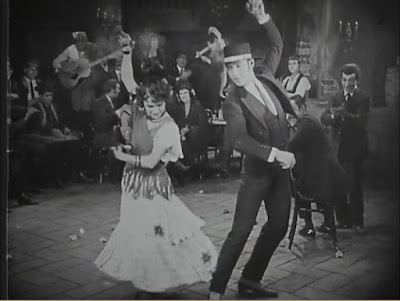

And he can dance...
 

Throughout proceedings, a local philosopher keeps popping up, almost at random… Don Joselito (Charles Belcher) “a student of humanity” who will act as a guide to the morality of events passing comment and offering advice… ultimately condemning bullfighting. That beast with ten thousand heads… the audience bloodlust driving the barbarism that costs lives.


Gallardo’s success makes him the idol of Seville’s café culture and he gains a manager (Fred Becker) along with a matador, El Nacional (George Field) who “fought for living and not for glory” as well as a popular picador, Potaje (Jack Winn) and old Carabato (Gilbert Clayton) who served Juan “in order to cling to the arena and retain his pigtail” – worn by the fraternity. The film may disapprove of the sport, but it takes a delight in the details.


There’s a lovely scene in one of those cafes when we get the chance to see Valentino dance – he had made his way initially in Hollywood by dancing and teaching dance – and you can see his poise on the dance floor alongside and a dancer named Rosa. The women gets just too close though and Juan’s loyalty to Carmen makes him push her onto the floor… it’s a foreshadow of things to come.
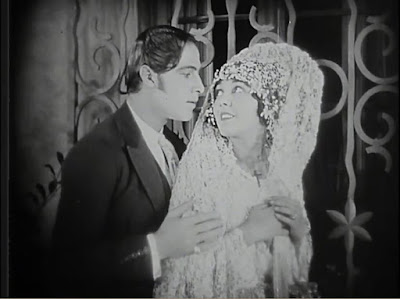

Rudolph and Lila Lee
 

Men were Doña Sol’s hobby. A bullfighter was a new experience.


Time passes and Juan is famous across Spain, and he catches the eye of the daughter of the country’s bull-breeder, Doña Sol, played by the “exotic” Nita Naldi, who was born Mary Nonna Dooley to Irish parents in New York…  Juan’s reaction to this new attention is primal, and he willingly accepts her gift of a ring given by Cleopatra to Ceasar… he’s flattered but still loyal to his wife, but Doña Sol is not easily dissuaded.


The two begin an affair, with Doña Sol dragging out the dark aggression in the man, a strange sadomasochistic edge to his fifty shades of betrayal. He doesn’t feel comfortable in her world of refined hypocrisy and artificial emotions, but he can’t resist the animal games she makes him play.


A page from Don Joselito’s book reads: Juan Gallardo has reached his goal. Will success spoil him or will his love for little Carmen overcome the plaudits of the populace and the cruelty of the national sport?


Which sets up the finale perfectly!

Rudolph and Nita Naldi

Blood and Sand has Glamour and Alvin Wyckoff’s cinematography captures some lovely atmospheres, Juan’s wooing of Carmen, the mock action in the stadia and the streets supposedly in Seville. Valentino has the star power and is able to convey humour as well as sexuality, he doesn’t take himself too seriously – an attractive feature for most of those watching – but he is passionate beyond reason when push comes to shove. Here his masculinity is used against him by the vamping Naldi… who else could carry this all off and still remain heroic?


The version screened was from a Lobster print of the David Killiam restoration which is shorter than the recent version released by Kino on Blu-ray. This has the tinting restored and comes in at over 25 minutes longer with a smashing score played by the Monte Alto Orchestra and a booklet including an essay from noted Valentino expert Donna Hill. Well worth purchasing if you haven’t got it!


And remember, as Don Joselito says, Happiness and prosperity built on cruelty and bloodshed cannot survive.


Monday, 5 March 2018

Unsolvable... The Mysterious Lady (1928) with Carl Davis and the Philharmonia Orchestra, Royal Festival Hall


In the stalls at the Festival Hall there was no option but to just sit back and surrender to Carl Davis’ sound and Greta Garbo’s fury; both were overwhelming in their own way and the result was a unity of music and expression that you won’t find in Cineworld.

Crossing Hungerford Bridge after the show, I heard a complaint that the score had been “too loud” and “ill-matched” to the action but this is an opera without words and Garbo is radiating the same intensity as a stage full of singers with Puccini on full volume. If you want your Swede’s subtle and “silent” then maybe try some Ingmar Bergman instead?

The tempo is set early on when Austrian solder Captain Karl von Raden (Conrad Nagel) gets a last-minute ticket for the opera and finds Tania Fedorova (Greta Garbo) elegantly draping herself over the edge of their box as she watches Tosca. Karl is mesmerised and can hardly focus on the events on stage and Mr Davis’ score cleverly captures this by accompanying the interplay between the two leads as well as the performance on stage, quoting from the opera itself. Allegedly it’s an uncredited Betty Blythe playing the opera singer, but Conrad only has eyes for Tania… just as she planned (the minx!).

He doesn't even need to see her face...
Tania was due to meet her cousin, but he fails to turn up and, what do you know, she’s left her purse at home… like any gentleman faced with such a situation, Captain Karl races to the rescue and escorts her home in a handsome cab. He almost leaves only to find he has Tania’s carefully forgotten silk, returning it to her he accepts her offer of a “coffee” and enters her apartment not only abandoning all hope of an early night but also leaving his cab driver to soak in the pouring rain. Director Fred Niblo plays this for laughs and thankfully keeps the drama mellow just as Garbo herself injects the odd twinkle among the smouldering.

It’s been a while since I watched Greta in Hollywood and you can fully understand the impact she had on the American public with a forthright sexuality that slinked and scolded and yet was self-determined and not fully revealed. As author Zadie Smith recently put it, Garbo exhibited an “inviable selfhood, ultimately impenetrable by other people.” Here as elsewhere, Garbo’s character has a secret and yet another secret beyond that too… In the first instance she is a Russian spy and she has deliberately targeted the young Captain in order to take advantage but it’s a role she takes far more intensely than necessary.

Conrad Nagel and Greta Garbo
We are in Vienna in 1910 and Europe is bracing itself for conflict as the Russians and Germans eye the Balkans and each other. After their night after the Opera and a “perfect day” in the sun, the Captain is informed of Tania’s day job and is suitably vexed. Karl has a vital package to take to Berlin and his career and many lives depend on it, but he’s followed by Tania who “comes to him as his lover and leaves as his enemy…” such a difficult woman this mysterious lady.

She has the secrets and Karl has a court martial, ritually humiliated in front of his regiment who turn their backs as he is stripped of insignias and medals before being thrown in jail for treason. He’s given a shot at redemption when released by his uncle Colonel Eric von Raden (Edward Connelly) who sets him up with a trip to Warsaw under the guise of a Serbian pianist.

Karl naturally finds Tania at a cocktail party and plays Vissi d’arte, their aria… she turns in shock to find him playing these dangerous chords and luckily decides to follow her heart. But Tania is under the wing of General Boris Alexandroff (Gustav von Seyffertitz) and whilst he won’t wait forever for her to surrender to his very limited charms, he is also very suspicious of the pretty pianist. And why does he keep on playing Pucccini?!


The Mysterious Lady is a symphony of Garbo in shimmering silk and magnificently shaded close ups - devised and shot by William H Daniels, who specialised in setting up that face for the most devastating effect.  It works optically of course but all the more so because of the specific mysteries of the actress’ expression; she is constantly wrong-footing the watcher’s expectations with distracted agitation and we look that bit harder almost seeking her reassurance. She rides the edge of defined emotional response in a way that haunts us still. Worn down by pretty much everything at this point in America, film critic Alexander Walker describes how Garbo managed to make her exhaustion look like "romantic agony..." and that "...no film so clearly shows that, for Garbo, passion was a form of tragic depression."

For his part Conrad Nagel was ill-served by the example of Lars Hanson in the surviving nine minutes of The Divine Woman shown before the main feature. Large Handsome can go toe-to-toe with his compatriot and even deluged in dozens of Garbo kisses and with the actress – shockingly and perhaps to him, surprisingly – grabbing him by the hair, he keeps on responding no doubt urged on by guttural Swedish encouragement from director Victor Sjostrom. Conrad’s no dummy but he is outshone by the divine energy of his co-star as were so many others.

Lars and Greta amidst the rough and tumble
Such a shame that only one reel of The Divine Woman survives but what an explosive section it is as Lars and Greta play forcefully for each other’s affections as the clock ticks away his last moments before he must depart with his regiment: they have only right now and, as it happens, so do we.

Carl Davis conducted his own scores and he had the full might of the Philharmonia crammed on stage with him – an 87-piece ensemble of intricate power augmented by piano, harp and possibly even the sink from Carl’s kitchen. The score referenced far beyond my limited experience of contemporary classical music but was as expertly constructed around image and acting as you would expect: you don’t need to understand the method just feel the results. As with actress so with composer.

The natural volume of such an orchestra is quite different from the amplified power of, say, Mogwai who I have also seen in the Royal Festival Hall (front row, right by the bass speaker…) but the results are the same minus the ringing ears. This is music with which you have a tangible connection and which, interwoven with the action on screen leaves you stirred and smiling as those silent film endorphins race around for a few hours still. 

Both these films are available on the Garbo Silents collection from TCM, but you haven’t really lived them until you’ve watched them in cinema with Carl’s band.
