Showing posts with label Bonn Silent Film Festival 2024. Show all posts

Friday, 30 August 2024

Sea song... Maria do Mar (1930), with Stephen Horne and Elizabeth-Jane Baldry, Bonn Silent Film Days 2024


This film announces itself as a dramatized documentary about the lives of fishermen from Nazaré, and is more fiction than the "controlled actuality" of Robert Flaherty even as it is clearly influenced by his approach.  It concerns a woman and a boat both called Maria do Mar which form the basis of a love story that splits a community in the then much smaller town on the Costa de Prata – a kind of pescatarian Romeo and Juliet in which the drama dominates leaving the documentary to filter through and infuse the overall entertainment.


Talking of which, for the accompaniment, Stephen Horne’s flute, piano and accordion is mixed with Elizabeth-Jane Baldry’s harp with telepathic cohesion as they ride the unfolding waves from stillness to storm. Elizabeth has only one instrument but a huge range of sound from the thunderous deep notes to the high-end beauty of her strings and the thumping dread of the harp’s frame. The two work so well together, extemporising in solo whilst coming together on pre-arranged loose themes and creating a mix that has such sympathetic force with the action on screen. This is another one I’d love to have seen live but thanks again to the Festival for streaming such treasures.


Villagers haul the boat ashore

All begins in the bright sun as José Leitão de Barros’ camera drifts over the bleached white streets of Nazaré, pointing at a Dutch angle down one long street, perhaps leading our eye back to the recent past. We see the fishing boat Maria do Mar – Maria of the Sea – as it arrives on the beach after a successful expedition. The people of the village rush down to pull the ship onto the sand and we get to meet some of the main characters, the captain Falacha (Alves da Cunha) and his daughter Maria (Rosa María) also of the sea. Then there’s one of his land-based team, Tia “Ilhôa” Aurélia (Adelina Abranches) and her young son Manuel (Oliveira Martins) who hasn’t gone to sea yet.


As the village hauls the ship and lands the catch there’s also some comic relief in the perpetually hungry Turkey (Álvaro Horta e Costa) and his weaselly pal Lacraio (António Duarte) along with host of weather-worn locals young and old whose character speaks as eloquently as the sand, sea and rocks around them.


The fishermen return to their small houses for lashings of freshly-cooked fish soup, cooked by Rosa and her mother (Perpetua dos Santos) and the older crew as they celebrate Falacha’s birthday. Events are cut short though as a storm is brewing and the Captain has to decide whether to save the nets – still set out at sea – before the force of the sea becomes unstoppable. There’s some good work from de Barros as the village is mobilised and all run down the whitewashed streets to the beach even as Ilhôa counsels against it – better to lose the nets than her husband. What the film lacks here in convincing special effects it makes up for with reaction shots from anxious villagers, some in close up others on rocky outcrop warning the fisherman to avoid a course too close to the treacherous outcrop.


Alves da Cunha

Murderer! It was your ambition that lost them!


It’s all to no avail though and the Maria do Mar is lost, seemingly with all hands, until a loan figure staggers out of the foam, the captain has survived. With so many dead, and her warning still painfully fresh, Ilhôa leads the complaints against Falacha who ultimately cannot bear the guilt and the next day, after prayers and family is not enough, he takes the only honourable course he feels he has left and drowns himself in the bleakest of fashions, walking into the sea leaving his wife and daughter behind.


Time passes with the two families bitterly divided by the tragedy as they carry on their lives with their men and main breadwinners, lost. Maria toils in the fields whilst Manual avoids the military draft being his mother’s only source of income – a scene which mixes pathos with some comedy as his mother places her tiny frame on the scales, the viewer in no doubt she’d be an asset in any battle.
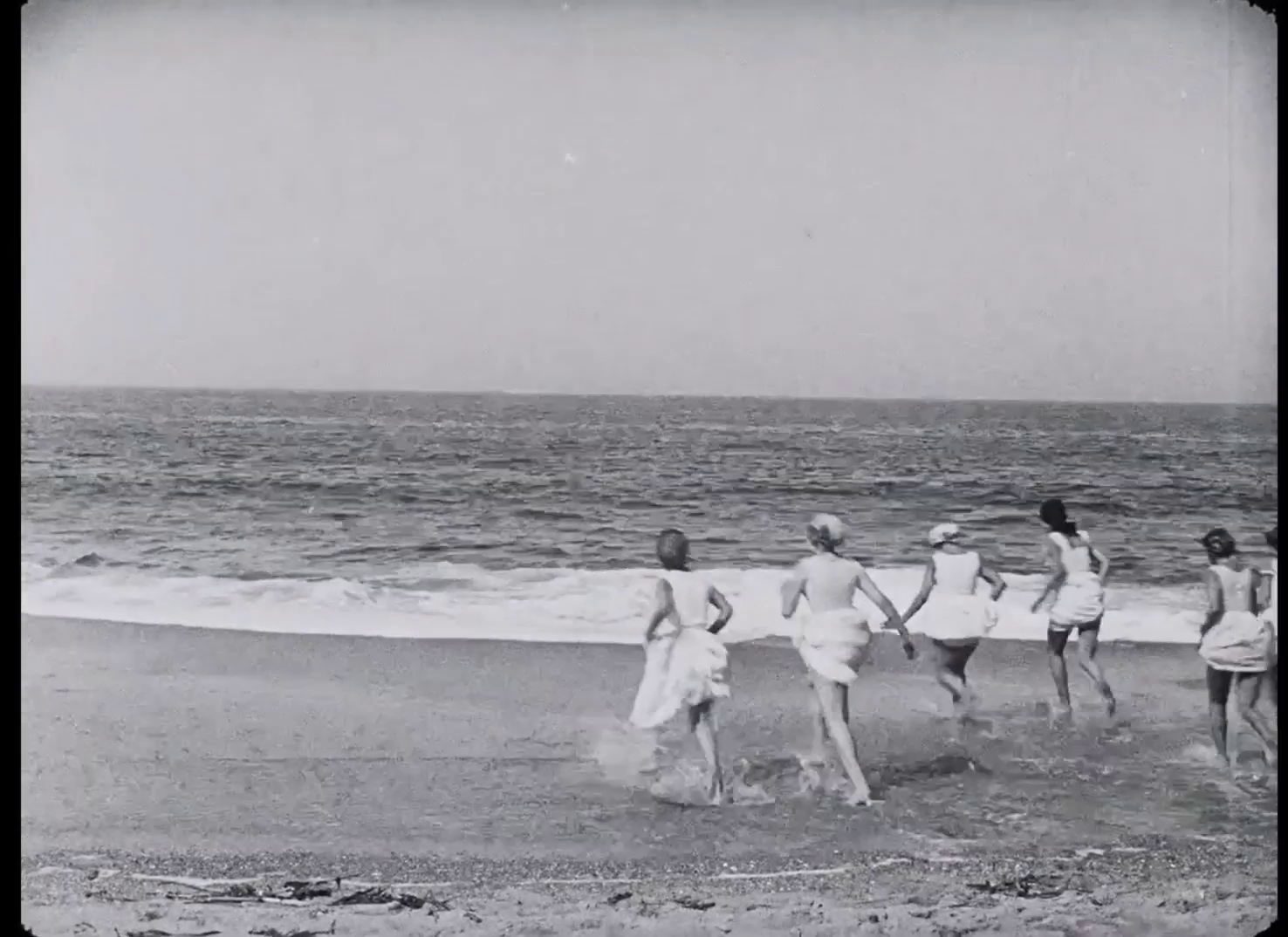


The mood shifts as we see Maria and her friends out on the beach, stripped down to their petticoats for a trip out on a boat and a swim. Amidst the sparkle of the water and the dazzle of the sun on their bleached underclothes, they don’t notice that one swimmer has drifted too far out and is in distress. Luckily a group of the young men are nearby and Manuel launches himself into the waves to save the young woman. de Barros makes this the most romantic of rescues, with lingering shots of the muscularity of Manuel and Maria’s partially exposed body hung limp with near exhaustion. It’s like a ballet as they drop silently to the sand having pulled free of the sea and only then does the boy realise exactly who he has saved.


No brave deed goes unrewarded or, in this case, unpunished, as the couple are brought close as they were always destined to do whilst their mothers resist with all their might, Ilhôa even bringing in an enchantress to cast a curse on the doorstep of her neighbour – none of us can pretend that’s something we’ve never considered… The push and pull grows stronger though and you’ll have to watch it for yourself to see if love can prevail against this harsh and, literally, unforgiving environment.


Rosa María and Oliveira Martins

It's a beautiful film and one that presents its ethnography in the most stylised of ways with huge close-ups of the people adding to the natural scale and serving to sensitise the individual conflicts and love. I can see why it is considered one of the most significant Portuguese silent films and how it is influenced by other European techniques even as it creates that unique flavour. One of the most striking things about silent film is how the new media reflects the traditions of storytelling, performance and national style. Never since have we had the same freshness of transition with each generation relying on previous cinematic technique which here, we see for almost the first time.


In the notes, Patrica Viera is quoted* linking the film to the burgeoning Salazarism movement with the idea that “… society was the reproduction of nature in the realm of human relations”. There was an emphasis on “natural cinema” showing the Portuguese living naturally and “habitually” all of which would serve a more conservative mindset as António de Oliveira Salaza came to power in 1932 and went on to serve as Prime Minister until 1968. But that’s a different story: silent film is always an education.


The film was restored by Cinemateca Portuguesa in 2021 and along with the sublime accompaniment I hope again that we get to see this all on the big screen in the UK.


* Patricia Vieira: Portuguese Film, 1930-1960. The Staging of the New State Regime. New York, London 2013


Monday, 26 August 2024

Obscured desire. The Woman and the Puppet (1929), with Günter A. Buchwald, Bonn Silent Film Festival 2024


My sweet, can’t you just be satisfied with everything I’ve already given you? … my entire body is yours to hold and caress… Isn’t it enough, all that? In that case, perhaps it’s not me that you love, but only what I refuse to let you have?

Pierre Louÿs, La femme et le pantin (1898)


Every so often a silent film not only surprises you but pulls you to the edge of your armchair and has you blinking at the screen in delight. So, it is with the story and the actress in La femme et le pantin (1929) in which Conchita Montenegro’s dancer not only beguiles and bewilders her puppet, Don Mateo, she completely un-mans him in the most feminist of ways reaching right out from 1929 with dazzling power and beauty. If anyone has a thousand ships that need launching… here’s your woman!


Based on Pierre Louÿs’ 1898 novel of the same name, the story was adapted as an opera in 1911 by composer Riccardo Zandonai, before its first film version in 1920, an American film directed by Reginald Barker and starring Geraldine Farrar – which it’s hard to imagine having the same force as this version directed by Jacques de Baroncelli. The story is also a familiar one as it was also filmed as That Obscure Object of Desire (Cet obscur objet du désir) (1977) by Luis Buñuel but… imagine some of that director’s intentions and frankness being on display half a century before? de Baroncelli is that bold as, indeed, is his star performer and, looking up on Louÿs’ background of erotic prose and poetry, the man to whom Oscar Wilde dedicated the original French publication of Salome, and who signed a copy of Dorian Grey* to thank him for his revision of the book's manuscript… it’s difficult to see anything like a literal adaptation being made anywhere else but France at this time.


Tristan Sévère

The film transgresses in so many ways, not least the obvious ones with Montenegro dancing in the nude, with nothing left to the imagination save for that which her syncopated physicality implies, which, for a seventeen-year-old, comes with an extra layer of “obscurity” for modern audiences even if perhaps less so at the time? That said, the man she entrances is described as an ageing aristocrat here played by Tristan Sévère who was only 25 but greyed up, with Don Mateo being 37 in the book whilst Conchita is just 15.


Where The Woman and the Puppet really differentiates it’s risk-taking is in giving Conchita almost complete agency and not simply in a vampy way – no evil Theda here – but with a character who knows the measure of her man and who isn’t toying with him she is stress-testing his love to destruction if required. This is not so much in revenge for his daring to acquire her but a genuine mission to establish the truth of their relationship or at least that’s the way it seemed to me on a single viewing.


The film begins with an image of four female dancers bouncing a male puppet up and down on a blanket stretched between them. This is taken from a painting by Francisco de Goya y Lucientes, The Straw Maniken, (1791–92) which is, now as then, in the Museo del Prado in Madrid and which, in the book, Don Mateo refers to while lamenting how Concha treats him. Here it is re-enacted with Conchita holding one edge and Don Mateo twisted in flaccid rage just as the puppet… he can’t live with her and he can’t live without. He wants the one he can’t have, and it’s driving him mad as Stephen Morrisey sang sometime later.


 Don Mateo being all manly

This madness begins, as does so much, on a train journey and there’s a magnificent shot of a steam train set against the alpine snow on which we find the jaded Don Mateo “notorious throughout Spain for his fortune and his female conquests”. Accompanied by his friend André Stinvenol (Henri Lévêque) he goes to watch the Spanish dancers in third class where he interrupts a fight between an older woman played by Andrée Canti with whom I would not mess and a ferocious yet out-matched Conchita Perez, who is afraid of no one and, after laughing at her opponents dancing, mocked her still further with her own dance.


I kissed you because I liked you but you can’t kiss me without loving me!


Don Mateo is captivated for all the humdrum reasons men usually are – and my Gen Z daughter was pretty frank on this point viewing the film… but their moment ends on the train. Months later at a lavish party in his villa, Conchita makes her way in to say hello and to tell him where she lives in Calle Monteros with her mother. Don Mateo duly goes to visit only to be befuddled by Concha’s pulling away when he tries to take her affection for granted. Nevertheless she invites him back and he is soon “madly in love” with this very young woman who is so far below his social class and yet exerts such power.


Don Mateo tells her mother that he wants to make Concha “part of his life” and the young woman having seen him hand over a sum of money, then flies into a rage with both parent and paramour; “I longed to give myself to you. You wanted to buy me.” As Paola Cristalli, quoted in the programme notes, observed in 2020: “There is always something that stands between Don Mateo’s gaze and the object of his attraction…” but it is also his own failure to truly understand her and his inability to communicate. It is incapacity to trust and, knowing him a jealous man, Conchita uses a friend’s lover to push and test still further.


Even when Don Mateo finally cracks and resorts to the violence we always expected, she makes him pay in her own time even after telling him it is a sign of his true affection. It’s not, he is reduced by the aggression and shows that the kind of love she needs is beyond him on the basest of human levels.


If this makes the film sound frustrating it is anything but with good performances from the support and this amazing central display of nuanced force from Montenegro. Is the nude rude as Nell Shipman’s self-promotion asked a decade before? It’s gratuitous of course, but it does show that Concha has some level of control even when she makes this decision – the men watching her are diminished and, of course, Don Mateo falls short yet again in his response. A complex and unexpectedly challenging film that reminds us once again to never under-estimate the makers of these films.


For the live screening Günter A. Buchwald on piano and violin was accompanied by Frank Bockius on percussion but the live stream had Günter’s magnificent new score played by himself and orchestra. I really hope there’s another chance to view and here this in the UK or Italy. Restored in 2020, it’s one of the standout discoveries – for me – of the last few years.


Conchita Montenegro abides...


*Recently sold at Christies, details here!


**PaolaCristalli’s notes for an August 2020 screening in Bologna.


Goya's Puppet


Tuesday, 20 August 2024

Anata no ai wa kaenai... In the Shadow of Yoshiwara (1928), with Sabrina Zimmerman & Mark Pogolski, Bonn Silent Film Festival 2024


Yoshiwara: wine and women, the place of pleasure and market of love…


Teinosuke Kinugasa’s film came some two years after his ground smashing A Page of Madness (1926), described by some bloke on IMDB as “hardly a crowd pleaser” although I’d have to say this depends on the crowd. In the Shadow of Yoshiwara aka Jūjiro (Crossroads) became the most widely distributed Japanese film overseas up to that point with the director/writer bringing a copy himself on the Trans-Siberian Express.


Clearly influenced by European cinema in terms of his use of shadows, double and multiple exposure, Kinugasa also cut quickly and used montage to heighten moments of dramatic tension. This copy features German and English translation and so it’s unlikely it was from a print screened with Benshi and is possibly from the original German release in Berlin, as Im Schatten des Yoshiwara (The Shadows of Yoshiwara). The style of performance is altogether home-grown with exaggerated, febrile movements accompanying extended expression – heads are thrown back in evil laughter and bodies shake with anger and sadness. It’s a mix of the heavily stylized Kabuki theatrical tradition with more western-styled film acting and it makes this film the opposite of say Yasujirō Ozu whose Dreams of Youth was released in the same year.


Yoshiwara is set in the red-light district of Tokyo and it’s a studio-bound just like a UFA film and benefits from the atmospheric compression this brings – is this a subconscious awareness or are our eyes just so hard to fool even in a mostly darkened set. A young man (Junosuke Bando) has made the classic mistake of falling for a courtesan, in this case O-ume, the beauty of Yoshiwara (Yukiko Ogawa). He returns home to the rooms he shares with his sister (‍Akiko Chihaya) battered and upset after fighting for his love with men who clearly are not of the romantic persuasion.


Junosuke Bando

Don’t go out today, stay with me brother…


The sister is calm in both her emoting and response to his hysteria, making sure their door is locked – it isn’t as their landlord pops his head in to ask if they’re alright – and trying to prevent her brother from further exposing himself to danger. The young man just can’t help himself and rushes off taking a newly made kimono she has made as a token to impress O-ume… It is genuinely pathetic and watching his desperation to win the heart of this woman who no doubt cannot afford to reciprocate, is painful.


Firstly, he is struck to the ground by one of the shogun patrons and he lies on the ground terrified of returning the challenge and then, a more evenly matched opponent, the one he bested the night before (Keinosuke Sawada as Myoichiro Ozawa) takes his chance for revenge by pouring hit ash on his face. The boy is blinded and if he expected any sympathy he’s in the wrong place as he cries out for O-ume, lashing around before confronting his hateful rival and, striking without thought, or direction, believing he has killed him.


He runs off in the direction of home as the other man bounces up to reveal that he was only pretending… the brothel erupts in laughter and heads are thrown back with evil relish. The contrast with his sister’s compassion could not be greater and when a doctor offers hope that he may be able to regain his sight if she is able to pay for treatment she is faced with only one option… She goes to see the local “procuress” (Yoshie Nakagawa) who will be able to set her up with potential clients willing to pay for her favours and, worse still, there toothless policeman – a revoltingly-leary Minoru Takase (as Ippei Sōma) – is willing to go to the head of the queue.


Akiko Chihaya


What hope is there for these two in a world in which there is a price for everything and honour is so casually thrown away in exchange for power and possession.


Reading William O. Gardner’s observations in the catalogue, Kinugasa was drawing parallels in this story set in 1850 during the late period of Edo Japan with the modern consumerist society that Japan had become by this point when it was still a laissez-faire liberal democracy, albeit one beginning to restrict opposition with an establishment concerned about the relatively swift changes in society. The filmmaker saw “…an “entertainment” world made possible by an advanced money economy…” and the desperation of the ordinary working people to take part not only in the past but in the economically stricken period of the 1920s.


In this context, when there’s a price to be paid for sight and love no wonder some of the poorest people are crushed in front of our very eyes.


Accompaniment on the stream was from Sabrina Zimmerman on piano and Mark Pogolski on violin who matched the intensity on screen and reached through to the turmoil of the young siblings faced with a choice between madness and self-obliteration. Not the easiest of watches but a very impactful experience.


1 William O. Gardner: New Perceptions: Kinugasa Teinosuke’s Films and Japanese Modernism, in: Cinema Journal, Vol. 43, No. 3, 2004


‍

The crossroads...


Monday, 19 August 2024

Bodhisattva... The Light of Asia (1925), with Willy Schwartz & Riccardo Castagnola, Bonn Silent Film Festival 2024


This unique film was produced entirely in India without aid of studio sets, artificial lights, artificial properties or make ups…


This proclaims one of the introductory title cards for The Light of Asia/ Prem Sanyas (Love or Asceticism) the first of the famous three collaborations between German director Franz Osten and the Indian lead actor and producer Himansu Rai, the others being Shiraz (1928) and A Throw of Dice (1929). Based on Sir Edwin Arnold’s book, The Light of Asia (1879), which tells the story of how Prince Siddhartha Gautama became the Buddha or the "Enlightened one" and founded Buddhism; it’s Buddhist in tone as well as content, a very vegetarian film and one in which kindness is its own reward. Osten and Rai’s next two films would feature Islamic and then Hindu storylines, reflecting the Sub-Continent’s cultural breadth and something which would be sadly more controversial today. The adaptation is from Niranjan Pal and features “specially selected titles from Sir Edwin Arnold’s masterpiece…” which add to the lyrical quality of this spectacular yet peaceful journey – Namaste as my mate Alan the Buddhist would say.


Rai’s face is now so familiar to me that I almost feel I know him along with the other star of all three films, Seeta Devi. The Anglo-Indian actor, born Renée Smith, matures a lot between this film, when she was only thirteen, and the other two and, whilst it’s only make believe, as with Loretta Young for example, only just 15 when Laugh, Clown, Laugh (1928) was released, it’s rather disconcerting. The producers knew as much when she was described as sixteen in the publicity for a film that did well in Europe and elsewhere.


That said, the love on display is rather chaste and spiritual, at the end of the day, this is a beautifully made epic featuring an all-Indian/Anglo-Indian cast of thousands, plus elephants, camels and a world-class crew mostly from Germany, is still a joy to watch. Shot entirely on location against a backdrop of some of the most glorious architecture, including that owned by the Maharajah of Jaipur who funded the film, as well as ordinary streets the Prem Sanyas is as much a travelogue as it is a fantasy.


Seeta Devi and Himansu Rai

The film starts with an elephant roar and scenes of contemporary Delhi (shooting was mostly in Lahore, in what is now Pakistan) following some of the Europeans attracted to the “romantic” country to see the land of many wonders and many contrasts. These are the crowded streets my Grandfather Bill experienced as a teenage conscript in 1918, an experience that was to change his view of empire and British society, and it’s striking to think of the lad from Widnes walking these pathways.


Then there is the Jumma-Musjid, then the largest place of worship in the Islamic or indeed any, world towering over the teeming worshipers as a tram passes advertising Dunlop Tyres… wonders and contrasts indeed! Next we see Benares, one of the oldest cities in the world and regarded by the “Hindoo” as the Holy of Holies. Onto the Temple of Buddha-Gaya, 16, not 17 centuries old and the Bodhi Tree – the Tree of Knowledge – under which Buddha sheltered for 40 days and nights to find a cure for human sorrows.


A group of tourists asks a holy man about Buddha and we cut back to two and a half thousand years – the Iron Age in Britain but an age of palaces and princes in India when there was a consolidation of smaller chiefdoms into larger states accompanied by increased urbanization and the rise of new religious movements including Jainism and Buddhism. Against the backdrop of medieval and more recent architecture used in the film, you marvel not only at how India has changed but how enduring aspects of its culture and style have remained whilst “we” still lived in huts and villages.


Temple of Buddha-Gaya, dating from 5th/6th Century

Any road up, in one such palace their lived a King Suddhodhana (Sarada Ukil) and his queen (Rani Bala) who were sorely in need of a male heir and were even so desperate as to use the traditional method of getting a sacred elephant to choose a worthy lad from the streets but, in this case the animal, having found someone sensed no need as months later a son was born to the queen who promptly died.


The young man grew up to be Gautama (Rai) a noble and a pure-hearted, noble prince he was too, stopping the royal hunt when he saw the carnage and rebuking his cousin and rival, Devadatta (Profulla Roy) for wanting to continue the bloodshed. Soon after the King has a dream which his mystics interpret as meaning his son will renounce the throne in order to pursue a holy path or service and reciprocal altruism. You can’t fight fate but the King tries by keeping his son free of the outside world and the suffering to be found there.


The King has also tried to get his son interested in the opposite sex but it is only when they visit a noble neighbour, King Dandapani, that Gautama experiences love at first sight with Gopa (Seeta Devi). To truly win the young princesses hand and heart he has to defeat all comers in a contest involving three challenges: picking a feather from the ground on a racing horseback, shooting an arrow at a drum blind-folded and them pushing his opponent – that Evil Cousin again – off his horse using a lance but without injuring him. This is all filmed in a large arena with all the finery and thousands of locals as extras, the Maharajah of Jaipur honouring his forebears.


Having won fair maiden we now get the marriage between the two observed in detail with traditional finery and a magnificent wedding march they seem set for cosseted contentment… Gradually Gautama gets restless and insists on a visit through the streets of the city and, whilst the King forbids the present of the old and the sick – on pain of death – he can’t hide them all and, for the first time, the young prince glimpses reality. Seeking answers, he resolves to leave the royal compound and, giving away his clothes to a humble beggar sets of in search of enlightenment in the world of men.


This is the night, choose thou the way of greatness or the way of good…


Himansu Rai provides a highly accomplished lead especially for a man who had initially wanted to become a barrister in London and he and the Indian Players, followed by Bombay Talkies were to advance Indian cinema learning from their shared experience with western crew and production companies.


Interestingly according to Veronika Fuechtner, in The Many Faces of Weimar Cinema (2013)* whilst Devi continued in silent film, she did not speak Hindi being English educated and so wasn’t able to continue in talkies. Fuechtner also points out that the Anglo-Indian community were less prejudiced against acting as a profession even as they were viewed as rather upper class. It’s not unusual to see men playing women in Indian cinema of the silent period but not so with Osten and Rai.


Accompaniment for the live screening was provided by ‍Cellophon featuring Paul Rittel and Tobias Stutz (Cello duo) but for this online stream it was Willy Schwartz and Riccardo Castagnola who combined a mix of traditional Indian instruments all played and composed by Schwarz, with Castagnola’s more contemporary electronica adding to the magical mix.


The streaming also used a different material with a rare 35mm print of the German version from the collection of the Friedrich Wilhelm Murnau Foundation was screened whilst for those of us lazy souls online we got the restored English version, digitised by DFF in 2013, which looked great but… analogue dreams.


*Available from Amazon and other tax-paying booksellers.