Pola Negri – Asta from Poland
Buffalo Bill…
She is a star in our homeland
Buffalo Bill…
Warsaw cabaret song circa 1917
Before Germany, before Hollywood, her fellow Poles were already comparing Pola Negri with the Danish superstar Asta Nielsen and you can see just why in Bestia aka The Polish Dancer (1917) in which she does an even raunchier version of the Apache Dance featured by Asta in her breakout success, Afgrunden (1910). Bestia is the oldest surviving Pola Negri film but it’s also the only survivor of her Polish films made from 1914 to 1917 when she moved to Berlin to appear in a German revival of Max Reinhardt's theatre production of Sumurun – having already been in a successful Polish run of this play in 1913. In Berlin she met Ernst Lubitsch, and the rest is history but even in Warsaw, we can already see the actor/dancer’s star power and her ability to emote as if everyone is looking and she just doesn’t care.
Pola plays Pola Basznikow, a young woman who enjoys the
party life much to the annoyance of her father who paces around in a fury as
Pola dances and drinks with friends. After a blazing row with her father, Pola
decides to leave and enlists the help of her friend Dymitr help. The couple
stay at an hotel run by his untrustworthy friends and, sensing they’ll be
looking for her to pay her way, she “borrows” Dymitr’s money and heads off on
her own to Warsaw leaving the young man with vengeance filling in his heart and
an empty wallet. He swears revenge.
 |
| The Polish dancers |
In the big city she is soon spotted and makes her way on
stage becoming involved with rich married men with too much money and not
enough restraint. She’s living la Vida Loco but what goes up must come down in
the language of most film of this time.
Pola is also showing her increasing screen impact and deathly side-eye in the recently rediscovered Die Marchesa D’Armiani (DE 1920) directed by Alfred Halm. Only the first half of the film survives but it’s enough to show her on top form as Assunta, the titular Marchesa who torments and seduces Lothar von Raff (Fritz Schulz) the son of the police chief who ruined her mother’s life as part of a plan to get revenge. This sins of the parents are passed onto these helpless offspring and whatever cruelty Assunta can devise we know there’s worse to come… at least we do if we read Jay Weissberg’s essay in the Catalogue!
John Sweeney accompanied with melding music and mood in ways
that seem almost unconscious but are very deliberate. Talent and unending
practice moves his hands along with Pola’s eyes, dance and darkening heart…

You might think that the arrival of Pola, Nazimova and Garbo
from the decadent old countries might have signalled the end of The Griffith
Girls and a certain type of childlike women whose stories were usually about
love and not sex. You might think that… but never right off the Irish! Colleen
Moore – who had an Irish Granny (like most of us) was the evening star
featuring in Her Wild Oat (1927) screening as part of the Marshall
Neilan strand.
Moore had been one of Griffith stars and whilst she lacked the looks of some, the acting skills of others (maybe?), she was overloaded with charm and pure pep! It is not possible to watch Colleen Moore and not fall in love with her characters: she has depth and human frailty that wins you over every time and yet she’s never mawkish or phoney. This is a magical skill and one that enables even run of the mill narratives to succeed.
Here she plays Mary Lou Smith, a regular working girl who runs a low-margin street stall selling coffee and eats to help the city keep on moving. It was her second film with Neilan after the under-rated Dinty (1920) and despite the appearance of a low budget, he ups the comedy and let’s her do the rest as the appearance on night of Philip Latour a handsome young man with overalls and no money (Larry Kent) offers her the hope of love and maybe more if she only knew?
There’s good support form Gwen Lee as her sassy, steadfast friend Daisy and Hallam Cooley as her journalist pal Tommy who almost gets her into too much of a “story”. It’s slight but snappy and there’s one of the best scenes of dialogue between two dogs at the end: these people knew exactly what they were doing – a hit!!

Today’s stunning rail journeys continued with New Brooklyn to New York via Brooklyn Bridge, no. 1 (1899!!) directed by James H. White (probably) and which showed the innards of this magnificent construct, opened in opened on May 24, 1883, and traversed by me on foot in 1987… There’s something about the optimism of travel especially when it celebrates engineering accomplishments. We need more of these films!
The evening finished off with a couple of comedy shorts written and directed by Neilan and proved how repetitive and coarse the genre could be no matter the undoubted skills involved. The Reformation of Ham (1914) featured and extended scrap between Ham and Shorty two ornery shipmates whilst Love, Oil & Grease (1914) actually had a plot but again featured an extended battle between Ham and his other buddy, Bud which was largely irrelevant to the fraternal battle between two siblings to out compete each other’s car company.
Donald Sosin played throughout the evening and deserves some kind of medal!
 |
| And engineering marvel that is still in use... |
Earlier in the day there was more stunning phantom train riding
with Schwebebahn (DE 1902) showing the Single-Rail Hanging Railway,
System of Eugen Langen, named after its inventor, Eugen Langen which is in Wuppertal,
in western Germany and is the oldest electric elevated railway with hanging
cars in the world. As it is it looks like the most made-up AI steam punk but
no, it’s real and it’s a marvel’
Next a Phantom Film in the form of a couple of short
fragments of FW Murnau’s otherwise lost film Satanas (DE 1920) which
looked very louche and decadent with Fritz Kortner being “cuddled” by Sadjah
Gezza in three takes? and Conrad Veidt at his most protean in a silver wig that
would become fashionable for 50 more years. We need more, of course we do!
 |
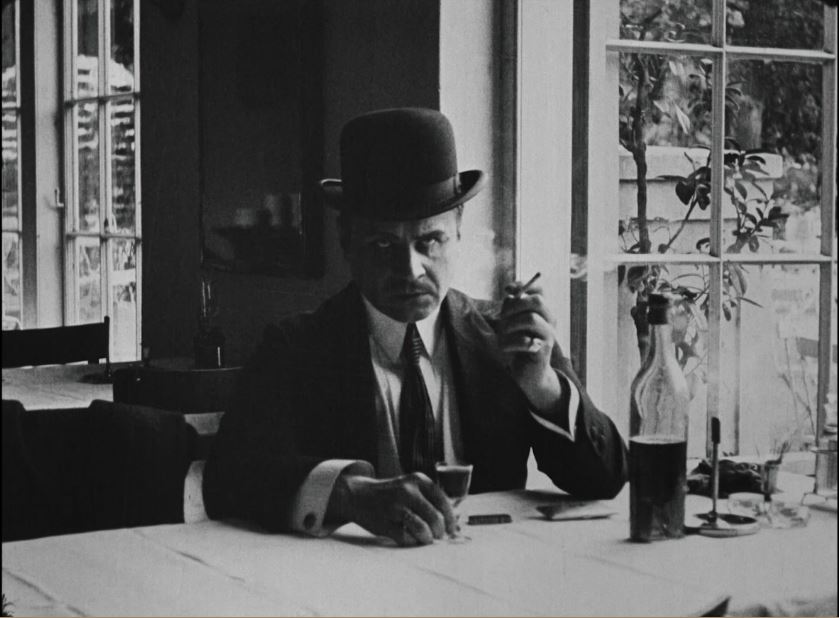
| Paul Rehkopf is Teufel! |
Talk of The Devil, you wait ages for a Weimar film in which
he features and then, like trains and trams, two arrive at almost the same
time. So it was that we experienced Die Teufelskirche (DE 1919?) a fever
dream of satanic visitation set in a rural community (literally so for the man
in Seat Funf in the front row of the 2nd balcony…). Adapted by Adolf
Paul from his 1906 play of the same
name, the story had focused on transgressive themes of free love, sexual expression
and the hypocrisy of bourgeoise morality, the film still has trace elements of
this daring agenda.
The Devil enters a small village disguised as a tinker aiming to make himself useful. He meets a farmer's wife, Frau Ane (Agnes Straub looking very much the part), and playing on her longing for a child strikes a deal with her in exchange for her wish for motherhood to come true. As part of this unholy bargain she must pass his message onto the community and this, naturally involves her seducing the priest (Hans Mierendorff) who builds a new church dedicated to the fallen one after his church is devoured by flames. Ane's cottage is also consumed much to her husband's despair... this Tinker is only using their misery to undermine their fragile order. Think of him like modern social media, or Fox News...
Directed by Hans Mierendorff it may or may not be all a
dream but, as always, The Devil is in the details. The Devil also has all the
best tunes and Günter Buchwald, on piano and fiddle _ the Devil’s favourite
strings! and Frank Bockius on percussion had a great time with this: think Hellzapoppin
without so much swing!
There was also time to marvel once again at the imagination and craftsmanship of Dave Fleischer’s animations with three films featuring Koko the Clown and his pal - Koko’s Catch (1928). Koko’s Klock (1927) and Koko’s Tattoo (1928) – it’s a cat which is, of course a bad idea when everything drawn comes to life and moves!
The accompaniment was really something special with the Orchestra della Scuola di Musica Città di Cordenons and Ensemble Armonia combining to give a modern child’s musical view of these eternally interesting ‘toons. Good job all round kids and grown-ups of all ages!
 |
| Agnes Straub breaks several deadly sins in mere moments |
The most affecting parts of the schedule came from “Female
Madness” part of a strand curated by Pordenone’s Collegium alumni and which achieved
the difficult task of addressing this subject in an historical way and using
works of documentary and fiction to show how the subject was treated. Feminism
and Foucault come to minds in terms of how these prime sources provide a
measure of our compassion and understanding then and now.
The medical films of Vincenzo Neri (1908-28) as well as La Pitié-Salpêtrière
University hospital footage showed people with various muscular ticks and stims
– one can only guess at the cause and yet the filmmakers hoped to use the film
as an aid to diagnosis. My daughter works in advancing Assistive Technology and
this is an early form of a much larger visual discipline now. There was a
character screen test for actor Eve Fracis from Alberto Cavalcanti and Jacques
de Baroncelli which bridged the gap between the medical and the performative.
The audience were unsure and not relaxed enough to clap in the usual way.
 |
| Madcap Asta |
It was remarkable programming as we moved in to Germaine
Dulac’s ÂMES DE FOUS (FR 1918), Louis Feuillade’s LE VIOLON (FR 1908), Max Mack’s
ZWEIMAL GELEBT (DE 1912) and then Edmund Edel’s DAS VERSUCHSKANINCHEN (DE 1917)
for which the words “zany” or “madcap” may have been invented. The Guinea Pig
(Das Versuchskaninchen) finds Asta Neilsen, who was 32, playing a teenager
called Jesta who is low on attention span and high on energy constantly
frustrating her father (Alfred Kuehne) and coming between him and his fiancée.
Amazingly, Jesta has a love of her own, played by Fred Immler who seems normal
enough but clearly likes her sense of humour.
Tiring of been worn down by his daughter’s constant comedy,
Dad decides to send her off to a strict school but, due to various mishaps, she
ends up at a lunatic asylum where the doctor quickly diagnoses insanity and
proceeds to try and treat her using the modern of methods including electric
shock treatment and a padded cell. It’s largely not funny anymore but still
interesting to see Asta playing in a weird kind of Mary Pickford role and one
that is uncomfortable in an age when we are still coming to terms with mental
disabilities.
Sometimes the visuals speak so loudly it’s hard to do anything
other than watch and Daan van den Hurk’s piano accompaniment was spot on.
The programmers say in the notes: “… we hope these film
present a thought-provoking set of representations that demystify how silent
cinema shaped, and was shaped by, ideas about women and madness that emerged at
the intersection of reality and fiction.”
Seif Abdo, Daniel Lawrence
Aufmann, Ellen Cleary, Hugo Ljungback and Matteo Masi
I missed THE SECOND SINO-JAPANESE WAR IN TOY FILMS DCP, 102'23" with Günter Buchwald on
piano accompaniment!
 |
| Asta is so meta in Bestia... her room full of her posters! |