Saturday, 17 August 2019

Boxing match… Early Women Film Makers, BFI Blu-ray release


‘There is nothing connected with staging of a motion picture that a woman cannot do as easily as a man and there is no reason why she cannot completely master every technicality of the art.’ Alice Guy Blaché

Like London buses, you wait years for a box set of early women film pioneers and then four of them arrive almost all at once. This BFI set is the latest and for those wondering which to buy I’m here to make the case for this over Flicker Alley, Lobster and even Kino Lorber, although in the latter case you really should buy both with the caveat that the Blu-ray version, which has the most content, is Region A and you'll need a compatible player.

Making an American Citizen (1912), unique to the BFI set
The Kino set is six Blu-ray discs and, of course, has a greater range of material than the others but it dovetails pretty well with the BFI set and together they give you 8-9 discs of unique, must have, material from an era that is only now being fully rediscovered. Even in the span of my relatively recent interest in early film, the directors in this set have been re-evaluated with pioneers like Guy Blaché and hugely popular filmmakers like Lois Webber been restored to their rightful position. There are some great films on these sets and they help to broaden our appreciation of the new media as one not just dominated by Méliès, Griffith, de Mille et al.

Kino goes long on Alice Guy Blaché with 14 films from 1911 to 1913 of which the BFI replicates five and adds two, Making an American Citizen (1912) and The Girl in the Armchair (1912). Only Flicker Alley covers her earlier work with Les Chiens Savants (1902), Une Histoire roulante (1906) and La Barricade (1907).

Guy Blaché's utterly lovely Falling Leaves (1912)
Guy Blaché pretty much invented narrative film making as Pamela Hutchinson explains in her essay in the excellent BFI booklet which also allows the contributors to comment on each film. There are two films not covered on Kino, Making an American Citizen (1912) and The Girl in the Armchair (1912) with the former taking the director’s experience of immigration and turning it into a proto-feminist fable. As PH notes, equality in marriage is a condition of acceptance in the new country, and the heroine, played by Blanche Cornwall, sees her husband Ivan abandon his domineering Euro-bullying to fit in with the New World after various American men step in to force him to adjust his behaviour.

It’s not just the fact of these films but their themes; there is a different sensibility at work and a willingness to tackle subjects from within rather from on high (and yes, DW, I’m looking at you).

Claire Windsor and Louis Calhern in The Blot (1921)
Nowhere is this more in evidence than in the films of Lois Webber whose work often contains a depth and intimacy that others lack. The BFI set includes The Blot (1921) which is not only one of her best but also one of the most impressive character-based dramas from the period, its tale of bourgeois poverty trap, neighbourly jealousy and conflicted love delivered by superb performances especially from Webber discovery Claire Windsor as the librarian at the centre of a love triangle between an educated but poor theology student and a wealthy Phil West played by Louis Calhern (who I’ve just seen in the BFI’s smashing restoration of Notorious (1946)). Her mother is also well played by Margaret McWade who hangs on in quiet desperation as the family suffers daily humiliation from their immigrant neighbours who make a healthy living through trade. There’s no right or wrong to either side and Webber’s take is sophisticated to stand the test of time better than Griffith’s Victorian morality tales.

Triangulated tension - Lois top right in Suspense (1913)
Webber tackles social issues with an even-handedness that eludes many and Discontent (1916) about an old man who is happier in his old soldiers’ home than with his well-intentioned relations, is another example. Her technical skill and innovation are also evidenced by a crisp restoration of the superb Suspense (1913) famous for its three-way split screen and overhead point-of-view shots: it’s a genuinely pioneering and tense story of home invasion on a par with anything coming out of Biograph.

Kino has 13 Lois Webber films including noteworthy features such as Too Wise Wives (1921), Hypocrites (1915) and Where Are My Children? (1916) yet, apart from the spectacular Suspense (1913), the BFI disc alone includes Discontent (1916) and The Blot (1921). I’m beginning to suspect collusion…

Here's Mabel!
The BFI set gives you by far the most Mabel for your money with five films of which Mabel's Dramatic Career (1913, 14 mins), His Trysting Place (1914, 22 mins) and the magnificent late period riot Should Men Walk Home? (1928, 28 mins) are unique to the BFI set. Mabel’s a marvel and I especially enjoy the rawness and energy of her work with Chaplin in Trysting and Mabel’s Strange Predicament (1914). Mabel directed the former and, probably, co-directed the second which sees Charlie progress from irresponsible parent to slightly chastened – and battered – husband; these two were making up so much content on the hoof and had improvisation to burn.

Mabel’s adventures are also marvellously accompanied by the Meg Morley Trio who’s tight, jazz-age playing catches the mood and movement of Mabel’s quicksilver narratives.

That's not how we rehearsed it Charlie...
None of the material on the third and fourth BFI discs is available on the Kino set and one of the main delights is a film from Olga Preobrazhenskaya, regarded as the first female Soviet filmmaker. Kat Ellinger’s essay reveals that little is known about the director and that whilst many of her films are lost, what survives reveals a concern for character over propaganda even though the film included here, The Peasant Women of Ryazan (1927) could be seen as an attack on the Kulaks (rich peasants) who were viewed as in the way of industrialisation/modernisation by  Stalin’s regime.

The Kulak in question is Vasilii Shironin (Kuzma Yastrebitsky) who allows his son, Ivan (G Bobynin) to marry Anna (R Pruzhnaya) a poor girl from the neighbouring village, only to rape her when he is away in the First World War. Anna has her father-in-law’s baby but has to live in disgrace with the village not knowing the cause of her shame. Shironin’s daughter, Vasilisa, (Emma Tsesarskaya) is the face of the new Russian woman, forging her own destiny by deciding who she marries and setting up an orphanage.

Damned by tradition and a Kulak's greed (R Pruzhnaya)
Even as the villain of the piece, Shironin has shame and regret and there’s a lot going on in a narrative that is true to itself and not just instructions from on high. There are some superb sequences of rural life showing the vibrancy of a culture that was under threat even just over a decade after the story was set. The performances are also excellent especially from R Pruzhnaya as the long-suffering Anna and from Emma Tsesarskaya as the modern Vasilisa. Ellinger has this as a feminist film but sadly things were to get worse in the ensuing decade and beyond.

The face of the future? Emma Tsesarskaya's character makes her own decisions.
Over in France, Germaine Dulac and Marie-Louise Iribe were to be allowed considerably more creative freedom. The former is of course well known for The Smiling Madame Beudet (1922), which deals so eloquently with the lot of many French women, a “key feminist text” as Jane Giles points out in her notes for a country which didn’t grant universal suffrage until 1945. Dulac’s range encompassed more regular fare such as La Cigarette (1919) in which a jealous archaeologist and older husband Pierre (Gabriel Signoret) plans on using a poisoned cigarette as revenge on his younger wife Denise (Andrée Brabant), who he suspects of wandering. It’s a stylish and good-looking romantic comedy – lovely locations along with well-designed interiors and there’s a great performance from an Egyptian mummy too…

Some fairies, yesterday
Marie-Louise Iribe has already made a stylish impression on me in Hara-Kiri (1928) which she co-directed with Henri Debain’s and in Le Roi des aulnes (1929), her only film as sole director, she proves to have an uncanny style all her own. Based on Goethe’s poem Erlkönig (1782) and Shubert’s song of 1815, it features a father battling through a forest to take his sick son to a doctor. The two confront all manner of imagined horrors in the deep woods as the Erl King magics up fairies to obstruct their purpose, as if the illness wasn’t real enough…

Last but not least is The Woman Condemned (1934), an early talkie from Dorothy Davenport also known as Mrs Wallace Reid, wife of the film actor who died from drug addiction in 1923, who was determined that his death would not be in vain and that she would fulfil her own ambitions. Ellen Cheshire’s essay details Davenport Reid’s determined creative drive after being widowed as she wrote, produced and directed films with a social conscience. She transitioned to sound films and The Woman Condemned, an entertaining but over-worked and under-budgeted crime film that features an outstanding cross-examination scene with Claudia Dell giving her all.

Under pressure: Claudia Dell
Cheshire quotes Ivan Spear in Boxoffice (13th May 1939) wondering why so few women ‘attain high production or executive niches in the [film] industry and, further, why those few women who have done so have failed to stay at the top’. Davenport Reid was one of those who he said had “dropped from sight” but she continued working as a scriptwriter into the fifties and deserves to be remembered as a filmmaker in her own right and not just a widow.

The set also includes a snippet from Dorothy Arzner’s Dance Girl Dance (1940) along with Mary Ellen Bute’s experimental Parabola (1937). There are also three short featurettes on Mabel Normand, Alice Guy-Blaché and Lois Weber: fascinating lives and there’s a lot more to come in their rehabilitation as all the essays make clear.

Smoking is bad for the health...
I’ll leave the last word to Germaine Dulac writing in ‘Ayons la Foi’ Le Film (1919):
‘The time has come, I believe, to listen in silence to our own song, to try to express our own personal vision, to define our own sensibility, to make our own way. Let us learn to look, let us learn to see, let us learn to feel.’

The BFI set is full of these “songs” and it’s essential for all who want to listen. Available now from the BFI Shop on and offline.

The Kino-Lorber set is also available direct from their site and a reminder that it is Region A so you'll need multi-region capability.  It features a mind-boggling range of filmakers including Nell Shipman, Alla Nazimova (Salome in great quality!), Ida May, Julia Crawford Ivers, Frances Marion - her feature Song of Love (1923), starring Norma Talmadge - serial queens, Grace Cunard and Helen Holmes and more (two silent features from Dorothy Davenport Reid!). There's a 40% discount at the moment and together with the BFI set, this wonderful box set opens up a whole new-old world of cinematic and social history.


Monday, 5 August 2019

New dawns fade... Tonka of the Gallows (1930), Phoenix Cinema with Stephen Horne


“To become a little child again…” or "Verily I say to you, that the publicans and the harlots go into the kingdom of God before you." Matthew 21:31, as quoted at the start of this film.

This film was one of the hits of this year’s San Francisco Silent Film Festival and understandably drew a substantial audience of the Capital’s silent cineastes to the Finchley Phoenix. We’d come to see the serene Slovenian Ita Rina who had impressed me so much in Gustav Machatý’s Erotikon (1929) and who had, as Phoenix Programmer Miranda Gower Qian described, a delicate beauty which underpinned her quite staggering performance in this film.

Tonka was the first synchronised sound film in Czech Republic and the latest restoration, from 2017, is based on the French release which features one song and a prayer amongst the scratchy dialogue. The Phoenix elected to show the film as silent, with the exception of those two moments, partly because the film unarguably is directed as a silent but also because Stephen Horne, who played with it in San Francisco, could repeat his alchemical accompaniment for what is visual tone poem played out across Rina’s immaculate features.

Jack Mylong-Münz and Ita Rina
It was an event for the connoisseur, described by the SFFF’s Jay Weissberg as “…a deeply empathetic portrait of a prostitute whose self-contempt is equal to the scorn she receives from those around her.” We’ve seen that movie many times but rarely as affecting as here with an actress on song and a director who knows enough to hold back on the melodrama and let the audience and actress collude on the meaning and the depth of tragedy.

All starts well enough as city girl Tonka Sibenice (Ita Rina) returns from Prague to the village she came from, impressing the yokels (all great “faces” tempted from the fields of the Moravian countryside around Veselí nad Moravou) with her style – stockings and high heels. Her mother played by the terrific Vera Baranovskaya (star of Vsevolod Pudovkin’s 1926 film Mother) is delighted to greet her and the homecoming is like a fairy tale as Tonka sets out a coffee grinder and other presents. An old flame, Jean (Jack Mylong-Münz) rushes to the house and her romantic future seems assured… this is how films are supposed to end and yet this is only the start.

Jean's proposal only makes Tonka realise what she has lost
As Jean proposes, Tonka tumbles down from this blissful plateau and pulls herself back to Prague drawn by her guilt having lived life as a very popular prostitute – she has deemed herself not worthy and not for the last time. The key to her downfall is not her chosen profession but her self esteem mixed with a kindness that exceeds her calling. One night two policemen arrive after a condemned man has requested a woman for his last night, the others shrink away but Tonka willingly accepts although she doesn’t quite understand why until after she arrives.

Her scenes with the killer (the excellent Josef Rovenský who featured in Pabst’s Diary of a Lost Girl) are exceptional, the two terrified, she of him and he of his last night, until Tonka brings out a child’s wind up toy and they become distracted. The two are lit in close up, the condemned cell flooded in shadow as the focus is on their desperate attempt to find comfort and, as Tonka says, courage. It’s a tour de force from the performers and tribute to Karel Anton’s direction as well as cameraman Eduard Hoesch - the gravitational core of the film drenched in the darkest night before the final dawn.

Josef Rovenský and Ita rina
Tonka gives the killer the strength to comes to terms with the end of life and the second sound sequence features her reading of the Lord’s Prayer; surely a sign that she too has found peace through this kindness… only words are exchanged as she realised, at last, what made her come to this man.

As with the Spring, so too is this moment another moment of tragic misdirection from Anton for her act only serves to condemn Tonka in the eyes of the World. The other workers at the brothel have always been jealous of her and now they exact merciless revenge on “The Widow of the Hanged”… Tonka’s appetite for the life she lives drains away and soon she is on the streets, battered with charity is in shorter supply than cheap booze.  A chance encounter with Jean in a dive bar brings hope as  he takes her back home and this time they will be married but on the eve of their wedding another meeting in a bar with one of her old customers drives him wild and he throws her across her mother’s floor in a shocking rage.

Back she goes to Prague and deeper and deeper she declines… will there be one last chance?


There are many silent films that show the descent from, often rural, innocence to degradation via sex in the city and yet Tonka is cleverly structured to give the viewer more pause for thought. At many points Tonka could save herself and yet, clearly, she doesn’t… why is this? The tragedy is all the more poignant for our having to wonder why and Tonka’s evocations of childhood bliss make our awareness of the fall from innocence even more pronounced.

There’s also an ending worthy of David Lynch which, as with many points of the film, wrong-foots the viewer; have we just watched a dream of the doomed?


Stephen Horne accompanied with the range and sympathy you would expect and there was more than one moment of exquisite timing such as when the bordello’s pianist stops in readiness for Tonka’s song. Such an emotional film requires a delicate touch and Stephen had many deliciously-poignant lines to underscore Ita Rina’s delicate emotional shifts – a sublime and heart-breaking duet.

As Miranda Gower Qian had said in her introduction, the combination of live music and visuals can lift silent music free of its time and place. In the magnificent setting of the grand old Phoenix and with such an appreciative audience, this is always assured!

You can order the Czech DVD of the 2017 restoration screened from Amazon or direct from the Czech Film Institute which is cheaper! 


Friday, 26 July 2019

The spaces between… Notorious (Hitchcock, 1946), BFI re-release restoration


“Of all its qualities, the outstanding achievement is perhaps that in Notorious you have at once a maximum of stylization and a maximum of simplicity… “ Francois Truffaut interviewing Alfred Hitchcock

This sparkling new 4k restoration was one of the hits from this year’s Cinema Ritrovato festival in Bologna and is being screened at Bristol’s Cineredis before nationwide re-release starting at the BFI on 9th August.

Hitchcock’s response confirmed Truffaut’s assertion and that he was aiming to make an espionage story without the usual violence but with as much insecurity and menace as possible. He also achieved this with baddies who have depth, love and fear of their own: Claude Rains’ Alexander Sebastian loves Ingrid Bergman’s Alicia Huberman every bit as much as Cary Grant’s Devlin and yet, whilst Alicia reciprocates the latter’s feelings she is also not without sympathy for Sebastian. We fall for the shocking intimacy between the double agent and the spy as much as for the “goodie” and for a while there is doubt.

Ingrid talking to an unidentified man: it's a full two minutes before we see Cary's face
This is one of the many things that continue to engage the modern viewer in this a-typical and quite gripping post-war spy story. The three leads are mesmerising with Bergman, inevitably, the centre of attention radiating a vivid spectrum of emotion and yet always holding something back. It’s in the tilt of her head as she nuzzles up against Cary Grant in one of innumerable close ups from Ted Tetzlaff’s camera, that we search to find her true meanings. Sometimes the screen is filled with a slow-motion waltz between the two lovers as their heads touch or, famously, kiss for three minutes… which may or may not have been the longest kiss in screen history or a virtual ménage a trois as Hitchcock later suggested with his notoriously crude humour.

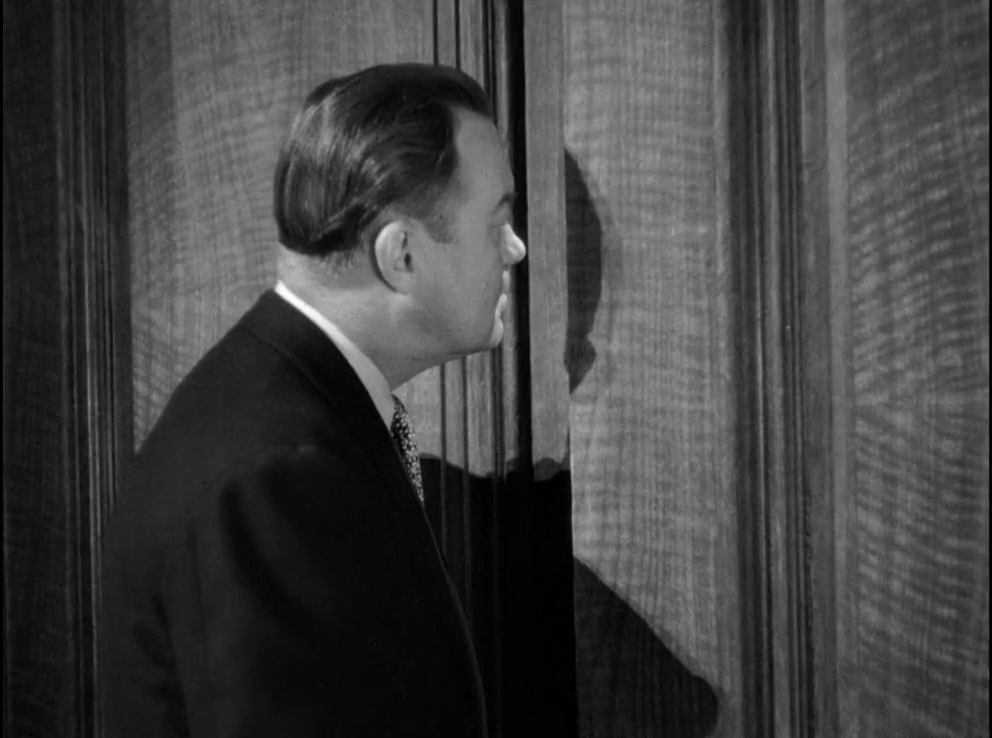
Notorious approaches the genre from the most acute of angles from the start when Alicia sees her German father convicted of treason by a US court; even this is witnessed form the point of view of a court official looking through the courtroom doors as her father learns his fate.

We're all Peeping Toms for notoriety
After avoiding the press outside court we’re back at Alicia’s apartment for the drowning of sorrows 
and the rare sight of watching Ingrid Bergman getting drunk. There’s one man she doesn’t recognise and we don’t either as only the back of his head is shown. Its only after the party has broken up and the handover lands that we see the full face of Cary Grant’s FBI agent. She takes him drunk driving and only finds out he's a cop when she's stopped by a traffic cop.

More great camerawork greats Alicia's massive hangover the following morning arguably one of the Director's finest portrayals of the pained disorientation of over-indulgence; Cary appears at an out-of-focus angle whilst Ingrid stares desperately at her orange juice, barely able to track the man as he crosses over her room to stand over her: we've all been there although not with these two in the room. 

Under over hung
 There’s an instant connection between Alicia and Devlin – we expected it – but he’s there to do a job and she’s, frankly, a little bit out of control. Devlin persuades her to fly down to Rio and to do a job for the Bureau… she accepts with little to lose only to find that she has to romance a former admirer, Nazi sympathiser and friend of her father, Sebastian (Rains).

Love and loyalty are soon to be sorely tested as Sebastian truly falls for Alicia and, in order to obtain the information required, she agrees to marry him… Devlin is in too deep to accept this dispassionately and begins to distance himself from Alicia almost encouraging her to act the wife more than the spy… human nature undermining objectives.

The rapport between Rains and Bergman is real enough and we feel for the jilted agent until Alicia starts to spot the clues among Sebastian’s friends even though pretty much the only one acting like an anti-American is his beyond stern mother (Leopoldine Konstantin), who sees through Alicia and everyone else with the x-ray eyes of demented conviction.

Three minutes of breaking the Code's three-second rule
As Hitchcock plays with our heart strings – jealousy and betrayal are so potent – there is the further tension of Alicia’s double and possibly triple turn. The director builds new, awkward spaces between his two main lovers who are so intertwined when sure of their love whilst slowly applying the pressure of Alicia’s mission. The camera swoops down over a dinner party at Sebastian’s to show her holding the keys to his mysterious cellar among the Nazi’s surrounding her; one slip and she’s uncovered.

But those keys… the tension is almost unbearable as Alicia and Devlin search the cellar for clues among the bottles as the bar man upstairs gradually runs out of champagne: a trip downstairs is inevitable and, as usual Hitchcock has us flying by the seat of his pants.

The film is so well timed and balanced and follows a narrative full of threat but low on physical threat: there was so much fear in 1946 that it was simple a question of plugging in. Hitchcock’s choice of nuclear plotting was, ever so slightly too close to the bone and he aroused suspicion among the FBI…

Claude Rains comes between...
I can understand how it became one of Truffaut’s favourites, so well balanced throughout, lean and graceful just like its amazing stars. And, with that 4k restoration, it is simply irresistible!

Notorious is back in cinemas UK-wide from 9 August at BFI Southbank, Watershed Bristol, IFI Dublin, Filmhouse Edinburgh, Glasgow Film Theatre, Tyneside Cinema, Belmont Aberdeen, HOME Manchester, Broadway Nottingham, Arthouse Crouch End and selected cinemas UK-wide.


It will also be one of the highlights of BFI Southbank’s two-month Cary Grant season that begins on 1 August. It all looks great so here's some more of that...


Sunday, 14 July 2019

Charmed… Captain Kronos – Vampire Hunter (1974) & Hammer Scream Queens, Phoenix Cinema Vampire Festival


To the four actors on stage before us, a part in a Hammer horror film could have been “just another job” with there being rent to pay, but it also provided the chance to find their way in this most competitive of careers at a time when British film was not exactly flourishing. Their backgrounds may have varied but in a profession in which filmmaking might only reward the truly inquisitive, they knew they had to make the most of any screen time, even if you were just being burned at the stake.

Judy Jarvis (nee Matheson) was formally trained and, as she put it, a “jobbing actor”, for whom working with people of the calibre of Peter Cushing was invaluable experience on a par, perhaps, with her time at the Liverpool Playhouse when, in between productions, she had to work shifts at George Henry Lees to support her room and board. Screaming as Mr Cushing burned her at the stake in Twins of Evil may not have been on an artistic level with her stage work at say, the Bristol Old Vic, Broadway or Sir Tyrone Guthrie's production of Measure for Measure, but it was part of her journey as a performer. It may also, as she said, have been the longest scream in cinematic history.

Caroline Munro, Judy Jarvis, Bruce G. Hallenbeck, Pauline Peart and Madeline Smith 
Madeline Smith would also learn from the actors around her and even chat up the crew to find out how the process worked, the lighting being important to any performer; just look what von Sternberg did for Marlene or Stiller for Garbo… All were at pains to stress the importance of collaboration and how script, director and crew could make or break any performance opportunity.

For Caroline Munro working with Christopher Lee enabled the self-trained actress to considerably raise her game: “I didn’t really have to act it because Christopher Lee was there and he was absolutely magnificent… The turning point was working with him as I hadn’t been to drama school and hadn’t done all the normal stuff you were supposed to do.” She learned on-set and acting became very instinctual for her, self-taught and "very driven by my feelings.”

There was similar praise for Peter Cushing who Caroline described as “… totally present which therefore made you present…” whilst Madeline echoed that thought: “…he totally inhabited the part and it inhabited him!” She described his work ethic on Frankenstein and the Monster from Hell (1974) when he’d go through the script every night making notes and additions even though his wife had just passed away.

The Queens on stage - both this and above courtesy of Miranda Gower-Qian, Phoenix Programme Director
Both Madeline and Judy feature in an upcoming documentary on the actor from Rabbit and Snail Films; it’s due for release in August details are on their website - link below.

The event was part of a Vampire Film Festival which saw screenings of key films at the Phoenix Cinema along with contributions from film makers. Tonight's was introduced by American horror expert Bruce G. Hallenbeck (author of The Hammer Vampire: British Cult Cinema) who talked about Hammer’s revitalisation of the vampire genre, showing clips from Dracula which he’d first seen aged five. Hammer didn’t create the vampire film but they perfected it commercially making cinema darker, more sexual and more graphic than anything seen before.

Another clip from the company’s last film, The Satanic Rights of Dracula (1973), featured Pauline Peart and a gaggle of glamourous blood-suckers being destroyed by sprinklers possibly containing holy waters. The reality was far from glamorous as the actress had to wear contact lenses that made her ordeal all the more uncomfortable: “I had to scream because I had contact lenses and my eyes were burning!”

Pauline Peart on the left coping with her cruel contacts
“I hate funerals! You must die, everyone must die!”

Hammer adapted J. Sheridan Le Fanu’s novella Carmilla with a lose trilogy starting with The Vampire Lovers, featuring Ingrid Pitt and Madeline Smith in one of the most talked about films of the seventies... in my school at least. It was followed by Lust for a Vampire and Twins of Evil both of which built on the successful formula and included Judy Jarvis (nee Matheson).

Madeline Smith and the great Ingrid Pitt in The Vampire Lovers
A clip from our main feature, Captain Kronos, followed showing the Captain rescuing Caroline Munro from the stocks for the crime of dancing on a Sunday, as she stands up, her hair is thrown back and that knowing smile gives a hint of the energy and adventure to come. Yes, Hammer is camp, but as Kronos was to show, not without its share of decent directors, writers and, of course, actors not the least of which are these famous Scream Queens.

Hallenbeck asked the four how they felt about this epithet and their response was refreshingly honest all round with some, no doubt, well-practiced zingers. Madeline Smith said that, in the Vampire Lovers she did indeed “…scream a lot, because Ingrid was biting me on an unspeakable place… “ There were also screams of frustration from Ingrid Pitt who hated her fangs and then a moment of reflection as we considered the time when her vampire teeth fell out into Kate O’Mara’s cleavage and “all the crew offered to retrieve them…”

Peter prays and Judy screams...
You were left with a picture of four people who had made the most of their opportunities, been kind and supportive and received the same in return. People who are happy to share such positive experiences with good humour and a smiling sense of perspective. Hammer films were part of a democratised industry which broadened opportunities and supported a very successful British studio against the odds. How fitting that those of us who watched and enjoyed can now examine them in more detail and listen to such enlivening accounts of the process as well as the personalities.

Like a lot of popular culture, productions that were only ever meant to have a limited commercial existence have gone on to enjoy a digital after-life and to be not only re-assesed critically but also enjoyed by new generations. There were plenty here tonight who are now viewing these films for the first time and in the broader context of their cultural significance. As Judy concluded: “It’s wonderful... to have this recognition so many years later. Thank you!”

Screening: Captain Kronos – Vampire Hunter (1974)

Horst on a horse
Made on a micro-budget of £160,000, Brian Clemens’ Captain Kronos was a thoroughly enjoyable mix of swash-buckle, folk horror and rather a-typical vampirism. It was intended to become part of a series featuring Horst Janson as the dashing blade and it’s understandably one of Hallenbeck’s favourites and that's high praise given that he’s seen them all and many times too.

Thinking of the elements highlighted by the Q&A, it was noticeable how strong the script was for this film as well as the cinematography of Ian Wilson and Laurie Johnson’s spirited score. There were lots of knowing references and, darn it, jokes such as when Dr Marcus (John Carson) touches Kronos war-wound and says he knows he has guts as he’s seen them. There’s even a bar scene in which a “guest-starring” Ian Hendry and two henchmen face off against Kronos only to be dropped by a swift flash of his blade: the sword play is stylishly unlikely until a prolonged battle at the death which probably carried a large part of the film’s stunt budget!

Hello Ms Munro
Kronos and his aide, Professor Hieronymus Grost (the excellent John Cater, one of so many experienced stage actors who would lend gravitas), are vampire hunters – even more fearless than Roman Polanski’s from 1968. They rescue a peasant girl Carla (Caroline Munro) and set off to the scene of the strangest of vampiric killings, young women hypnotised and then sucked of all vitality, left for dead looking like old crones.

There is indeed an energy and honesty from Caroline Munro in this role and she clearly had the instinct to go with her screen presence as she rose to the level of those around her. Her Carla adds a vital element to the hunters, bringing out Kronos’ human backstory and allowing the Professor to explain their methods. Handsome Horst Janson is also very good as Captain Kronos and having had a heavy German accent, is well-voiced by Julian Holloway who I had no idea was the son of Stanley...

Don't talk to strangers
As the young girls keep on being picked off, the intrepid team use dead toads to track the path of the vampires who will animate the amphibians should they pass over them. The finger of suspicion and the steel sword of vengeance soon point to the mansion of the Durward family who’s father Kronos had fought alongside: the most feared of swordsman. Is it the son, Paul (Shane Briant) or the daughter Sara (Lois Daine) or is there an even darker secret? Well, what do you reckon?

I liked the visual dynamics of the film with excellent use made of tight angles to accentuate tension and maintain the sense of forboding even amidst the comfort of a family home or a tavern. This is a skill the best of the Hammer films always used and here the menace and the "horror" are mostly in the mind with the anticipation of another bloody cut-away all set in the pastoral peace of the Hertfordshire countryside. 

Love the design of this room - all made vulnerable by the camera angle
It's hard to think of a more positive and affirming evening at the cinema so well done Phoenix, ace programmer Miranda Gower-Qian and all concerned, especially the Scream Queens - it was a pleasure to meet you all. This was also the first time I’ve seen a hammer horror film on screen since I was a teen sneaking into the Liverpool ABC near Lime Street, at least this time I didn’t have to fib about my age!

The Peter Cushing documentary featuring contributions from Judy Jarvis and Madeline Smith is due in August, details on the Rabbit and Snail Films website which also features snippets of other productions and interviews. There's also an interview with Judy Jarvis on her career and her Hammer films.

Captain Kronos lives on with a graphic novel from writer Dan Abnett and artist Tom Mandrake, it comes with an introduction from Caroline Munro.