Sunday, 10 March 2019

Dean’s mean… Outside the Law (1920), with Stephen Horne, BFI


 “Priscilla Dean… was a feminist icon before such a label ever existed.” Eddie Muller

As the BFI’s Bryony Dixon said in her introduction, the birth of the Hollywood gangster movie is normally placed in the late twenties with the likes of Underworld or The Racket, following on from the prohibition-induced black market, but here is an early contender from Tod Browning which has many of the classic ingredients; a Moll, a vicious hoodlum and betrayal for love. Outside the Law is a dynamic movie and the print we saw screened was largely superb, with so much detail on the big screen in NFT1.

It was Tod Browning’s second collaboration with Lon Chaney and, as if to make up time, Lon has two roles, one as Black Mike Sylva, a gangster with his face twisted by malice, and the other as Ah Wing, loyal servant to Chang Lo (E. Alyn Warren) who seemingly had a larger role in the original cut with what we have now being based on a 1926 re-release.

The look...
The undoubted star though is Priscilla Dean as Molly Madden (Silky Moll), who plays the Moll (ha!) to perfection and, as she proved in Browning’s The Virgin of Stamboul (1920), was an actor of presence, range and natural warmth. She is top-billed for a reason and you can see why she was such a star and how she earned the epithet, The Queen of Crookdom, in her run of nine flicks with Browning. She’s snappy and sassy and dominant in a way we don’t normally see – Bryony was right in that, we’d want to watch more having seen this film.

Eddie Muller’s notes from the San Francisco Silent Film Festival 2017 we reproduced here and he sums up this appeal: “the public loved the power she wielded on screen; especially the sceptical sneer that became the actresses’ trademark, alerting audiences that there would soon be hell to pay and Miss Dean would be cashing the cheques.”

Lon One and Lon Two...
Dean plays Molly – aka Moll - the daughter of “businessman” Silent Madden (Ralph Lewis) who is determined to step away from his life of crime – ironically, Lewis was in an even earlier crime film called Going Straight with Norma Talmadge. They take advice from the sagacious Chang Lo and plan their exit.

Unfortunately, Black Mike has other ideas and, planning revenge on people he really, really hates, he hatches a plan with Dapper Bill Ballard (the always-charming Wheeler Oakman who was also married to Dean at the time) to frame Silent for the shooting of a cop and force Molly into working with them. Silent is duly sent down for a couple of years, not found guilty exactly, just “in the general location” when the killing went down (la, la, la in Ameri-ca…) and leaving his daughter without a “protector”.

Cilla and Ralph Lewis
Molly, pained at her father’s injustice, happily goes along with a plan to rob jewels from a society party, little suspecting that it’s another of Black Mike’s traps and that he will leave her in the lurch for the cops to grab as he makes off with the loot. But, crime, as the title card says, can’t hold sway over the human heart and Dapper Bill confesses all to Molly with whom, naturally, he has fallen in love…

 
The two collude as the deal goes down and they avoid even a triple cross before hiding out and going stir crazy waiting for the noise to die down. Is there still time to get back on the straight and narrow, will Bill penetrate Moll’s tough exterior with his puppy-dog eyes and the repeated intrusions of the cute kid from across the hall (Stanley Goethals) and will Black Mike discover them?

I’m not spoiling anything by revealing that there’s a huge bloody punch up at the end, much the same as in The Virgin of Stamboul and one heck of a gun fight in which Miss Dean plays a full part.

Also worthy of note is a small, uncredited cameo from a fifteen-year old Anna May Wong.

Wheeler Oakman before and after...
Stephen Horne had fun with this one using piano, zither (?), bowls and flute – a one-man gamelan rolling out a stream mood-matching themes that blended seamlessly with the narrative in ways few can sustain. Sometimes his music is so good you don’t notice it – in the best possible ways – whilst sometimes you do look over to check that there really are only two hands involved. Nothing is ever sacrificed to the integrity of his duet with the performers on screen and, if you’d seen Priscilla Dean, you’d know what I mean.

 Another excellent dip into the archives at the BFI, next up is Maurice Elvey’s Palais de Danse
(1929) which will be introduced by Elvey-expert Dr Lucie Dutton.

Anna May Wong on the left.

Sunday, 3 March 2019

The road from Utopia… City Without Jews (1924), BFI with Stephen Horne


This was the second time this film has been screened in London and after Olga Neuwirth’s radical and assertive score at the Barbican last year, we had the specialist improvisation of Stephen Horne which allowed the film to fully make its own statements. Stephen started more emphatically than perhaps is usual; every film leaves its mark on the playing and he has such a range of themes and tone, not to mention instruments.  Piano, accordion and kalimba were used in assured synchronisation to bring out the humour, dynamism and the horror, in a film that smiles out with agonising hope through the decades of subsequent disaster.

Hugo Bettauer’s book was written in 1922 when anti-Semitism seemed just another weapon of cruel politics in post-war Austria as it tumbled downwards to economic rock-bottom, the days of empire long gone. Someone had to be blamed for this fall from illusory grace and power and in the “Utopia” (aka Vienna) of the story, it is the Jews with their seeming control of finance, retailing, creativity and patisserie… that are deemed the problem.

Karl Tema and Johannes Riemann
The film had previously only survived in fragmentary form – a censored version was in the Eye archive - and Fumiko Tsuneishi of Filmarchiv Austria described how a chance discovery in Parisian flea market in 2015 of a nitrate French edit enabled completion of most missing parts including the hitherto lost ending. The restoration also now has the original tints and more details on the religious lives of the Jews which had been expunged for the Dutch audience… There are some narrative jumps but the result is a balanced story with a resolution that makes its survival all the more poignant. But, above all else, this must be viewed as an artefact from 1924 when things were already serious enough. Any resemblance to 2019 is purely depressing.

Directed by H K Breslauer, the film is a good-looking and fast-paced comedy drama that makes its point with all the satirical subtlety you’d expect when the idea of one group in society being in anyway in control of good fortune was as risible then as now. It’s sometimes described as an Austrian expressionist film and yet, short of the ending, when an antisemitic parliamentary representative Bernard (Hans Moser) is jailed in a room full of twisted shadows and stars of David, it’s not going to pass Lotte Eisner’s test but that sequence is a powerful one: this obsession is unreasoned and quite, quite mad.

The people of Utopia have their say, marching for "out" then marching for "in"...
The politicians fail their people as, in the face of Utopia’s economic downturn the new chancellor, Dr. Schwerdtfeger (Eugen Neufeld) responds to the voters’ need to find an easy target to blame in order to distract from broader questioning of authority. Gradually he accepts the unthinkable – it’s far easier to say what they want to hear - and he passes a law banning Jews who must leave the country by 25th December – and a Happy Christmas to you too. 

This impacts a number of the politicians’ families, almost as if they hadn’t really thought through their plan. This includes the son-in-law of arch Jexiter Councillor Volbert (Ferdinand Mayerhofer) whose wife gives him a smack around the chops as their granddaughter is threatened with exile. There are also two sweethearts, Lotte (Anny Milety), who is the daughter of one moderate assembly member Linder (Karl Tema), and a Jewish artist Leo Strakosch (Johannes Riemann), who has to leave for Paris. Fathers and daughters, rich and poor will all be separated and there are heart-rending scenes as the Jewish population prays in the subterranean synagogues and then heads out to Zion on foot and by train… refugees leaving their homes as those behind decorate their Christmas trees and, largely, care less for their former countryfolk.

The councillors ignore the violence they encouraged.
A rich American anti-Semite helps give the economy a lift and for a while, things improve for the Christians at least… but soon Utopia suffers as other countries refuse to do business with them and then, shock horror, their Yankee benefactor marries a rich Jewish girl. At the same time the cultural life of Utopia suffers without the creativity of the Jews, their plays and even their fashions, whilst cafés become beer halls and a culturally-impoverished society becomes an intoxicated one.

As hyper-inflation kicks in jobs are hard to get and Utopia is heading for disaster, luckily, Leo, who has snuck back into the country disguised as a catholic Frenchman with a beard (take that Clarke Kent), helps to organise counter propaganda to get his people back. The reformers need a two-thirds “super-majority” to change the constitution in order to allow the Jews back but they are just one vote short until Leo has a plan to deal with that troublesome Councillor Bernard…

Anny Milety and Johannes Riemann
The story’s author, Hugo Bettauer was an investigative journalist by trade who also wrote Die freudlose Gasse (The Joyless Street) which was made into a film by Georg Wilhelm Pabst in 1925. He was described as a "Red poet" and "corruptor of youth" by the Nazi Party and was killed by one of their members, Otto Rothstock in 1925. Rothstock was found guilty and committed to a mental asylum before early release in 1927…

City Without Jews (1924) is now available on DVD from the FilmArchiv Austria and it comes with an excellent score from Austria’s leading silent film accompanist Gerhard Gruber (piano), Adula Ibn Quadr (violin) and Peter Rosmanith (percussion); as with Stephen Horne the music is playful and as spirited as the film itself. This is an essential purchase and, if you’re quick, you can grab a copy from the BFI Shop or from Filmarchiv Austria online.


Thursday, 28 February 2019

New school… Tuition (1940), BFI Early Korean Cinema Season


This film was only rediscovered in 2014 in the Chinese Film Archive and of the dozen or so featured in this joint season of the BFI and Korean Culture Centre, it might well be my favourite. Based on a story by a fourth-grade schoolboy it tells the story of a similar boy’s struggle to get by in the face of poverty and illness. In comparison to other more overt melodramas, it offers the most naturalistic take on life under the Japanese whilst still offering a compelling and very satisfying narrative.

Korea was a Japanese colony from 1910 to 1945 and by the forties, as tonight’s supporting feature Patriots Day in Joseon, showed, the province was being told to be more grateful and supportive of the empire as the Sino-Japanese war progressed through its third year. By this stage Japanese was the chosen first language and yet, Tuition, though originally scripted entirely in that language was re-written to include extensive sequences in Korean.

As if that wasn’t challenging enough it also showed the poverty that could affect even the most hard-working and able of families with a story in which a young boy is left looking after his grandmother as his parents leave to make money as peddlers. That hard work and ingenuity plus steadfast loyalty and love triumph in the end is one thing but these are not necessarily Japanese traits despite the warmth shown by the Japanese school teacher who is the only major non-Korean character.


Directed primarily by Choi In-gyu (Angels on the Street) and Bang Han-joon who stepped in after the former was taken ill, the film is very well-made and seemingly went down a storm both in Korea and Japan where it was praised for illustrating “… the possibility of Joseon filmmakers to produce art films unstained by commercialism.” This point gets to the heart of Tuition’s enduring appeal, it presents as an honest film, treading a path the makers wanted to and telling a sentimental tale with humour and astute observation almost as if the original intentions of the 11-year old writer had been fully carried through.

At one point our young hero, Wu Yeong-dal (Jeong Chan-jo) is arguing with his deadly rival, the smartest girl in the class, An Jeong-hui (Kim Jong-il), over wood they are collecting until they look down to see rice fish in the stream; they immediately stop and work together to catch them. Thus, are friendships made by a mutual fascination with nature whether it be free fishes or even just the cucumber plants Jeong-hui sketches; are you interested in science asks the teacher, “no, I like drawing…” comes the reply.

The film shares its young protagonists’ fascination with discovery and, culminates in Yeong-dal’s epic 24-kilometre solo walk to seek help from his auntie in which we share his brave delight in finding his own way across his country via foot, ox-cart and bus.


We first encounter the two friends-to-be arguing over a football in the playground and then competing to impress their tutor, Mr Dashiro (Susukida Kenji) in class. Jeong-hui outdoes Yeong-dal by drawing their town on the map of Korea fibbing that her father had taken her there on the train. She’s got front and that rubs the boys the wrong way but soon she and Yeong-dal are united by shared interests and their mutual difficulty in paying their tuition fees.

At home Yeong-dal lives with his grandma (Bok Hye-suk) who struggles at the best of times until she falls ill and he must care after her as the money and food begins to run out. He’s not heard from his parents in months and begins to give up hope as everyday the mailman passes them by. He begins to skip school even as neighbours pitch in to help and even when Mr Dashiro subs him the two dollars to pay his school fees, he ends up having to give it to grandma’s landlord… there seems no end to their poverty trap until, in desperation, grandma thinks of her distant sister.


Will there be a happy ending? It doesn’t matter when a film is this engagingly charming and when you already know that Mun Ye-bong was playing Yeong-dal’s mother, you can expect a big finish and the bucolic dénouement does not disappoint.

The acting from the youngsters is especially impressive and is credit to the direction and a generosity of spirit that still leaps from the screen. Definitely one to watch out for and proof that even in the dark days, creativity and hope continue to drive us onwards from the screen.

Mun Ye-bong - perhaps the major film star of the colonial period in Korea?

Sunday, 24 February 2019

Sex and the city… Sweet Dreams (1936)/Fisherman’s Fire (1938), BFI Early Korean Cinema

Mun Ye-bong, the first Korean film star? 
Sweet Dreams was rediscovered in the Chinese Film Archive in 2005 and is the earliest surviving Korean sound film and a fine example of the melodramatic fare that typified the cinema of the time. The dialogue is in Japanese with Korean subtitles and reflects the increasing control of the colonial government even though this is not a propagandist film, except for a strong message on the importance of road safety and motherhood.

The film was originally seven reels and was badly damaged when found, and there are some narrative jumps that result that can’t be laid at the door of director, Yang Ju-nam, who has some interesting ideas. A fight occurs off screen with appropriate sounds and the odd character falling into view, there is a good use of space, overhead shots of characters in pivotal conversations, tracking shots and extensive close-ups of the film’s star, the very striking Mun Ye-bong as things reach their fateful conclusion.

There are also some glorious shots of the streets and buildings of this distant Seoul, wide streets populated by very few cars – unimaginable now – and fascinating glimpses of hotels, cafes and theatres.

Tense reflection, Lee Geum-ryong and Mun Ye-bong
Mun Ye-bong plays Ae-soon a discontented house-wife married to a serious man, Lee Seon-ryong (Lee Geum-ryong) who frets over her continuous shopping and general galivanting. We see a bird in a cage, an image of how Ae-soon sees herself, even as she ignores her daughter Jeong-hee (rather splendidly played by Yoo Seon-ok). The couple row and Ae-soon leaves amidst genuinely distressing scenes as she pushes her daughter back as she slams the door… father walks slowly back into the room and comforts his daughter.

Ae-soon is picked up by a dodgy-looking chap with a sharp suit and spivvy moustache, Yoon Byeong-ha (Lim Woon-hak), who offers her the chance of the good life even though he’s all mouth and must steal to maintain the lifestyle. Ae-soon becomes bored and flirts with a theatre performer, sending him flowers which he gives to another performer, getting the measure of this her: “pretty flowers have thorns…”

As Ae-soon follows her dream of the sweet life through wealthy-male acquisition, her daughter dreams constantly of her mother’s love and the loss of happiness; it’s manipulative but believably painful. As with all melodrama there will be a balance and as Ae-soon shops her boyfriend after he pulls off a messy robbery, fate is about to intervene…

Mun Ye-bong and Lim Woon-hak
On this evidence, Mun Ye-bong was deservedly a star and has the emotional flexibility to accompany the looks. She is also in three of other extant films from this period, also included in the BFI/Korean Culture Centre’s season – Angels on the Street (1941), the full-on propagandist Military Train (1940) and Straights of Chosun (1943).

I watched Angels at the KCC and it’s a fascinating film about two orphaned children saved from the streets by a priest and his family. It was the first Korean film to experiment with live sound recording and has a neo-realist feel way ahead of even the Italians. Well worth seeking out and director Choi In-gyu deserves more recognition for a film that has gorgeous locations and smuggles plenty of native wit despite a full-on propagandist resolution complete with salutes to the Japanese flag.

Angels on the Street (1941)

 Fisherman's Fire (1938)

“She is old enough to do housekeeping here.”
“Housekeeping? Your wife can do housekeeping…”

This film was a different kettle of fish… but with the same melodramatic drivers and a stricter, more old-fashioned underlying morality. Young girl leaves the fishing village for the bright lights of Seoul; what could possibly go wrong?

Director Ahn Chul-yeong paints a lovely picture of the coastal life and this is a well-edited, visually poetic film with lingering shots of tumultuous seas set against a patient shoreline and a strong-featured cast. It looks idyllic and you wonder why anyone would want to leave it for the smelly old city unless, the y had to. The dialogue is recorded in studio and has the ambience to go with it, early days but Sweet Dreams sounded more naturalistic to me.


In-soon (Park Rho-kyeong) has just come of age and whilst her conservative fisherman father is keen for her to do the washing and cleaning she wants to explore, get educated and earn the money he is struggling to make… Sadly Dad gets lost at sea and, in debt to the dastardly money lender Mr Chang, her mother agrees to sell her to him only for his son, Chul-Soo, to offer to clear the debt… He has reasons of his own, of course, and is trying to steal her away from her true love, handsome fisher-boy Chun-Seok.

She ends up going with Chul-Soo to Seoul and things get very complicated and, frankly, very frank despite her pal Ok-Boon trying to lead her onto the straight and narrow. One thing leads to another and destitution may surely be followed with serious moral and physical consequences unless there’s a way of returning to the simple bliss of fishing.

A lovely-looking film and another precious snapshot of a lost age.

In-soon (Park Rho-kyeong) and her city "host" Chul-Soo
There’s still one week to go with the quietly-subversive Tuition (1940) on Tuesday 26th (Mun Ye-bong is in that too) and Hurrah! For Freedom (1946) on 28th – appropriately completing things with a celebration of Korea’s liberation from Japanese control after a quarter of a century. Details on the BFI and KCC sites.


Tuesday, 19 February 2019

Tell not show… Red Desert (1964), BFI with introduction from Enrica Antonioni


"...the Giuliana in Red Desert is  not an invention of mine and I have found people like her everywhere...” 

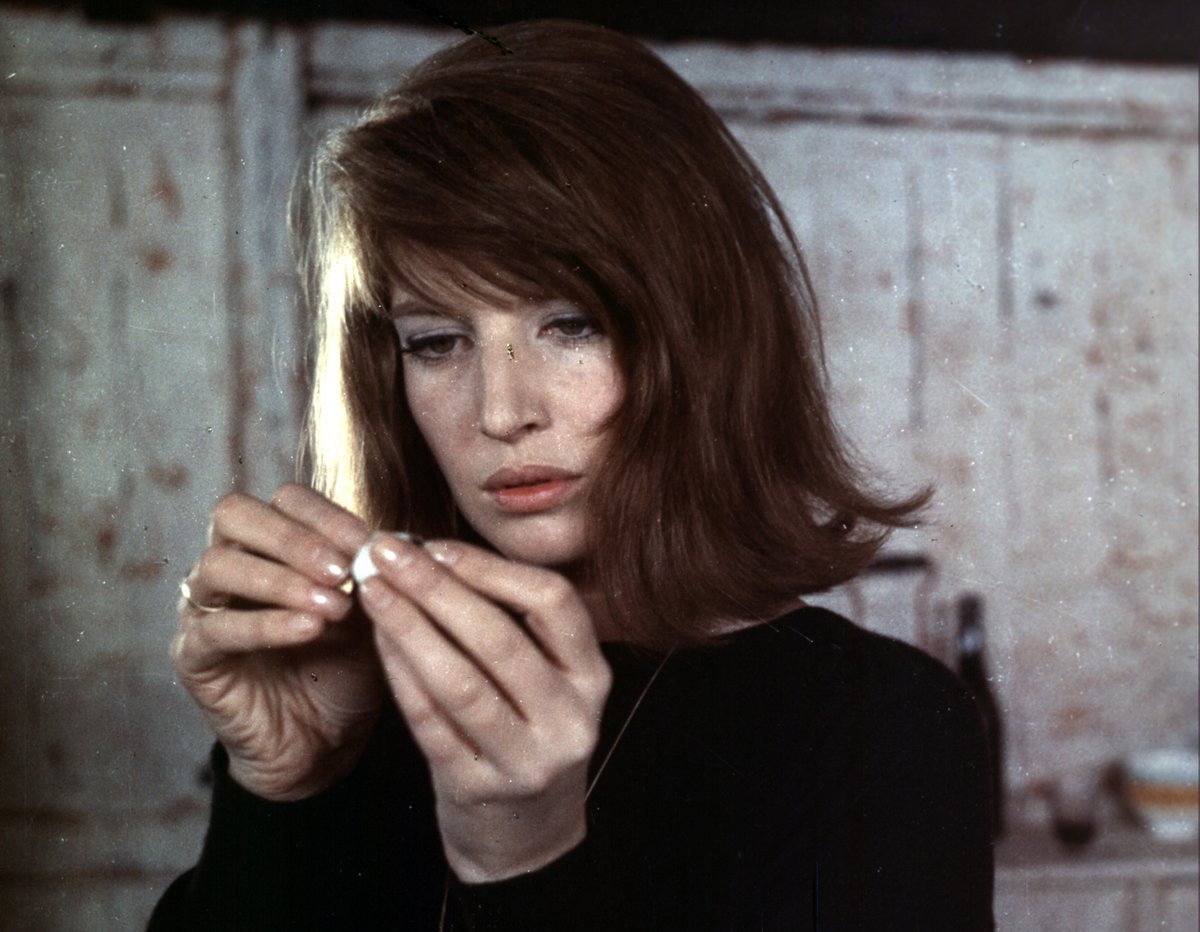
Antonioni was inspired to make this film by seeing a row of trees outside his hometown of Ferrara dying as a result of pollution from new factories. He had a scene in which he painted hundreds of trees white to show the impact but it rained and he had to abandon the shot… but he had other shots up his sleeve and, most importantly, he had Monica Vitti.

Introducing this film was Enrica Antonioni, the director’s partner for 36 years and who also worked as producer and actor in his films from The Passenger onwards. Here she described herself as not so much an expert of cinema but of the man and of the artist, who she remains passionately committed to, spearheading the ongoing screening of his work and the maintenance of his position amongst the finest filmmakers. She explained the title of this film which Michelangelo was originally going to call Blue and Green, as being about the desert man is making; a virile, blood-drenched wasteland in which one must find new ways to survive. As a seeker, the director felt at home in as, after the success of Blow Up he headed for the barren landscapes of Zabriskie Point before getting Jack Nicholson lost in the Sahara for The Passenger.


In his first colour film, red predominates making this one of the greats of scarlet cinema up there with say, Red Shoes, Taxi Driver and Deep End. It’s a state of mind as well as the most primeval warning of nature, fight or flight also hell and despair. If this is Antonioni’s ecological film it is also his most specific film about neurosis with Monica Vitti playing Giuliana, a woman driven to psychiatric trauma by an inability, as Enrica pointed out, to assimilate with her surroundings and the New Environment of post-war industrialisation.

She quoted her husband in saying that acceptance and adaptation went hand in hand, and that our survival depends on this. Like a Bedouin he was willing to see the best in the environments that are always important in his films – concrete alienation would be replaced by geographic only after this trip to the increasingly polluted desolation of northern Italy – he was born in Ferrara, a land of mists, which fired his imagination and which features in this film as the characters head off to a shack on the coast for a bawdy weekend and are shocked to see a huge container ship emerge outside their window, the fog obscuring its approach.


The film opens with eerie, fractured electronic music from Vittorio Gelmetti, as Giuliana and her child, Valerio, take a seemingly innocent walk along the road outside her husband’s factory where a strike is taking place. It’s another of his extended set-pieces and when suddenly a member of the union hails a lone strike-breaker, we see the individual under pressure from collective forces beyond his control. Monica approaches a striker and buys a half-eaten roll from him; this is not what we were expecting from this smart glamorous woman and, as she hides behind a hedge and eats the food, she was perhaps too frightened to take elsewhere.


This was Vitti’s fourth film with her then partner, and it is perhaps her most vulnerable and telling performance and we really have to study her hard to follow a nuanced and complex – frustrating and rewarding – emotional journey that could, perhaps only be delivered by such a close, cinematic couple. Not unusually for Michelangelo’s films, a woman in search of a deep connection, is ultimately miss-read even by, in this case even a sensitive and emotionally intelligent man and we can only guess at the inspiration.

Richard Harris (you know, Jared’s Dad!) plays successful entrepreneur Corrado Zeller – a friend of Giuliana’s husband Ugo (Carlo Chionetti) – a man who is always on the move and never settled whether it’s in his home town of Turin or the city he grew up in, Bologna… Clearly, he still hasn’t found whatever it is, Bono, that he’s looking for and, as he plans a business in South America, he very much decides he’d like to take a trip to Giuliana.

Carlo Chionetti and Richard Harris
Antonioni sets up this vague love triangle almost in passing as the concern of Ugo is his wife’s mental health; she is in recovery and treated with child-like care by his business-like, brain; there’s money to be made and factories to build. Even their apartment is cold and angular with the only warmth being provided by a Romanesque stool, stuck out, unnaturally on a landing, providing no comfort.

The full background to Giulana’s breakdown is only gradually revealed and the couple plus Corrado and three pals head off for a wild weekend in the cramped quarters of that small “love shack” on the coast where much drink is consumed and boundaries are nearly broken… Then the ship arrives and it appears to be quarantined meaning that the couples run off before, Giulana in a panic almost drives her car over the end of the quay…

Gradually Giulana reveals more to Corrado, especially when Ugo goes off on business and we think we know where it’s heading when she tells him if only her husband would ask the same questions about her health. She crashed a car and, it transpires tried to take her own life and Corrado takes this all in his stride, saying all the right things, which I’m sure he believes. It is only when, after her son tricks her into thinking he has polio, that, in desperate relief after he reveals his deception, she runs to find Corrado at his hotel…


The romantic union the film had been hinting it doesn’t quite transpire and in one of the director’s more powerful scenes of heterosexual confusion, the man fails to give the woman what she really needs. As ever, these moments feel autobiographical and, indeed, Enrica says that this film was his last “purely autobiographical…” as he wanted to move far beyond his bourgeoise upbringing. I do wonder if she and Monica sometimes watch these films together and laugh in recognition, smiling over their Campari as another classic Michelangelo-moment is revealed.

There’s, of course, far more to the film than this but redered with Carlo Di Palma's incredible cinematography, this believable story of mental illness at a time of change and danger, it is hard to better. I’ve said it before but watching Antonioni is like watching a silent film, the dialogue is sparse and the expressiveness of the leads always at such a high level, especially Monica, Jean, Marcello, David, Vanessa, Sarah and Jack… you spend two hours reading their facial “intertitles” always engaged and never quite sure.


He always leaves a little meaning left undiscovered… it took him a long time to put these films together and, for these persistent mysteries, you can see it was worth it: “I look and tell what I see, I do not show…”

In her conclusion, Enrica Antonioni quoted her partner:

 “…much of humanity has not yet adapted to the new times, it has not filled the gap between moral antiquity and (today)… neurosis reveals the concerns… the Giuliana in Red Desert is  not an invention of mine and I have found people like her everywhere, it’s not me, it’s our stories that venture into psychopathology and if we were all aware that we live in a state of neurosis, society would find a solution. Otherwise men in crisis will inevitably bring the World to ruin.”

And this, as she said, was fifty years ago.

The BFI Antonioni has been a joy and each screening has revealed so much more about the work especially with tonight’s introduction: this is a director who’s work still inspires and still carries so much meaning. Next up I have Zabriskie Point so we’re ending with a bang.