Tuesday, 9 December 2014

Nothing is real... Die Puppe (1919)


A subversive fairy tale in a film played out from a child’s model set up by the director… The Doll (Die Puppe) shows the post-modernist verve of Ernst Lubitsch to stunning affect, aided by the powerhouse comic miming of Ossi Oswalda. Quite clearly The Wildcat wasn’t the first example of the director playing with form and formula in glorious fashion: you keep expecting a Marx Brother to pop up, a lumberjack or maybe the Spanish Inquisition.

This was one of five features the director completed for UFA in 1919 although it was filmed in late 1918. It’s hard to imagine the mood in Germany at that time and perhaps this film is part of an escape to fantasy in those dark, defeated days.

Ernst Lubitsch gets his dolls house in order
It certainly looks like it as Lubitsch sets about constructing the dolls’ house at the start of the film: a small wooden cottage set atop a steeply-sloped paper mache hill. As the dolls become people we see one of the characters roll down the life-sized steepness directly into a square pond cut in the “ground”… he calls upon the Sun to dry him off and sure enough it emerges from behind the clouds to smile its warmth on his drenched clothes.

Sunshine dry-cleaning
The film has its own internal logic and is superficially a fairy tale only with characters driven by very adult motivations. There’s a young noble man apparently terrified of woman, a young boy who talks and thinks like a man (very Almodóvar!) and a woman who’s a doll who is actually a woman. Add the monks – pious on the outside and gorging pies on the inside and you have a world in which the deceptions of distrustful and selfish humanity distance them all from the truth.

Gerhard Ritterband and Victor Janson
Lubitsch took the basis for the story from the story by Ernst Hoffmann which inspired the ballet Coppélia and created something a little darker with co-screenwriter Hanns Kräly. The young man with the wet suit is Lancelot (Hermann Thimig) the nephew of the Baron of Chanterelle (Max Kronert). The Baron is nearing the end of his life and to ensure the continuation of the line, pressures Lancelot to get married.

On hearing of the potential availability of such an eligible bachelor, the local maidens begin to gather much to Lancelot’s discomfort: he is terrified of the prospects and runs for his life from the 40 women hoping to attract his attention.

Ich möchte kein Mann sein!
He makes his way to the nearest Abbey to ask for sanctuary interrupting the monks’ meal. These are no ordinary brothers: they gorge on vast quantities of meat and worry about their funds running out… yet to the outside world they are frugal as would be expected. Lancelot is welcomed into their midst but is only given scraps of bread as they continue their feast.

Monks munching
It is only when one of the monks sees an advert from the Baron offering his nephew 300,000 francs if he takes a wife that they take an interest in the young man… the ecclesiastic air is filled with bitter irony. But he cannot be with a woman… but one of the monks remembers that there is a man in the town who makes life-like dolls indistinguishable from real life: Lancelot can marry a mechanoid, collect the cash and – of course – hand over the money to the monks!


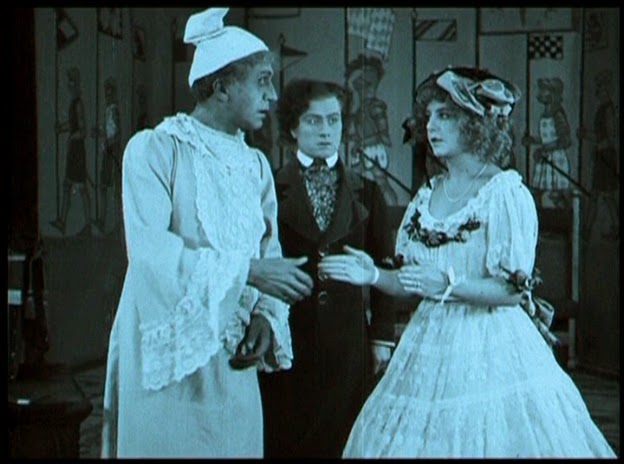
Lancelot goes off to the house of the bizarrely-coiffured Hilarius (Victor Janson) who is busily creating a new doll in the image of his daughter Ossi (Ossi Oswalda) aided by his outspoken young apprentice (Gerhard Ritterband).

There’s great scene in which Lancelot is escorted into the middle of a large room and then as Hilarius turns a wheel, dozens of designer dolls stride out form their storage shelves to embrace him: he’s as frightened of them as he is of the real thing.


They’re all a bit saucy for him and Hilarius decides that his newest creation would be the purest and goes to fetch the Ossie doll… unfortunately by this stage there has been an accident and the doll is broken. Ossie, naturally, stands in for the doll whilst the apprentice – whose fault it is – fixes things.

Ossi Oswalda
Off goes Lancelot with the girl-not-doll to arrange the marriage of man and mannequin as soon as possible. Ossi Oswalda revels in the role and her timing is absolutely spot-on as every smirk, gurn and slap is choreographed perfectly with Lancelot’s inability to spot the obvious. At their wedding she hungrily devours cake almost in front of him whilst enjoying a dance with the guests without his noticing his only comment is to marvel at her “intricate mechanism” when she reveals that she can dress herself.

The Baron meets the bride
Who is this young man and why is he so obtuse?

The couple go off to the monastery where the money is to be handed over, the model is to be mothballed and Lancelot can rest a lot… but really there’s too much mischief in Ossi for this story to end like this…

Lancelot and his lady
Die Puppe shows Lubitsch’s mastery of his content and also his uncanny ability to throw subversion into the heart of his comedy: the surface pantomime has clear secondary meanings but many of these have deeper and challenging interpretations. Yes the monks are corrupt but why does Lancelot agree to their weird plan when they will gain more than him? The Lord moves in mysterious ways but not as mysterious as organised authority perhaps… And love, true love, comes in the most unexpected circumstances…

Hilarius has a hair-raising experience (that's Lubitsch's pun not mine!)
I watched the version on Eureka's Masters of Cinema box set Lubitsch in Berlin: Fairy-Tales, Melodramas, and Sex Comedies – an essential set which I’m sure you’ve already got! If not it’s available from Amazon.

Amazon's new all-night delivery "horses"...

Saturday, 6 December 2014

Cinematographic-therapy… The Mystery of the Kador Cliffs (1912)


This smart film uses cinema as a therapeutic resource helping to cure one of the key characters of her mania and revealing something of the power the new medium was recognised as having. The woman gazes intensely at the screen as the events that traumatized her are replayed almost as life… in shock she staggers towards the screen and looks around at the back to see if it’s real: how can these images be?

I have had a very boyish fascination with pre-war films that would demonstrate pre-Birth of a Nation innovation but it’s impossible and it’s pointless – largely – the true test is whether or not a film is entertaining. Inevitably this is more likely to be those films whose production values are more aligned to modern tastes but beyond a certain point films begin to resonate as entertainment rather than academic studies… although there are many ways to enjoy watching a film.


Émile Keppens and Suzanne Grandais
The Mystery of the Kador Cliffs shows the advanced state of French cinema in 1912 being slickly made, inventive and still carrying genuine jeopardy and anxious resolution. Directed by Léonce Perret it is not so much a who-dunnit but a how-he-who-dunnit-gets-caught… a bit like Columbo only a bit snappier, with more forensic method and fewer cigars.


Perret uses some great locations, not least the titular cliffs, all of which are captured very well by cinematographer  Georges Specht as well as evocative Bauer-esque sets from Robert-Jules Garnier; rich in detail and depth of focus. There are no short cuts on the budget and there are dozens of different shots in the film which is remarkably well-preserved.


Events begin as the last will and testament of the Marquis de Kéranic are read out to his expectant cousin, Comte Fernand de Kéranic (Léonce Perret no less!) and young niece Suzanne de Lormel (Suzanne Grandais).  It’s the usual troublesome arrangement that can lead to trouble: Suzanne must make it to 18 without going mad or otherwise blotting her copybook or else she will lose all of the inheritance to her other uncle and tutor the Comte.

Now, this is asking for trouble but the Comte seems easy-going enough, surely nothing can disturb his peaceful stewardship of his young ward’s coming of age? Well… turns out the Comte has a gambling problem and is deep in debt. Perret reveals his predicament with the unfolding of a letter rather than through intertitles, the film takes the time to reveal its story and has a well-paced narrative that might well not have been tolerated in say the United States.

Léonce Perret and Suzanne Grandais
The Comte now reveals his true colours as he takes Suzanne for a walk down by the rocky Kandor seashore… the shots here are well made as the couple walk over pebbles past the craggy outcrops. The Comte asks his niece for her hand in marriage but Suzanne recoils, not just in revulsion but also because she loves another.

She runs off leaving her satchel which the Comte opens to find love letters from her beau, Le Capitaine Jean d'Erquy (Max Dhartigny)…  now he knows everything and begins to plot… alone in his darkly-lit study.


But next we see the Comte apologising to Suzanne and trying to make good but then we see him slip a sleeping draught into her drink before the two go for a walk down to the remote cliffs. Suzanne duly feints just in time for another part of the Comte’s plan comes into play. He has written to the Captain pretending to be Suzanne and has organised for them to meet at the rocks… as the soldier’s boat nears the Comte hides in the rocks with a loaded shot gun and lets off a smoke signal to attract the young man.

When he’s close enough the Comte fires two shots and Jean falls to the ground. Presuming him dead the Comte leaves them both to the mercy of the incoming tide… killing two lovebirds with one foul stone.

Lost at sea without a paddle...
Yet, Jean isn’t dead, far from it – he recovers enough to pull Suzanne into his boat and as he feints from loss of blood the two drift off into the uncertain waters. The two are lucky though and float ashore sometime later to be rescued by fisherman… but the experience has cost them: the Captain is too ill to be interviewed by the police whilst Suzanne has been driven catatonic by the near death experience… her mind is closed to all enquiries.


Thinking himself safe from any comeback, the Comte has Suzanne declared mentally unfit and proceeds to reap the benefit of the clause in his brother’s will that means he is the sole heir in such an event. All of his financial problems look at an end…

And yet… Suzanne’s maid writes to the Captain when he has recovered and suggests they contact one Professeur Williams (Émile Keppens) a man who has a reputation for solving the seemingly un-solvable psychiatric cases through revolutionary use of cinematic techniques!

Avoiding the use of intertitles
I must say no more about this fantastical plot other than to urge you to seek out this film and its remarkable closing sequence for yourselves!

Clearly the modern mind may well find few surprises but imagine the impact this would have had at the time when the arts of psychoanalysis and cinematography were still new and developing apace.

Re-creating the crime!
The director doesn’t act quite as well as he directs – Perret’s background was in comedy and it shows; his villainy being merely expressed with a half-smile and a shrug as Suzanne rebuffs his advances – but he gets good performances from his cast, especially Suzanne Grandais who moves from being madly in love to mad with ease. Her scenes with the cinema screen are particularly affecting even now…

I watched the Kino DVD which is part of their excellent Gaumont Treasures collection and comes complete with a super new score from Philippe Dubosson. If you haven’t already got it, it’s available direct from Kino Lorber or from the creative accountants at Amazon.

Léonce Perret

Monday, 1 December 2014

Laugh-in… The Sound of Chaplin, Barbican with BBC Symphony Orchestra


To fully connect with silent film you need to watch it in a picture house and with a live accompaniment and to really appreciate silent comedy you also need a live audience to laugh with. There’s something special about the primal response to physical comedy and you always laugh louder when you’re part of an audience egging each other on, getting the jokes together, relieved as you collectively affirm that the world’s funny and not just cruel.

The importance of this communal comedy was never more marked than during wartime and tonight’s four Chaplin films were all released from 1914-18… it’s surely no co-incidence that this was the period when the lad from Kennington became simply the most famous person in the World?

Charlie and Edna
This event at London’s Barbican represented one of the high points of the Chaplin Centenary celebrations and was aimed at showing the importance of music to his comedy. Neil Brand introduced the show and highlighted Charlie’s musicality – he played the violin from an early age and was able to pick up tunes by ear as well as composing his own, including pop hits like Smile and Lamplight. After 1921’s The Kid Chaplin also composed all of his own scores and showed a depth of musical understanding that ranked alongside his other core competencies as a performer, writer, producer and director…

But the early works did not have a Chaplin score – at least on release, he returned to Shoulder Arms later in his career – and so tonight we were treated to new scores composed by Timothy Brock and Mr Brand and performed by the mighty BBC Symphony Orchestra.

The films on show tracked the irresistible rise of Chaplin from his Keystone beginnings to the increasing control of the Mutual years then to the almost complete freedom he was afforded at First National.

A near miss...
Kid Auto Races at Venice (1914)

Planned host Paul Merton (who sadly couldn’t make it due to illness) had said that this short was filmed in less than an hour which says something for the production finesse of Mack Sennett as well as his commercial imperative: keep ‘em coming! It’s no classic but, like say Love Me Do for The Beatles, it announced the arrival of a major talent and, in Chaplin’s case it was also the first film to be released featuring his “Little Tramp” character in just his second film.

As you’d expect it’s primitive Charlie in the drunken version of the tramp – staggering between shots and determined to stay in front of the camera supposedly filming the kid’s auto race.  Directed by Henry Lehrman, who also plays the Director, it features repeated shots of Charlie being kicked and thrown out of the way but he always returns.

This Charlie looks almost deranged but with a very modern determination to stay in frame and to let the new social media deliver him a slice of fame.

Street wise...
 Easy Street (1917)

By 1916 when this film was produced, Charlie was at Mutual and directing as well as writing and acting.

Charlie plays a derelict who is drawn into a mission by the sweet sounds of a woman singing. Turns out it’s Edna Purviance and with a single glance the down and out’s world view begins to change… he wants to steal the collection money but there’s something inspiring about this woman and he agrees to go straight.

Charlie becomes a policeman taking advantage of some unlikely rapid-training scheme and is posted to Easy Street, the most violent of slums in which the police are regularly battered by the locals led by the fearsome physical presence of a very big Bully (the excellent ogre, Eric Campbell). Charlie not knowing what he’s doing, manages to best the Bully through the aid of a gas lamp.

Gaslighting Eric Campbell
He meets the Mission Girl and goes to the aid of a family with many small children including, improbably, Erich von Stroheim Jr. as a baby (shame it wasn’t senior!).  But the Bully awakes and easily escapes the attentions of the Police as he heads back to the street for revenge…

Chaplin directs with skill, building up the tension with parallel cutting and choreographing the chases through the tenements with perfect timing: these films have a rhythm all of their own and the movement is impossible to imagine without music.

Neil Brand said that he felt this was a very “London” film and drew a possible connection between the East Street Chaplin has lived in and the far from Easy Street in the story. Brand had aimed to channel the spirit of Charlie for the score of one of his favourite Chaplin shorts and the romance and rugged violence were under pinned in style. I don't think I've ever seen a silent musician move so fast as he ran on the stage to take a well deserved bow - a labour of love rewarded!

Charlie and Edna on board

 The Immigrant (1917)

This was another Mutual film with Chaplin doing all the work ably abetted by a number of stock players and the estimable Edna P. They make a good couple but Ms Purviance is perhaps more important than any of his future, younger, prettier, female co-stars. Edna acts as the perfect foil for Charlie, a strong actress who can anchor the drama letting her pal take care of the comedy.

Here the two are impoverished immigrants sailing into New York with little money and even less hope. There are some great scenes on the boat, especially dinner time when Charlie slides across the cabin as it tilts furiously from side to side: the timing is perfect as he slides on the greased wooden deck.

Eric Campbell threatens Charlie over the bill
In New York the couple encounter each other sometime later, having both fallen on harder times. Once again Eric Campbell is involved as an unforgiving head waiter whom Charlie must outwit to get a meal for them both… It doesn’t quite have the crash-bang of Easy Street but The Immigrant is no less impressive as a feat of comic construction.

Here and on Kid's Auto Races, Timothy Brock’s music perfectly melded with the action, as you’d expect from the score preservationist for the Chaplin family. Perhaps one of the highest complements you can pay is that even with the power of the massed BBC SO, you focused on the film and not the music – but the film through the music.

 
Shoulder Arms (1918)

Neil Brand described Shoulder Arms as one of the best films about the Great War, full stop and it’s certain that it hasn’t had the reputation it deserves.

Even at this stage – year four of the global phenomena – a few people were pushing back against Chaplin’s popularity yet, as the New York Times said in its review: “Most of those who go to find fault with him remain to laugh. They may still find fault, but they will keep on laughing."

It’s a film that addresses the conflict head on with jokes made from exploding shells, going over the top and even chemical warfare by means of cheese… There’s a narrative safety valve which I won’t reveal but even with that, any film that shows the soldiers sleeping almost under water in flooded trenches was a bold one given that the audience would all have been affected by the losses in Europe.

In the trenches
It was this honesty and the fact that Charlie was still viewed as “one of us” that ensured the massive success of the film at the time.

Edna pops up as a French girl in need of a rescue whilst Charlie’s brother Syd plays his sergeant as well as the Kaiser! The Germans are lampooned, especially their commanding officer who is tiny even next to Charlie and whilst there's also a variety of daft beards, chubby dullards and other misfits they’re not all evil just very, very silly…

Chaplin wrote the score in the late fifties and his music bridged the 40-year gap with ease. We’re used to modern scores but duetting with your 29 year-old self must have been a challenge for the septuagenarian. But for a man who couldn’t write musical notation this was impressive allowing his younger self’s images and intent to be enhanced and not over-written.

Charlie's just smacked brother Syd
A splendid evening all round which culminated in hand-bruisingly intense applause – you can’t beat the surround sound of a full orchestra and an auditorium laughing in unison! There should be more nights like these please Barbican…

Do I have to do everything?

Saturday, 29 November 2014

Empty spaces, abundant silence… L'Eclisse (1962)


Silence is so much a feature of Michelangelo Antonioni’s films, it’s not just the subtitles as inter-titles that means that I view them almost as cinema muto. They are amongst the most carefully composed works in European cinema and the images always have as much meaning as the dialogue and greater resonance.

Remove all sound from this film and it would still have a lot to say and it would still reward repeated viewing with new thoughts and response. L'Eclisse also offers treacherous waters for interpretation and may trap your humble commentator in pseuds’ corner… but why not.


L'Eclisse (The Eclipse) is regarded as the last part of a trilogy preceded by L'Avventura (1960) and La Notte (1961) - all essays on modernism, architecture, politics and communication: the spaces between people with the greatest gulf being between men and women. All three also feature Monica Vitti, an actress with supernatural expression who is capable of delivering the most impenetrable depths of nuanced uncertainty.

Alain and Monica
But you don’t have to watch these films stroking your bearded chin as you focus through chic horned-rim glasses, dressed in pressed white lined shirts and the finest Armani – although it does help. They operate as puzzles for all ages and were so ground-breaking that we now cannot help but view them through the prism of their influence. Ingmar Bergman may have had his reservations but other directors from Goddard to Scorsese have lauded Antonioni as perhaps the father of modern European cinema: the man who, as he claimed, took the bicycles out of neo-realism and mixed the sensibilities of documentary film-making with innovative narrative styles focused on the cultural tipping point of the early sixties when concrete and deadly technology had turned post war Europe into a society whose progression was built on philosophical quicksand: instinct left behind by innovation.

Monica Vitti and Francisco Rabal
L'Eclisse is divided into distinct segments beginning and ending with a break up as Monica Vitti’s central character, Vittoria, must continue her search for a valid relationship with modern men given inexplicable focus by a culture in flux.

The opening section sees Vittoria breaking up with her long-term partner Riccardo (Spanish actor Francisco Rabal) after an agonised all-night attempt to talk it over… The characters are shown at exhausted angles as they move awkwardly around the room, like caged animals tortured by incomprehension at their own captivity. Riccardo’s apartment is packed full of modern art, books and aesthetic artifice – is there a genuine connection with his possessions?


Vittoria looks through a frame and pulls out a trinket the viewer may have seen as part of a picture: but it’s not real just an illusion. The house is on a new estate on the edge of Rome – all manicured lawns and quiet, ordered streets – the future of bourgeois living yet overlooked by a menacing water tower that has the slightest echoes of the mushroom clouds so threatening the World order at the time: the age of accumulated anxiety.

Vittoria escapes the attentions of her new ex and goes to find her mother in Rome’s stock exchange - the Bourse. Milan was and is the main exchange in Italy but the Roman version was favoured by smaller investors. Antonioni shot over the weekend with a good many stockbrokers guesting as extras for authenticity… their work all sweaty, panicked shouting for an edge in an exchange where values may shift at the slightest rumour, miss-calculation or pronouncement from a trusted source.

Lilla Brignone and Monica Vitti
Vittoria’s mother (Lilla Brignone) is a well-off widow addicted to the thrill of playing the stocks and is far too excited about her latest gains to listen to her daughter’s story. She uses an energetic young broker Piero (Alain Delon) to place her “bets” and he doesn’t seem to let her or any of his customers down so totally focused is he on winning in this frenetic, animalistic environment built, as it so happens, on the site of a pagan Roman temple with ancient columns still visible in this monument to modern greed.

Monica Vitti,  Mirella Ricciardi and Rosanna Rory
Vittoria returns home and is greeted by her friend Anita (Rosanna Rory) the wife of a pilot who is away collecting a new plane. They drink and then join their new neighbour, Marta (Mirella Ricciardi) recently returned from living in Kenya. This section has perhaps the most specific meaning of any in the film as the colonial life is examined and Vittoria ends up in black face dressed and dancing as an African maid: uncomfortable viewing to modern eyes but pointedly so given Marta’s reference to Africans as “monkeys”... something Vittoria gently takes her to task on.

Childlike responses to night-time strangeness
Their party is disturbed after Marta’s dog escapes and they race out into the darkness to find it along with several others running free. Vittoria finds the poodle but then is distracted by the sounds of the wind blowing through the ropes of flag poles – like a child she retains a fascination with the unexpected: an almost musical noise gently pushing through the night stillness.

Vittoria flies with Anita and her husband over to Verona for another interlude. As she wanders the airfield taking in the unfamiliarity she passes two African men sitting outside a café: nothing happens in the film by accident.

The trading floor
The scene shifts abruptly back to Rome as the stock market takes centre stage and we learn more of Piero. There’s a black day on the markets across Italy and Vittoria’s mother is not alone in losing millions of Lira. Piero is at the centre of things trying to limit the damage and secure his company’s clients for the recovery. There are dark mutterings about the market being rigged, political influencers and insider trading… this is Peiro’s world and Antonioni doesn’t like it.

Millions of Lira lost, the man takes a tranquilizer and draws flowers...
Fascinated by one man’s reaction to his huge losses, Vittoria is drawn into events and from there to Piero. They begin a relationship but it’s a faltering one: they cannot seem to match their pace… He takes Vittoria to his family home and she’s almost shocked by the display of art on show: either it’s too much conspicuous consumption or she cannot reconcile this cultural background with Piero’s fiscal amorality.


Piero is lightning quick at calculating opportunities on the markets but he can’t “play” Vittoria and can't absorb her fluctuations in the way he can company data. For her part, Vittoria doesn’t understand his fascination with making money… she’s more interested in working out the world around her and – at the very least – finding something different, something real.


They agree to meet once more but the film ends with multiple images of their regular meeting place; the finer details, the water butt – now burst open and flooding the pavement – the building works, passers-by, the city making its way oblivious to the significance of the empty space on the corner of the street and of the unbridgeable gaps in human understanding: the spaces between us all.


The cinematography of regular Antonioni collaborator Gianni Di Venanzo, is superb and allied to the director’s choice of locations presents an other-worldly view of a progressive Italy that still looks modern half a century later. These new suburban vistas are almost empty and with nary a car in sight whilst near silence provides an almost ever present soundtrack to Vittoria’s un-spoken reconnaissance as she slowly walks the streets.


Vitti’s self-control is supreme and she manages to convey so much with expressive economy – her face a picture of studied neutrality and her eyes giving away only the possibilities of her thoughts. By contrast Delon’s Pieor is impulsive and cock-sure: the unreality of monetary gain being its own reward: an end unto itself and the irrational refuge of many a modern careerist.


I watched the Criterion edition which comes complete with a booklet of essays, expert commentary from Richard Pena and a second disc of additional features including the documentary Michelangelo Antonioni: the Eye that Changed Cinema and a short Italian feature on the film: Elements of Landscape.

It’s available direct from Criterion on DVD or Blu-ray or from Amazon.

Who is the nurse and where is she going?
I’m not sure if L’Ecclise ranks higher than L’Avventura or La Notte but perhaps I need to watch it as much as I have those two films... your response evolves with each viewing. This is not just the director’s knack for avoiding too much narrative certainty but also the immense detail in his work and its enduring integrity.