Saturday, 16 August 2014

An inconvenient truth… Hypocrites (1915)


"...the most startlingly satisfying and vividly wonderful creation of the screen age..." New York Evening Journal January 1915

Ah Lois Weber, this time you’ve really upped the ante: this is a film ostensibly about Christianity but which boils down to the simple battle to live true to yourself as well as your beliefs. Let he who is without sin and a sense of perspective… cast the first stone.
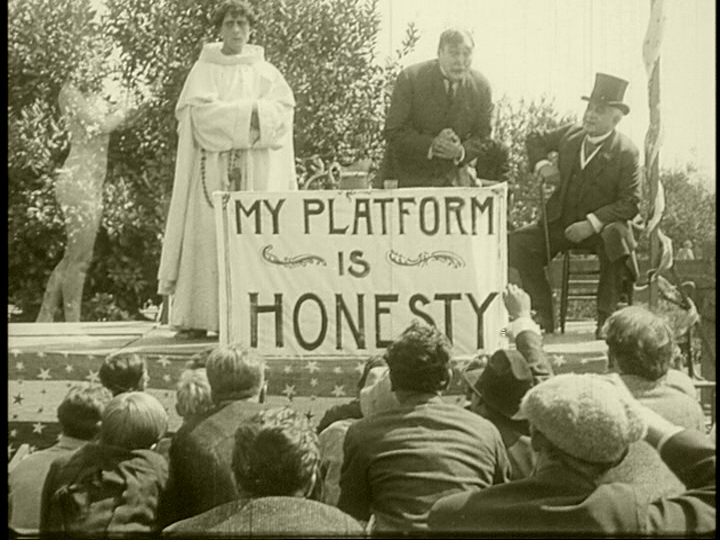
Naked Truth examines political honesty...
Weber was a supremely accomplished film-maker as well as being a direct and opinionated one and whilst this film was entirely an expression of her own philosophy it also contains some marvelous technique and not a little humour. It was an incredibly successful because its simple, robust message chimed so well with contemporary beliefs but also, possibly..., because of its daring use of female nudity. The Truth is naked throughout and she is played by one Margaret Edwards, former winner of a body beautiful competition - "the most perfectly formed girl in the world..." - who reveals pretty much all in misty double exposure… I’m sure Lois knew what she was doing and, because of the religious  content she got her way… mostly.


The film opened on 20th January 1915 at the Longacre Theatre in New York with an actor dressed as a monk providing a live prologue... this was serious and very popular, stuff. The New York Times called it "daring and artistic" whilst the Evening Telegram went so far as to say it was "...the most remarkable film ever seen". Margaret Edwards even appeared at the Los Angeles opening, dancing between the screenings - it was an event.

In spite of scrupulous efforts to ensure that religious and secular authority were won over by the moral message Ohio banned the film and the Mayor of Boston reputedly asked for Truth to be painted over so that the whole truth was less revealed. Never the less, Hypocrites made Lois Weber's name and Mr de Mille was no doubt taking notes...

Courtenay Foote as the priest and the monk
 Hypocrites begins its slightly convoluted narrative in a small-town church in which an earnest priest (Courtenay Foote) is trying his upmost to connect with his mostly-complacent parishioners. Weber’s camera focuses on groups in the audience, a bored businessman here, a distractedly faint-hearted family there and many who would just rather be somewhere else. There’s knowing looks and watch-checking whilst afterwards a senior figure asks for the priest to be removed but to “keep my name out of it”.

These are people caught up in everyday concerns who are just going through the motions, attending church as a social obligation whilst they think of better things to do. Yet there are some who try – a woman in black who looks mournful and another in the choir who gazes with zealous love at the priest, his every word caressing her belief.

And some fell on stoney ground...
But it’s not enough for the preacher and he despairs of truly reaching them, the wandering attention of his own choir being aptly demonstrated by his discovery of a Sunday scandal-sheet featuring a story on Why the Truth has Startled Paris (Truth is again naked in the illustration in the paper… Lois was thorough in her imagery and this allegory is controlled from start to finish).

Exhausted the priest falls asleep and starts to dream of his struggle, finding himself attempting to lead his parishioners up a steep hillside. Few follow, the woman from the choir and the woman in black but the family fail as the father cannot carry their sick child and the banker is weighed down by his money. As the few climb higher and higher the difficulty increase until only the singer remains – near the hill top she reaches out for the priests help but she needs to find her own way to the truth.

Myrtle Stedman asks for help on the path to truth...
As the people cannot make the journey to find the truth the priest asks for the Truth to come to them and the two descend into a story within the dream in which he is Gabriel the Ascetic…

He sculpts a statue of truth which nearly blinds even his fellow monks once it is revealed to the public there is mayhem. The scene involving the unveiling is a great set piece from Weber, her camera panning round a circle of assorted rich and poor,the royal family, soldiers, drunkards, working girls and the innocent. They are made up of the same faces from the church all deaf to the truth with the exception of a young girl, a woman who has fallen too far and a nun who loves Gabriel the man not the monk...

The outlook turns black as the people reject Gabriel...
For the closing section we see a lot more Truth as Gabriel brings her to the modern world in order to hold her mirror up to scenes of politics, high society, relationships, and family. All are found to be flawed with the family facing the death of a child through their over indulgence.

In one remarkable sequence, The Mote in the Eye, the camera focuses on the eye of Myrtle Stedman to show Gabriel's face: she wants to do the right thing but her feelings for him overwhelm her moral decision. It's a great bit of composition and if you look hard enough you can see the cameraman's hand whirring the camera's handle around.

The mote in the eye of Myrtle Stedman
Lois makes sure we get the point, again and again... but her technique is so very polished you have to admire the film even if you don't want the preaching.

There are good, if mannered, performances particularly from Courtenay Foote without which the whole enterprise would fall apart.  Myrtle Stedman is also convincing as the woman with the Ascetic in her eyes whilst Adele Farrington covers her range of roles with assurance and Dixie Carr makes for a mournful Magdelan. Of course, Miss Edwards deserves a special mention for sheer commitment...

Margaret Edwards, Courtenay Foote and Adele Farrington
I watched the Kino DVD which is available direct or from Amazon. It comes with a suitably earnest new score from Jon Mirsalis who helps the film hold its mirror up to the modern viewer... we can scoff at the century-old conceits but, all that aside, are we being true? Lois Weber is hardcore even now...

"Everyone told me that ...plays, aiming at anything like a moral,would never pay... Hypocrites was my first chance to prove that I was right." Lois Weber from a Moving Picture Weekly interview in July 1915.

I would heartily recommend Anthony Slide's excellent biography Lois Weber - The Director Who Lost Her Way in History which is also available from Amazon as an e-book. Thanks to him, she's finding her way back...

Spot the cameraman!

Sunday, 10 August 2014

Moon madness… Salomé (1923)


"Look at the moon! ...looking for dead things."

I’ve always liked the drawings of Aubrey Beardsley who, along with the more painterly Arthur Rackham, defined late-Victorian story illustration with their often unsettling graphics alongside the strangest works of Edgar Allen Poe and others. Beardsley also illustrated Oscar Wilde’s 1893 play Salomé about the curious incident of the prophet undone by seven veils and the impatient impulse of youth… and was a strong influence on the look and feel of Nazimova's filmed version of 1923.

Wilde wrote the play in Paris (and in French...) where he had been familiarising himself with the decadent and symbolist art movements. He supposedly completed the bulk of the composition in a single sitting after an evening discussing the legend with his fellow artists and writers - an act of passionate writing at a time when his life was shifting into radical directions... In Salomé the act of merely looking can lead the soul on a fateful dive into the heart of desire.


Beardsley illustrated the play's 1894 English edition and added his own twist to the central character who in his hands became a knowing, sexually-advanced woman completely in control of her own allure. Even Wilde was concerned his work might be overshadowed by the power of the drawing even though he had initially viewed Beardsley as "...the only artist who, beside myself, knows what the dance of the seven veils is, and can see that invisible dance."

Detail from Beardsley's illustrations for the 1894 edition
Directed by Charles Bryant, Salomé is the quintessential platform for producer and star, Alla Nazimova - a woman aiming to combine both Wilde and Beardley's visions. This mix allowed her to put together  one of the first genuine Hollywood “art” films – an enterprise laced with her European artistic sensibilities from the choice of story, writer, designer and even sexuality… Maybe the rumours of an all-gay cast were just hype, but this story of transgressive - deathly - passion may have additional spice being performed by homosexual actors given Wilde’s proclivities and their eventual consequences.

Earl Schenck and Arthur Jasmine - I don't *know* to be honest...
Whatever the interpretations modern minds may make… it is undoubtedly a superbly-designed photo-play that achieves a lot with essentially a single studio placement. As with Camille, design was provided by the extraordinary Natacha Rambova who, taking full inspiration from Beardsley, manages to capture his erotically-charged decadence if not quite the exactitude of his draftmanship… But no wonder the author of Dorian Grey thought he had found a kindred spirit in this electrically inventive portrayer of the perverse: “I have one aim – the grotesque. If I am not grotesque I am nothing”.

Don't look now...
Such freedom of expression clearly appealed to Nazimova who was forging a brave career through her alien sophistication and an angular, conflicted, expression so at odds with the warmth of mainstream American cinema. Yes she strikes a pose but it rings true and if you look hard enough she’s actually very funny in a “does this bother you…” sort of way.

Salomé is a challenging enough subject in its own right but without Nazimova’s conviction it would collapse in on its own conceit. Salomé needed to be well choreographed to translate the author’s rhythms and, with title cards used only sparingly, the film’s attempts to visualise Wilde’s narrative rest on controlled direction and timing. The pantomime occasionally grates but then some of these characters are plain villains and they are meant to be grotesque…

The look of lust from Herod...
Not Salomé though, she’s just a bored teenager…  just about:  Nazimova was 44 at the time and with expert lighting and deep inches of foundation she carries it off, like Mary Pickford on crystal meth. She sits bored stiff at the table as the regal bacchanal rages all around. Her stepfather, Herod, Tetrach of Judea (Mitchell Lewis) has obtained power by murdering his brother and acquiring his wife, Harridan sorry Herodias, and her altogether more alluring daughter, Salomé.

They party with a collection of bizarre guests, a group of Pharisees who argue over the existence of angels, men in strange hats and with strange hairdos and nervous servants so concerned over the risks of their master’s approbrium that they would rather throw themselves off the battlements rather than be granted an audience with an unhappy King… seriously worse than the corruptions of the American studio system.

Party guests
Tiring of her step-father’s inappropriate attentions, Salomé leaves the banquet hall and steps outside for some fresh amusement. She finds  her  loyal servants Narraboth, Herod’s Captain of the Guard (Earl Schenck) who harbours unrequited love for his mistress and  Herodias’ Page (Arthur Jasmine).

Salomé ignores them and distractedly stares at the stars in a provocative pose before sounds from a deep well break her reverie… These are the prayers and pronouncements of John the Baptist  or Jokanaan in the film and play  (Nigel De Brulier), a seer and prophet  who just won’t be silenced on the subject of the impending Messiah.


Salomé catches one look at his fine chiseled features and slender strength and is hooked, demanding that he be release so that she may learn more. One of her admirers passes on the key not before a confused servant kills himself rather than face Herod’s wrath.

Jokanaan emerges and refuses to be distracted from his cause by the “young” seductress in spite of her best efforts: he knows that even if he glances at her too deeply he could fall. Soon good feeling turns to bad and, in the face of Salomé’s infatuation, faithful Narraboth kills himself in front of his love but she simply steps over his corpse in her attempt to speak closer to Jokanaan. Horrified at this callous disregard and so much else besides, Jokanaan returns to his cell…


“Thy hair, Jokanaan, is like the long black nights when the moon hides her face! The silence that dwells in the forest is not so black as thy hair!”

The film, as the play, makes constant references to the Moon – it’s tied to fate and the immutability of feminine will. What starts off blue gradually gets darker as a skull appears to fill the centre and then the sky runs red as matters descend into madness.


Salomé sulks and as the party finally comes out to join her, is made an offer she cannot refuse by Herod: if she dances he will give her anything she desires. She agrees but doesn't reveal what her prize will be…

There follows the dance of the veil in which Nazimova makes like Lady Gaga and showcases her graceful energy, she’s not quite Pola Negri but she gets the point across. Herod is certainly won over and only stops his inane grinning when she says what it is she wants: nothing less than the head of Jokanaan served on a silver salver.


Initially there’s no one to do the deed as too many have respect for the holy man but finally it is over and Salomé realises exactly what she has lost…. And there’s rather more to come as Herod takes matters into his own hands.

Salomé is wonderfully mannered and exists pretty much in an unsettling world all of its own - surely one of the most subversive films of silent Hollywood and one that undoubtedly confused its intended audience. It was a box office dud that prevented Nazimova from being able to make further films with the same control - still, she's now surely viewed as a prophet not without honour in her adopted country.


Salomé is available on DVD via Amazon and it deserves more than the basic efforts on sale. “We’re all of us lying in the gutter but some of us are staring at the kerb…” as Julian Cope later paraphrased Oscar Wilde’s famous observation…

You can also get the Beardsley illustrated  English version via Amazon... which leads you down a slightly different path.

Sunday, 3 August 2014

BOOK NOW for... A Night at the Cinema in 1914

http://www.flickeringmyth.com/wp-content/uploads/2014/07/night19142.jpg

It’s 1914 and picture houses have taken over Britain’s high streets with greater ferocity than even  the most tax-effective multi-national coffee houses. London has almost 500, Manchester over 100 and Liverpool just 30-odd – what did my great grandparents do with their time?! – for  working  men and women the great escape was well and truly underway. With programmes starting at various points in the evening there was a place to seek imaginative refuge for all shifts.

BFI Silent Film curator Bryony Dixon set the scene as she introduced this special programme aimed at replicating a typical night’s viewing for Britain on the cusp of the Great War. So much film is lost from this period, with as little as 11% surviving from  this year of catastrophic global destruction. We are lucky to have what remains and  all 14 films (natch) provided a good sampling of the information and entertainment available from fly-away balloons, to un-submergable submersibles via face-pulling competitions and a rajah rollicking...

The Rollicking Rajah
All were sound-tracked by the fleet-fingered Stephen Horne who skilfully interwove contemporary themes with his own trademark energetic invention. Stephen knows the musical sensibilities of the period like few others and he also brings his own rich flourishes. When Pauline’s in peril you might expect generic jeopardy themes but Mr Horne also adds an element of romance as the hero relentlessly pursues his stricken love as she’s torn from frying pan to fire and back again.

Sadly Stephen wasn’t playing live tonight but there’s a reason for that as this show goes on the road playing in over 40 venues across the UK and his music has been recorded including, he told us, the odd bum note for added authenticity... I didn't hear any!

This is an excellent initiative from the BFI and we owe it to ourselves to go see and support as much as possible and, after 1914, I can’t wait for the follow up, rumoured to be 1915!

Palace Pandemonium
The programme features fascinating snippets such as Emmeline Pankhurst being rather forcefully escorted by the Police to present a petition to Buckingham Palace – a moment of genuine historical drama and significance. You felt like shouting out - don't worry you're going to win! More was to follow as we saw the wedding of Archduke Karl , successor to his murdered brother Franz Ferdinand as ruler of the Austro-Hungarian Empire as the war began.

There were flying demonstrations from Hendon and  a viewing of the dogs Shackleton was to  use for his expedition to Antartica – there was a good deal of product placement with adverts for their reliable dog feed plastered all around… the golden age of advertising had begun.

German troops parade through Louvain
The great war obviously changed the tone of 1914 but the documentaries remain upbeat showing Egyptian soldiers, our helpful boy scouts and soldiers relaxing at Christmas. There was also remarkable footage showing the German occupation of Louvain in Belgium – clearly not filmed by a British camera.

A sharp political edge was delivered by the fascinating stop-motion  water-colouring of Laurence Speed: General French’s Contemptible Little Army. German military aggression was the target and the soldiers of the Empire gradually joined forces to trap the Hun before the Russian Bear…drawn to life with quick-drying alacrity by Speed's unerring brush-strokes.

Florence Turner
Daisy Doodad’s Dial was a frankly bizarre comedy short from the Amercian comedienne Florence Turner who was based in  Britain. It concerns the efforts of Ms Turner and her hubbie to win a face-pulling competition - whatever happened to those? They’re both very adept but Florence's facial flights of fancy end up getting her arrested before she finally wins out with her gentile gurning.

Fred Evans and his special effects
If Daisy's daft Lieutenant Pimple is off the scale silly. Fred Evans character featured in something like 200 films and in this episode, Lieutenant Pimple and the Stolen Submarine, he overcomes a potentially crippling micro-budget to help the Royal Navy save a secret submarine from being snatched by spies. The enemy manages to submerge the supposedly unsinkable sub but Pimple goes after them with the aid of low-tech diving gear and his ability to seemingly breath underwater and to send messages via carrier carp/homing perch...

Up, up and away...
There was more believable jeopardy in The Perils of Pauline in which Pearl White's queen of the serials survives being cast adrift in a balloon, kidnapped by baddies and is left tied up in a burning house. Can the hero ride to the rescue in time? No spoilers...

Throughout Mr Horne's accompaniment kept pace with the diverse moods of drama and documentary but he was faced with perhaps his most entertaining challenge with The Rollicking Rajah.... This film originally came with a synchronised soundtrack on disc using the Vivaphone sound system.Sadly the disc no longer survives by Stephen was able to recreate the music with the aid of splendid vocalisations from the BFI's own Tim Everett. It was superbly done and there's something supremely unsettling about seeing a talking movie from 1914: it has to be heard to be believed - something like the missing link in re-connectivity.


The evening climaxed with a thunderous comedy from an English music hall star making big waves across the pond; Mr Charles Chaplin in A Film Johnnie. This Keystone comedy has Charlie in his spiteful drunk phase getting hopelessly confused about the nature of reality when he falls in love with the Keystone Girl, Virginia Kirtley and setting off to rescue her from her cinematic enemies...

It was the slickest offering on show and points the way forward to the eternal dominance of Hollywood but Johnnie was not necessarily the funniest and the very British quirks on view resonate more: we haven't changed at all.

A Night at the Cinema in 1914 plays across the UK throughout August and beyond. I would urge you to go and see it if you can and, please, don't forget to remove your hat once the screening begins.

Showtimes and venues are detailed here on the BFI site.


The most poignant clip showed British troops celebrating Christmas at the front. Optimistic expectations that the show would be over by that point had been dashed as the two sides dug themselves deeper into their infernal trenches. How many of these men saw out the war?

Monday, 28 July 2014

Be careful what you wish for… The Red Shoes (1948)

 
`Why do you want to dance?' `Why do you want to live?'

A film about ballet for people who don’t necessarily like ballet, a populist “art” film and a fairy tale where the magic is provided by human drive and imagination… The Red Shoes isn’t straightforward at all but then what Powell and Pressburger film ever is?

The centre piece of the film is the 17 minute Red Shoes ballet which abandons any pretence at theatrical reality by taking off into a cinematic flight of fantasy that Gene Kelly could only dream of. The film is magically real – perhaps the very peak of The Archers’ trademark style and one that confused their distributors so much that they never gave it a proper premier in the UK. Unable to reconcile the adult content in what they presumed was a family film, Eagle Lion all but buried The Red Shoes until a record-breaking response in New York lifted it to international success and eventual recognition as one of the greatest films ever made.


From this distance you can still understand their response and this film isn’t as far away from Peeping Tom as you might think, as Moira Shearer’s presence in the latter may well prove. Miss Shearer was a prima ballerina with the Royal Ballet, perhaps second only to Margot Fontayne in London at the time. So, unlike Black Swan for example, here we have a actress who can actually - really - dance and who moves with the dangerous grace founded on the bruised flesh and cracked ankles of a thousands days’ practice. She is authentic and fascinating: a delicate beauty, whose sensitive features are crowned by a mass of rust-red curls and set atop a body perfectly poised: you can really only be this way if you have no other choice.

Moira Shearer,
Moira may also be simply one of the most beautifully-filmed redheads in cinema history. Jack Cardiff was the man and his cinematography is revealed by the recent Criterion Blu-ray to be even better than I had imagined. The extremes of porcelain white and red are almost impossible to photograph sympathetically, especially against the sumptuous backgrounds used by Powell but Cardiff’s depth of field reveals even Shearer’s freckles.

My wife, a redhead herself and no mean ballet dancer in her youth, was suitably impressed – solidarity of colour and tone. The reds… they know more than they let on.
Robert Helpmann, Moira Shearer and Léonide Massine
Shearer is not the only dancer in the film and there are notable parts for Ludmilla Tchérina as Irina Boronskaja, Robert Helpmann as Ivan Boleslawsky and Léonide Massine as Grischa Ljubov. Powell effectively put together his own company for the film and this plays a major part in the authenticity: these characters knew how to act around each other.

But the non-dancing cast was also well-chosen and none more so than Anton Walbrook who’s Boris Lermontov manages to be maniacally controlling and also strangely vulnerable. He carries a natural authority and with trademark restraint manages to underplay a role that could so easily fall flat through an excess of grim single-mindedness. Boris just needs to find beauty in his art and even the prospect of being danced to in the inappropriate surroundings of an after-show party is too much for him to bear.

Anton Walbrook and Léonide Massine
But the dancer in question is one Vicky Page (Shearer) who has already caught his eye over a ladle of punch: she agrees with him and impresses with her own determination to perfect her craft – as the above quote reveals, she has no option but to dance. Is she really as single-minded as her statement suggests: is dancing all she can do with her life?

Vicky’s inevitable rise is held back by Powell as she joins the ranks of hopefuls in Lermontov’s troop and we’re immersed in the life of the ballet. Also involved is a young composer Julian Craster (Marius Goring) who has impressed the great director with a composition that has been ruthlessly stolen by his music teacher. Lermontov points out that it is better to be capable of producing such a work than to have to steal another’s creation and commissions him to write a new ballet, The Red Shoes…

Marius Goring
The ballet is based on Hans Christian Andersen’s fairy tale which provides the perfect metaphor for the broader story of creativity versus life and other interests. Pressburger had originally drafted a treatment in the late thirties and now, after the changes in tone made necessary by their wartime cinematic service, the Archers were ready to make such an escapist film. Being them, this fantasy focused on the reasons we make art: is it possible to share a passion for creation with love or can attainment only be achieved through sacrifice?

Simple enough questions on the face of it but Powell and Pressburger succeed in walking the line between clarity and complexity and, in Moira Shearer, they have an acting presence capable of expressing actual hard-won genius on screen. Everyone else is posturing (albeit skilfully) but she demonstrates the end product… she’s the real deal.


The music by Brian Easdale is another element that has to be as good as the story demands: his music is the soul of Craster and an expression of his love for Vicky. Brian takes this near impossible brief  in his stride though and his compositions are wonderful, especially for the Red Shoes ballet itself – the only section he didn’t conduct, that was left to the mighty Sir Thomas Beecham. Easdale went on to win the Oscar for Best Original Music Score: the first Britain to do so.

Some films get lodged in the “canon” by reputation alone but The Red Shoes is one in which every major component is no less than excellent… it’s a film about ballet sure enough but also the most basic questions of life: this is why it continues to resonate and to retain its power.


 If you don’t already have it and you probably do… the Criterion Collection version is superb and the UK Blu-Ray uses the same transfer (I think?). Movie Mail has the latter plus DVDs whilst you’ll need Amazon.com for the former. You can also buy Brian Easdale's soundtrack on CD.

“Why do you want to watch classic film…?'  because they're entertaining. Not quite as good is it...?

Thursday, 24 July 2014

How I met my mother... Faces of Children (1925)


Never work with animals or children unless, that is, the children are exceptional actors… My cold cynical heart had prepared me for the worst with this tale of childhood anguish but, once again my friends, I was so wrong. Jacques Feyder’s film is a naturalistic marvel and one that at 90 years’ distance, Faces of Children (Visages d'enfants) still rings true with steadfast honesty and Feyder’s iron grip on the dimensions of genuine, emotional, narrative.

A good deal is also attributable to the film’s remarkable lead Jean Forest, who was just 12 at the time and plays with the controlled intensity of a boy twice his age. The director had featured him in his previous film, Crainquebille and probably wrote Faces… with him in mind – you can only make this kind of story work with such a freak of acting nature.

Jean Forest
But Feyder hits hard right from the extraordinary opening showing the funeral of the boy’s mother. In ten minutes or so of potent, economic cinema, the director introduces the main players and the situation against a stunning backdrop of a village nestled high in the Swiss Alps. It is beautifully sad and the worst of all situations: a mother dead leaving her young children all too early.

Victor Vina and Jean Forest
Pierre Amsler (Victor Vina) is the mayor of the remote village of Saint-Luc and his son Jean (Forest) is just.10 years old whilst his sister Pierrette (Pierrette Houyez) is merely five. Amongst the serious adult mourning, Jean looks on in shocked silence as the funeral process unfolds and his mother’s coffin is lowered down the stairs in their chalet. Pierette is too young to understand and is told that Mama has gone away for a while, but Jean is old enough to understand that he’ll never see his mother again.

The procession extends out of the house and through the snow-covered streets to the cemetery at the edge of the town. Jean follows alongside his weeping father whilst we keep cutting to see Pierrette playing with a neighbour… The boy braves the entire ceremony before finally collapsing in sadness… you’d need a heart of stone not to be moved but Feyder isn’t just creating a melancholy drama; these are well-drawn characters showing natural grief.

Rachel Devirys and Victor Vina
The months pass with father and son paying due respect to the departed but Pierre begins to worry about his childrens’ care with no mother. He starts to court a milk maid Jeanne Dutois (Rachel Devirys) but hasn’t the heart to tell Jean of his intentions. There doesn’t appear to be anything calculated in this new relationship as events will bear out…

Jean mourns his loss intensely, saying his prayers in front of a portrait of his mother each night. The portrait comes to life and his mother (Suzy Vernon) smiles down at him.

Jean Forest and Rachel Devirys
The new couple agree to marry but Pierre cannot tell Jean and sends him away with his godfather, Canon Taillier (Henri Duval) who is to break the news as best he can… As Jeanne and Pierre marry the priest tells Jean who resolves to support his father and make the best of things.

Things get off to the worst possible start as Jean returns home to find himself locked out. He cannot convince his new step-sister, Arlette Dutois (Arlette Peyran) that this is his home too and, having got off on the wrong foot, their relationship swiftly deteriorates.

Yes, Michel Hazanavicius has probably seen it...
Jean is relegated to a small back room as his sister shares his old room with Arlette – he resents everything that moves the family on from how they were. Jeanne is unrelentingly kind and fair minded never giving Jean a real reason to dislike her but he doesn’t need one as he works through his anger at the nearest targets: the symptoms of his mother’s absence and not the cause.

If all this sounds like standard emotionalism it’s probably because the subject matter has been done many times before and since but it’s all about the execution. Faces of Children feels like a well-written book, engrossing and never over played.

Pierrette Houyez, Jean Forest and Arlette Peyran
No spoilers… The battle between the children hots up as Arlette tries to  involve herself in the other’s games. She invades their little island where they are trying to roast chestnuts only to be repelled and pushed into the water by Jean: whatever she dishes out he sends back with increasing spite. Jean is tormented a boy trying to process adult grief and lashing out at anyone who even inadvertently increases his sadness.

Through it all his parents remain patient and Arlette – as we grown-ups can see – makes every allowance. Perhaps this only makes things worse as Jean finally begins to push things too far and lives are put at risk.

Arlette Peyran
The closing segments of the film see Feyder rapidly pick up the pace and torture the audience with the prospect of unbearably unhappy endings: you’ll just have to sit through these moments yourself because I can say no more without spoiling things.

As controlled film making, Faces of Children ranks with the best of French (and indeed Belgian) silent cinema. The leads are all superb and whilst the three children are the obvious standouts it’s also worth highlighting the performances form those adults forced to work with them… Rachel Devirys  is especially nuanced as Jeanne.

Searching by lamp light
The cinematography from Léonce-Henri Burel  and Paul Parguel is also superb, especially in the later night time scenes whilst they capture the majesty of the background locations as well as the intimacy of the children’s interior lives. Both had worked with Gance and it shows in the snows…

 
The film was poorly preserved after a disappointing commercial return and was only recently restored and then given a digital clean-up by Lobster Films as part of its essential Jacques Feyder box set. There’s also an excellent score from Antonio Coppola which perfectly matches the tone and the texture: good work all round team Lobster!

The film is available on its own or as part of the set either direct or from the likes of Amazon. Buy it and be prepared to risk wiping away a tear or two before the film’s end…