I will never gush about Faster, Pussycat! Kill! Kill!...
But I think it’s the least objectionable of Meyer’s films…
Danny Peary, Cult Movies 3 (1988)
You don’t have to believe it honey, just act it! Now let’s
move.
Varla, Faster, Pussycat! Kill! Kill! (1965)
John Waters described this film as not just the greatest film ever made but also the greatest film that will ever be made and in this demimonde of hyperbole and Mondo-trash aesthetic who can deny it, Mr Peary aside. For tonight at the BFI felt like an evening at the Scala in the mid-80s or rather, felt like the people sitting in NFT1 wanted an evening to have felt at the Scala in the classic era. There were quite a few of us who were there first time round and a truck load of people who weren’t even born but it matters not, this was the spirit of purely cinematic enjoyment we were here to capture and it was just what Mr Waters and Mr Meyer especially would have wanted.
Most spectacularly of all, Virginie Selavy, who had dressed
as Tura Satana’s character Varla, for her groovy introduction, was then joined
by two other women, dressed as Rosie and Billie, to give a go-go dance to the
film’s theme music against some pop art projection. It was far out, and, as
someone who first heard the theme on The Cramps live album, Smell of Female
(1983), complete with Lux Interior’s brief precis of the film, it felt like the
completion of a circle… Post punk weirdos from The Cramps to The B52s have
given credence to Meyer’s film and now felt like the turn of mod feminists.
 |
| Virginie Selavy and friends kick things of! |
I can get a little queasy watching Meyer’s work, but as
Selavy said, this was someone with a vision and who had quite some experience
having filmed the Normandy landings. He wanted to create escapist cinema and to
give the people what he thought they wanted. His film co-scripted with Roger
Ebert – yes, that Roger Ebert! – Beyond the Valley of the Dolls (1970)
was a bigger budget effort to translate his ideas of fast-paced, well-endowed
camp onto a more colourful screen but maybe he was better in the black and
white of this more “restrained” period with Motorpsycho (1965) and this
film.
He favoured single takes where possible driven by budget
and perhaps the documentary and industrial film background. He was aided by
Satana who was a woman of many talents and choreographed her fight scenes and did
all her own stunts. She’s a dynamic presence and sets the tone for the others,
Haji as Rosie and Lori Williams as Billie to follow. The three of them are
dancers at a strip club – the Pussycat Club was mentioned – on a weekend
vacation driving masculine sports cars in a masculine way. Varla has a 1964
Porsche 356 C Coupé [T6], Billie a 1959 MG A 1600 Mk 1 and Rosie a Triumph TR3
A… if the cars are what you’re looking at, in fact you’re probably distracted enough
not to notice them sometimes.
 |
| Lori Williams,Tura Satana and Haji (birthname Barbarella Catton) |
The opening is at breakneck pace as the titles,
supposedly filmed at the Pussycat Club, Sepulveda Boulevard, Van Nuys, see the
girls heading out on an adventure, driving their cars far too quickly out to
the flats of the Mojave Desert in California, scene of many a western and the
closing segment of Erich von Stroheim’s monumentally brutal silent epic, Greed.
If he’s watching on somewhere, I’m sure he’s smiling…
There’s tension between the women, as Billie more careless
than the rest is challenged by Rosie who has a clear eye for Varla, their
leader. These are the rapacious new breed of sexualised “violence” as described
in the introductory narration from John Furlong “… encased and contained within
the supple skin of woman, whose auspices bear the unmistakable smell of female…
Handle with care and don’t drop your guard… women operating alone and in packs…”
It hardly makes sense but we soon find out the salacious truth as a couple arrive in a 1963 MG B. Bikini-clad Linda (Susan Bernard) and boyfriend Tommy (Ray Barlow) are there for time trials but Varla challenges him to a race and, cheats to win leading to a fight in which she uses her martial arts to not only beat him she breaks his back – “…far too stiff in this heat, he’s had a bad accident!” They take off with witness Linda drugged and unconscious.
 |
| Porche, MG and Triumph! |
A lot happens at a gas station as their cars are filled
by a distracted attendant (Mickey Foxx) who provides some odd comedic moments
as well as setting up the rest of the film as he tells of an old man (Stuart
Lancaster) who hoards thousands of dollars on his remote homestead with one
hulk of a son called – cringe - the Vegetable (Dennis Busch) and another, Kirk (Paul
Trinka) who looks and acts as if he’s just walked into the wrong movie.
Now the girls have two tasks, a) to get away and b) to steal
the money but they’re up against an older equally rapacious violence in the
form of the abusive old man and his “damaged” son who has almost superhuman strength
and is easily triggered. So, it’s survival of the fittest for the rest of the
film, but, Meyer always has his almost quaint sense of morality there to
counter and excuse the exploitation.
It's the highest quality trash and stylish with potential redemption in the agency the women have and the greater evil they must ultimately face even though it is an excuse to bring out some heroic qualities. Luckily the BFI audience are all more than capable of contextualising this film and recognising the witty script, crisp narrative and overall dynamism. Still, there was a feeling of guilty pleasure… which is so very “Scala” isn’t it?
 |
| Male pride about to come before a fall. |
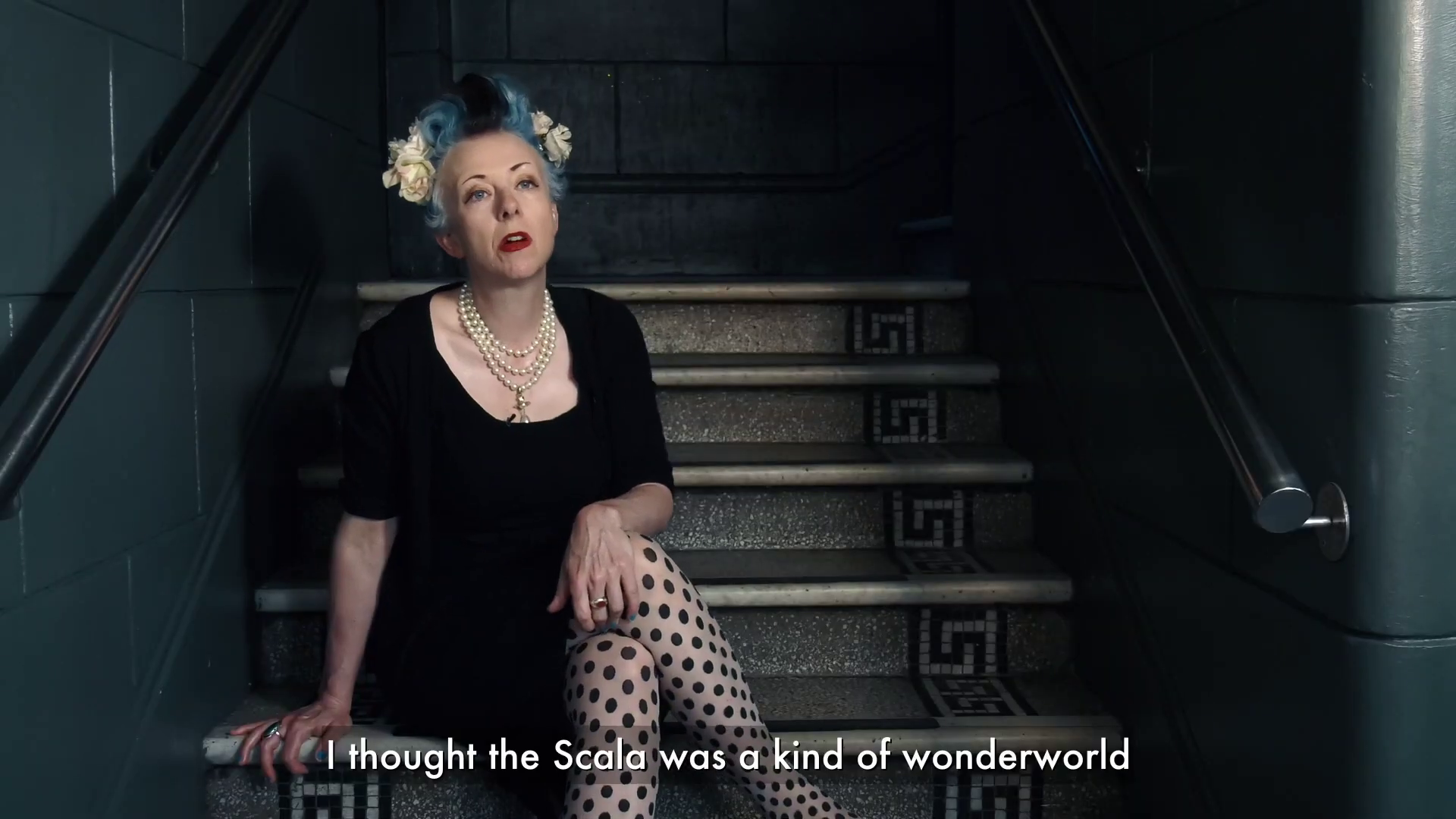
The season of the Scala’s greatest hits, Scala: Sex, drugs
and rock and roll cinema, runs at BFI Southbank throughout January and also online with selected films on BFI Player!
SCALA!!! Or the incredibly strange rise and fall of
the world's wildest cinema and how it influenced a mixed-up generation of
weirdos and misfits.
Jane Giles and Ali Catterall’s debut film is also released
on 22nd January on BFI Blu-ray, BFI Player Subscription Exclusive,
iTunes and Amazon Prime.
In addition to their astonishing film there’s a tonne of special features:
- Audio commentary by directors Jane Giles and Ali Catterall
- Scala Interviews (2022, 60 mins): previously unseen bonus footage shot for the film
- Scala (1990, 35 mins): a portrait of the cinema made for Cable London
- Scala Cinema (1992, 4 mins): student film shot at the Scala
- Shorts shown at the Scala (1989-1991, 60 mins): a selection of short films seen at the cinema:
- Relax (Christopher Newby),
- Flames of Passion (Richard Kwietniowski), and
- Coping with Cupid (Viv Albertine, yes, her from The Slits!)
- Animations by Osbert Parker (2022-2023, 4 mins total)
- Cartoons by Viz artist Davey Jones (2022, 3 mins)
- BFI London Film Festival introduction featuring cast, crew and audience participation (2023, 13 mins)
- Scala Programmes 1978-1993 (2023, 12 mins): a closer look at 15 editions – the Scala’s graphic design was a key part of the brand and reflected the spirit of the whole enterprise!
- Cabinet of Curiosities (2023, 18 mins): a guided
tour of ephemera, photos and clippings from the Scala archive
- Trailer
- An illustrated booklet with an introductory essay and Director’s Statement from co-directors Jane Giles and Ali Catterall; Scala Spirit 1993-2023 – former Scala programmers select the films they would have programmed following its closure; an essay by film director and animator Osbert Parker; notes on the special features and credits.
The booklet is only available with the first pressing so
please be quick and order your copy today via the BFI Shop in person or online!
The Scala Spirit must live on as we forge forward in ’24…