Showing posts with label Tore Svennberg. Show all posts

Thursday, 23 May 2024

Selma's ghosts... The Phantom Carriage (1921), with Stephen Horne, Kennington Bioscope


O God, grant that my soul may ripen before it is gathered in.


For years now I’ve had in my head the plan to write a Christmas story of the kind that Dickens used to write…*


After a few years of this silent film business, you have seen most of the cannon and have your own list of The Greats but all such classifications are blown out of the window when you see a screening like tonight’s with the right venue, the right audience and a supernatural accompaniment from Mr Stephen Horne that not only sent chills but brought out the full flavour of Victor Sjöström’s film and, indeed his own performance.


Not only was Sjöström probably Sweden’s finest silent film maker, he ranks as one of the finest of any era. Here with his fourth adaptation of one of Selma Lagerlöf’s works, he shows again why he is such a good interpreter of her work. Selma’s work is passionate and poetic and deceptively complex in expression and narrative form – trust me, I’m reading Gösta Berling yet again! Sjöström takes his time and makes her key points with precision and power: his two films based on her magnum opus, Jerusalem, use only the first 70-80 pages whereas Gustaf Molander gobbles up the remaining 400+ in his action-packed brace.


Perhaps Sjöström was more concerned with meaning and, as his stunning performance shows, he may well have had a personal connection with this story as Chris Bird suggested in his introduction, for the Swede’s father was abusive and alcoholic just as Sjöström’s David Holm is. For most of the film, Holm seems irredeemable, not just continuing to fall back into his old brutal ways but actively enjoying his cruelty in ways that suggest extremes of self-hatred. It seems that nothing will make him change, even when his actions throw his family into poverty, even when he is given another chance by his long-suffering wife played with high-intensity and the last flickers in the saddest eyes by the wonderful Hilda Borgström – who had previously starred in Sjöström’s Ingeborg Holm (1913).


Hilda Borgström and Victor Sjöström

Both Borgström and Sjöström can create so much atmosphere, soundlessly signifying the break-up of their marriage, hiding from each other and seeking oblivion in different ways and good as he is, nothing makes Sjöström’s Holm so frightening than Borgström’s reactions to him as he bashes down the door in their apartment she is exhausted and just drops to the floor. This is a film about domestic violence and the ties that suffocate.


The film is based on Lagerlöf’s 1912 book Thy Soul Shall Bear Witness! (Swedish: Körkarlen) after she had been commissioned to write it by the Swedish Tuberculosis Society* as a means of public education about tuberculosis ("consumption"). Holm has consumption and whilst he self-medicates with alcohol, he is also happy to cough in other’s faces to broaden his revenge on the world; sadly, this doesn’t sound so unlikely after our experiences with the Pandemic. As her recent translator Peter Graves has said, in The Phantom Carriage she manages to keep two balls in the air – the ghostly plane alongside the gritty slum story – without lessening the impact of either. Her director is able to maintain this ingenuity.


Holm is Swedish for Day, and appropriately enough, the action largely takes place over the course of a day – New Year’s Eve - with a potentially complex series of flash-backs deftly used to explain more of the background to Holm and the supernatural events that will be used to show him the reality of the world he has made.


Astrid Holm and Lisa Lundholm

Chris Bird rightly lauded the cinematography of Julius Jaenzon especially his ability to create the ghosts through in camera trickery and multiple exposures. Knowing that they were using wooden Pathé cameras – hand-cranked – makes the effects even more impressive. Chris read out a number of letters from Sjöström to his wife complaining about the slow progress on the required night-shooting and repeated takes but the results are ground-breaking in the cinematic world of 1921.


The story begins on New Year's Eve at the death bed of a salvation army worker, Edit (Astrid Holm), who calls out for a last visit of one David Holm (Sjöström). But Holm won't come, preferring to carry on getting sloshed in the graveyard with his drinking buddies. He tells them of a tale concerning a carriage driven by the last person to die in each year, which takes the spirits of the dead to their afterlife. A fight breaks out and Holm himself becomes the last fatality before the clock strikes midnight. He is greeted then by the phantom carriage and its ghostly driver, his friend and the man who first related the tale, Georges (Tore Svennberg). George it was who first led Holm into the life of drunken depravation and here he has come to collect Holm's mortal soul and take it to account for the life he has led.


It is now that the real horror begins as we learn about the un-making of the man through the intricate flash backs that gradually tie up the backstory. We see Holm’s estrangement from his wife and his pursuit of them across Sweden and how he ends up seeking refuge at the Salvation Army hostel run by Edit. She tries to help him by mending his jacket but he cruelly rips apart her handiwork and tells her he needs no saving… a defiant act of calculated cruelty but he’s picked on the wrong Christian, Edit won’t stop trying.


This is as uncompromising a film as you’ll find and it takes any lazy preconceptions by the throat and hands them back to you in pieces. The true horror is not ghostly carriages but in what people do to each other and themselves and the chances they let go. The film's prayer quoted at the top seems to me a very humanistic sentiment as much as religious: let me comes to terms with who I am before it is too late.


Victor Sjöström times two plus Tore Svennberg

Chris said that a 24-piece orchestra accompanied the film’s British premier in Leicester Square and tonight we had the closest it’s possible for one man to get with Stephen’s multi-dimensional accompaniment. There were the potent emotional lines you’d expect from his piano playing also, plucked strings, harmonium and flute with a spine-tingling reverb set up to stretch the latter’s pure notes to maximum uncanny affect. The man in front of me couldn’t quite believe what he was hearing and looked away briefly from the screen to check that there wasn’t a group of ghostly musicians playing along…


The Phantom Carriage is full of camera trickery and we also had a fabulous fantasy from Georges Méliès, the man who invented so many in-camera tricks, here with the 16-minute epic The Kingdom of the Fairies (Le Royaume des fées) from 1903. This is Méliès in excelsis with hand-coloured frames – courtesy of a Madame Elisabeth Thuillier according to Chris Bird – and which bring out so much delight in this relentlessly imaginative film. John Sweeney played along in complementary style, full of contemporary flourishes and rich detail to match the unparalleled invention on screen.


Another evening of pure quality all round at the Bioscope, epic in fact… thanks to all involved!


Great job Madame Elisabeth Thuillier!

*A letter from Selma Lagerlöf to her friend Sophie Elkanas per Peter Graves in the publication below…


**From Helena Forsås-Scott’s introduction to Selma Lagerlöf, The Phantom Carriage translated by Peter Graves, Norvik Press (2011)


Monday, 17 November 2014

Into the light... Sons of Ingmar (1919), Cambridge Arts Picturehouse with John Sweeney


This was a rare experience and in her excellent introduction, Trish Sheil, Film Education Officer for the Cambridge Film Consortium, explained why.  Victor Sjöström’s Sons of Ingmar exists only on 35mm film – it is not digitised – and the Swedish Film Archive only allows prints to be shown via double reel projection which the Picturehouse is now rare in providing. Our live projectionist also had to multi-task by manually inserting English subtitles, sometimes shadowing the screen to facilitate legibility – something like patting your head whilst rubbing your tummy at the same time.

The film only gets screened once in a silvery-blue moon and as Trish said makes for interesting comparison with Mr Griffith and other the leading lights of Hollywood with its moral complexity, naturalistic acting and novelesque narrative. The film pulls you along at its own pace, only exposing the depth of its characters sparingly and if you’re not wiping a tear from the corner of your eye by the end you’re probably not human.

Victor Sjöström
Set almost entirely against the Swedish countryside there is breath-taking cinematography from Julius Jaenzon which seems to push against the limits of the settings. At times he is shooting almost against the sun or at least with the light pouring diagonally onto the performers allowing for some extremes of light and shade that go against the contemporary rule book yet add to the engagement – you’re gripped by the unconscious response as the actors and the elements merge almost into one.

This risk-taking is most in evidence in the sequence outside the prison – so highly praised by Ingmar Bergman in Gosta Werner’s Sjöström documentary* - when the bleached white stone and sunshine confounds the eye as the players try hard to gauge each other’s feelings, blinking in the bright light searching for a reaction that confirms genuine love or pity.
 
Searching through sunshine
Sons of Ingmar
was the first of a series of films based on Selma Lagerlöf’s novel Jerusalem – Sjöström planned to make five but only completed this one and the follow up Karin Daughter of Ingmar , with Maurice Stiller directing a third. Nobel Prize winner Lagerlöf was a major figure and this adaptation was by over half the population of Sweden within weeks of release.

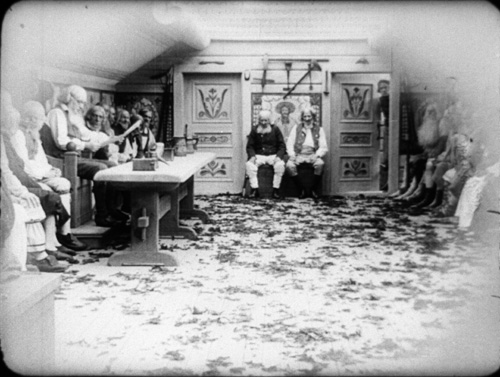
Her novel was an immense multi-generational parable involving an attempt to found a new Jerusalem – the dream of a “return” that haunts the subjects of a society in flux. Sjöström’s opening section reflects this as Lill Ingmar Ingmarsson (Sjöström) tills his field, mulling over a difficult decision and daydreaming about discussing it with his deceased father (Tore Svennberg).

 https://d2t98m0n7ql7on.cloudfront.net/newman/static/atchs/Content/m1/m1g1g.jpeg

He imagines a huge stepladder leading up to the clouds and slowly climbs his way high above the fields, the countryside and all of Sweden. He is greeted by a bearded St Peter who directs him to his father’s homestead – surrounded by lush fields and heavenly host of heifers…  He finds his father holding court in a large room full of dozens of generations of Ingmars: the heritage he must live up to.

If all this sounds fantastical then you have to bear in mind the Swedish sense of humour…  Sjöström’s Ingmar is a bit slow with a lower lip almost perpetually pursed as he over-thinks almost everything but, bear with him; he has some tough times to live through.

http://www.davidbordwell.net/blog/wp-content/uploads/Ingmarssons-500.jpg
The old sons of Ingmar
His father leads him to an ante room where young Ingmar begins to unwind his tale of woe…

Shortly after his father’s death Ingmar had decided to take a wife and had proposed his intention to the parents of local lass Brita (Harriet Bosse) – father (Hjalmar Peters) and mother (Svea Peters). They accept on their daughter’s behalf but she, still sweet on an old boyfriend, is not impressed at all… especially as, their banns published, it is decided that she should go to the Ingmarson farm to help out while the wedding waits.

Brita struggles on the farm, distancing herself from Ingmar and his aloof Mother (Hildur Carlberg) who can hardly move for knitting and is a slave to the routines of hard work. Only the alert middle-aged maid Karin (well-played by Jenny Tschernichin-Larsson) seems to notice her pain…

Jenny Tschernichin-Larsson and Harriet Bosse
Things get much worse as Brita gets pregnant as Ingmar obviously couldn’t wait for wedlock… she nurtures a hatred for the family around her and vows to make Ingmar suffer the only way she can. One day Brita disappears and after a night of frantic searching, she is found with her stillborn baby…

Brita is tried for murder and the whole village turns up to pass judgement of their own…  she can sink no lower and yet Ingmar speaks out on her behalf, accepting his part in the breakdown of their love and pleading for leniency: if she would only change her mind about him, he would marry her.


Brita’s eyes spark open with hope and yet, when her mother asks him if he meant it he says only that he was trying to get her a lesser sentence… “she has killed all love in him”. Never-the-less, Brita heads off to jail with hope in her heart whilst Ingmar returns to his farm weighed down by remorse and tainted love…

Three years on, as he asks his dead father, should he take Brita back or let her go to start again in America, all shame left behind. It’s a tough call and as the old man goes off to consult the massed ranks of the male line, Ingmar comes to his earthbound senses and makes his decision or does he?

Harriet Bosse
No spoilers…

By this stage of the film you are convinced of the resolution but Sjöström doesn’t allow such certainty to linger long and it’s anyone’s guess as miss-communication worthy of Antonioni ensures the audience is left willing the characters on against seemingly insurmountable odds of church, community and family.


This is surely amongst the most genuinely compelling dramas of the period with superb, restraint and power from Sjöström as well as from Harriet Bosse who’s character does a hateful thing but must still somehow gain our sympathy – you wouldn’t get that kind of role in a DW photo-play.

John Sweeney provided expert accompaniment helping to create a live event that will live long in the memory and that’s exactly where it will remain unless this opportunity ever comes our way again or that dream box-set of Sjöström rarities ever gets released. As it was, Sons of Ingmar was a transient experience just as it was always intended to be… a bit like life I suppose.


*The documentary is an extra on the Kino DVD release of The Outlaw and His Wife and shows the only digitised sections of the film from which I’ve captured the above images.

Saturday, 6 September 2014

Judging Jenny Hasselqvist … Vem Dömer (1922)


This is a film with many alternate titles Love's Crucible, Judging?, L'épreuve du feu, Who judges?, Mortal Clay, The Acid TestGod's Judgment… Maybe the distributors struggled with the precise meaning of a photo-play that is clearly more than it might seem.

Vem Dömer was Victor Sjöström’s follow up to The Phantom Carriage and was a lavish production premiered on New Year’s Day in 1922 accompanied by the Red Kvarn Orchestra and a publicity campaign including an illustrated book of Hjalmar Bergman’s story. Sjöström co-wrote the screenplay and whilst this tale of illicit period romance may appear atypical it has much in common with its predecessor and the director’s earlier work. Just as characters in There Was a Man and The Outlaw and His Wife must endure extremes in order to survive, so must Jenny Hasselqvist’s Ursula overcome not just a physical test but also a moral one:  she has to judge herself.

Gösta Ekman and Jenny Hasselqvist
I’ve raved about Jenny Hassselqvist before and she gives a great performance here with her ballet dancer’s physicality under-pining an energetic focus that draws the viewer in like few others. From the first moments when she is shown praying alone in the cathedral to her stunning appearance in silhouette mounting the wooden steps for her ordeal by fire, she holds herself so well and is able to convey so much just through posture – it’s remarkable. Then for her close ups, as she wrestles with the guilt of love and betrayal, she conveys a very modern, Huppert-esque intensity….

Interiors
The film is in dark contrast to Sjöström’s al fresco classics and is largely studio-based with the majority of exterior shots taking place at night. This puts the focus firmly on the main players… it’s dark and claustrophobic and you can count the smiles almost on one face. Given this delicate darkness, it’s a shame that there isn’t a restored version generally available:  the sections included in the Sjöström documentary on the Kino discs, reveal so much more of the lighting, set design and Hasselqvist’s expression than the copy I was able to view.

Gösta Ekman
But, even given the low-res limitations, Vem Dömer is gripping viewing. It’s an ostensibly Christian tale of faith in truth and love yet it’s also a meditation on self-doubt and guilt: redemption comes either through a kind of miracle or the realisation of truth… the choice is yours.

The plot: The film opens with Ursula praying alone, dwarfed in the dark mystery of a medieval cathedral. She is due to marry an older man she does not love and pleads with the statue of Christ at the alter for a way out so she can marry her true love Bertram (Gösta Ekman). She glances at a Latin inscription: “… and realises that she must do her duty.


The marriage has been arranged by Bertram’s father, The Mayor (Tore Svennberg) and Ursula’s intended, Master Anton (Ivan Hedqvist) a sculptor considerably older than his intended. Their wedding takes place amongst civic joy whilst Bertram looks on in misery.

Anton sculpts a statue of Ursula as the Virgin Mary a she poses exhausted on a pedestal… which is exactly where he has put her.  Anton worships her but she can only reciprocate with hatred for lost opportunities their bond has cost her yet, whilst Anton chip-chips away, she finds freedom reading in their garden where she is joined by Bertram.

Anton's work of worship
Anton and the Mayor head off to the ale house leaving the frustrated bookworms: two old men blind to the clear and present dangers of poetry... Ursula’s desperation is on the rise and the visit of a friar selling herbs and remedies (Waldemar Wohlström) provides her with a way out:  she will buy some rat poison and commit suicide with Bertram.

Hearing their plan, the Friar substitutes a harmless powder and heads off to spill the beans… and to get help.

No way out?
 The Mayor and Anton beat a hasty path with a large angry mob behind them… arriving at the house Anton confronts Ursula who, in misery, reaches for another solution; pouring what she thinks is poison into his drink. Seeing this in the mirror, Anton is crushed and his weak heart gives out as he reels from her betrayal.


Ursula is immediately suspected – as if the crowd needed much encouragement - but is saved after the friar’s story reveals the truth. Yet this is not a straightforward morality play: Ursula did have intention and, though she doesn’t yet know it, she was the cause of her husband’s apoplexy.

Soon the figure of Christ in the cathedral is seen to be weeping blood – by a young Nils Asther no less. Naturally… this is seen as divine evidence of Ursula’s guilt and the authorities waste no time in arranging a trial by fire to establish the truth.

Who judges? Nils second left.
Spoilers: The final set piece is a tour de force from Sjöström and I’ll try to avoid specifics… needless to say there are flames, fear and forgiveness and an emotional dénouement as powerful as it is unexpected.

The “modern” agnostic viewer might cringe at the non-secularity but I’m not so sure, as with The Phantom Carriage, that Sjöström has a straightforward Christian aim: these stories work on many levels and at their heart is the need to self-examine and to be true to one’s self.

Fire walk with me...
Jenny: The narrative is simple and could so easily encourage over-playing but Jenny Hasselqvist’s control enables her to play out Ursula’s whole story as if it were a ballet. Her pantomime is so impressive from a forlorn looseness at her opening prayers to the love-lightness of her scenes with Bertram and the heavy-hanging misery of her sterile posing for Anton’s statue. Once the accusations fly she stands tall in defiance and after the contortions of recrimination her final brave steps towards redemption are taken with head held high resolution.

Put this together with her ability to hold the camera’s gaze whilst emoting with equal grace and you have to my mind one of the most convincing dramatic actresses of the period. Her style still stands and, yes, there really should be a fan club!


Victor: Sjöström’s direction is powerfully economic and he keeps the focus on character above costume. The wonderfully expressive set designs of Axis Esbensen and Alexander Bakó are perfectly aligned from the unforgiving cathedral to Ursula’s little garden of romantic solace. J. Julius' cinematography captures every dark moment and flutter of joy – how good would this look on the big screen!?

Apart from the brief segment on the Kino DVD extra there’s no way to view Vem Dömer other than to wait for a rare screening or borrow someone’s VHS copy (merci Christine!) – it’s about time more of Sjostrom’s Swedish work was made available.


As for Jenny Hasselqvist, if you haven’t seen her performances in Sumurun, Johan and Gosta Berling then I recommend you go straight to Amazon right now: you will not be disappointed.

Gösta Werner's 1981 documentary is included as an extra on The Outlaw and His Wife - available direct from Kino Lorber.

Sunday, 6 November 2011

Humanistic horror? The Phantom Carriage (1921)

The Phantom Carriage (Körkarlen) is a renowned film directed by and starring Victor Sjöström. I'd has this on the shelf for some time and,after flipping a coin between it and Häxan, watched it on Halloween. I was expecting an horror story with an atmosphere to fit the occasion, but, what you get from Phantom Carriage is not just ghosts, special effects and the chill of mortality, it's a very human tale that challenges the viewer to wake up and grow up.

The story begins on New Year's Eve at the death bed of a salvation army worker, Edit (Astrid Holm), who calls out for a last visit of one David Holm (Sjöström). But Holm won't come, preferring to carry on getting sloshed in the graveyard with his drinking buddies.

He tells them of a tale concerning a carriage driven by the last person to die in each year, that takes the spirits of the dead to their afterlife. A fight breaks out and Holm himself becomes the last fatality before the clock strikes midnight. He is greeted then by the phantom carriage and its ghostly driver, his friend and the man who first related the tale, Georges (Tore Svennberg). George it was who first led Holm into the life of drunken depravation and here he has come to collect Holm's mortal soul and take it to account for the life he has led.

It is now that the real horror begins as we learn about the un-making of the man through a series of intricate flash backs that gradually tie up the backstory.

Sjöström acts his sock off as the wastrel Holm who gives in to a life of alcoholic self indulgence, dragging down all those around him in the same way he was sucked in. Neglecting those he loves he drinks away health and wealth, forcing his wife to take their children and flee.

He pursues them across Sweden and ends up seeking refuge at the Salvation Army hostel run by Edit. She tries to help him by mending his jacket but he cruelly rips apart her handiwork and tells her he needs no saving. She is not deterred and keeps on trying to help him, ultimately sacrificing her own happiness so that he can be re-united with his family.

But Holm looks beyond help and he seems doomed. It is only when his wife is about to take her own life and those of their children that he finally decides that enough is enough. But is it too late?

This is a pretty uncompromising film that takes any lazy preconceptions by the throat and hands them back to you in pieces. Genuinely moving and thought provoking; the true horror is in what people do to each other and themselves and the chances they let go.


The film's prayer is "Lord, let my soul come to maturity before it is reaped…" and this seems to me a very humanistic sentiment: let me comes to terms with who I am before it is too late.

The Phantom Carriage is superbly constructed with great acting and innovative production - there is extensive use of double exposure to create the transparency of the carriage and its un-living passengers. It deserves its ranking as one of Sjöström's and silent film's very best pictures but not necessarily in the way I expected.

Tribute to the extraordinary and enduring talent of Mr Sjöström... still making people think 90 years on! Jag hälsar er sir!

The Tartan DVD comes with a challenging modern soundtrack composed by KTL a musical duo consisting of Stephen O'Malley (of drone metal funsters Sunn O)))) and Peter Rehberg (Pita). It's not synchronised exactly to the action but interwoven thematically, matching the mood with raw yet delicate tonal extrusions.

Still available from Amazons worldwide.