Showing posts with label MR James. Show all posts

Sunday, 24 December 2023

Seasonal spirits… Ghost Stories for Christmas Volume 2, BFI Blu-ray Set


Hallo, below there, look out…


Amidst the sweet excitement of Christmas Eve, the BBC aimed to catch those of us still half believing in Father Christmas and turn our febrile imaginations towards the dark side of supernatural possibilities. This was rarely done more effectively than in the adaptation of Charles Dickens’ The Signalman, a brief but impactful drama featuring Denholm Elliott at his most feverish and frightened. This tale is the unsettling jewel in the crown of this lavish three-disc collection from the BFI, which features the stories BBC’s A Ghost Story for Christmas series not included on the frighteningly good first set released last year, all newly remastered from original film materials and presented on Blu-ray for the first time.


Michael Bryant in the library


The Treasure of Abbot Thomas (1974)


Lawrence Gordon Clark directs this episode, as he does for four out of five of the series, which features the mighty Michael Bryant as the Reverend Justin Somerton, another of MR James’ over-confident academics who, having exposed fakery at a seance run at the ancestral home of his student Lord Dattering (Paul Lavers), finds himself confronted with the genuinely fantastical. Researching a local monastery, he becomes fascinated by the legend of a stash of gold hidden by the disgraced Abbot Thomas who made the usual ill-advised deal with the Devil and paid the price after hiding it in a tunnel under the graveyard. The two follow the clues throughout the atmospherics of Wells Cathedral and the 13th-century church of St Mary, Orchardleigh before encountering a guardian set to protect the ill-gotten gold.


Bryant is wonderful to watch as he gradually shifts from scientific certainty to mortal terror and Clark handles the mood so well, you’re watching through your fingers and edging behind the sofa well before the climax.


Edward Petherbridge and some foliage


The Ash Tree (1975)


More MR James and the dangers of entitlement and assumption adapted by David Rudkin and staring Edward Petherbridge in the dual role of Sir Richard and his Great Uncle Sir Matthew who was cursed by a woman he denounced as a witch, Anne Mothersole, played by Barbara Ewing, who he condemned to death in 1690. Since that time the family lineage had passed to the sons of siblings with no direct heir being produced. Sir Richard  aims to marry the lovely Lady Augusta (Lalla Ward) who rides horses as well as any gentlewoman in the land I should dare say but he is gradually unsettled by strange dreams and noises emanating from the Ash Tree outside his bedroom…


Rudkin felt he could have done a better job with the script but it’s a creepy tale all the same and the cast are grand. I might never think of trees in quite the same way ever again…


Kate Binchy looking for signs

Stigma (1977)


This is the bloodiest of the series and is based on an original story by Clive Exton located near Avebury, Wiltshire with standing stones in the field and Silbury Hill not far away. A family are moving to an old cottage and have an inconvenient standing stone fallen in their garden which they have asked workmen to remove… and you can’t help feeling that’s a bad idea. The mother Katherine (Kate Binchy) arrives with their daughter Verity (Maxine Gordon) and the two watch as the workmen try to move the stone. You know what’s coming but the pacing is well-crafted and who doesn’t love stories about the stones and witchcraft.


It's folk horror and after the stone is removed Katherine starts to experience strange visions and what may or may not be blood appearing on her body and clothes. It’s atmospheric in the same way as Enys Men, and you’re never sure what’s real or imagined. Peter Bowles arrives to anchor the story in everyday reality and that’s an excellent piece of casting: surely nothing weird will happen with his affable confidence in place?


John Stride, Elizabeth Romilly, Geoffrey Burridge and those flowers


The Ice House (1978)


Directed by Derek Lister from original story by John Bowen, this story features John Stride, who I once saw on stage as Rosencrantz (or was it Guildenstern?) and he’s another subtle performer and not one you’d expect to find themselves in the middle of John Bowen’s eerie tale of a spa that is anything but good for the health. This is the least spectral and arguably least convincing of the series with oddness overtaking the occult as the brother and sister who run the facility Clovis (Geoffrey Burridge) and Jessica (Elizabeth Romilly) are about as obviously ordinary as the Adams Family.


Still, it’s not unenjoyable with the first signs that the health spa might be all it seems with strange disappearances and attacks of "the cools” felt by an uneasy masseur. All the reassurances from Clovis and Jessica just adds to the mystery and every time Paul (Stride’s character) is mollified you just want to scream at him to get out and get out now before the strange flowers at the old icehouse reveal their true meaning.


The Signalman (1976)


Denholm (Elliot) was so wonderful in that role, like a tightly coiled spring. There was such tension in the character: he was always only a step away from insanity.

Lawrence Gordon Clark


From an original story by Charles Dickens, well adapted by the Andrew Davies (A Very Peculiar Practice and many more) this tense tale mixes a superb location, a lonely signal box down a deep cut rail track running through the darkest of tunnels, with extraordinary performances from the aforementioned Denholm Elliott, as the titular rail worker and Bernard Lloyd as the Traveller who becomes fascinated with this lonesome and deeply disturbed man. The Traveller is out walking and coming across this strange gorge waves down at the Signalman calling out and shielding his eyes from the sun in a manner that appears to terrify the man. The Traveller befriends the man and the two spend long hours discussing the strange nature of the latter’s fear.


The story is so well paced with darkening mood increasing with every failed rationalisation and moment of failing relief, it pulls the viewer in to the fragile world of that deepened location as the inevitability of realisation, confounding though it is, pulls towards us, relentless, like the train…


Christmas just wouldn’t be Christmas without it, would it?


Denholm Elliot feels the pressure

Spooky features!!


Newly recorded audio commentaries:

-          The Treasure of Abbot Thomas by writer and broadcaster Simon Farquhar

-           The Ash Tree by writer and TV historian Jon Dear, incorporating material from author and editor Johnny Mains

-          The Signalman by Jon Dear and actor and writer Mark Gatiss

-          Stigma and The Ice House by writer Kim Newman and writer and filmmaker Sean Hogan


PLUS... 

  • A View From a Hill (2005) A later adaptation of MR James’ story about an archaeologist visits a decaying country estate to survey its artefacts, only to find his investigations leading him to the dark and unexpected past.
  • Number 13 (2006) More of academics and their unwise curiosity from MR James with Greg Wise an academic lodging in room 12 of a moody hotel in an English cathedral town whilst authenticating ancient papers. 
  • Spectres, Spirits & Haunted Treasure: Adapting M R James (2023), newly commissioned video essay by Nic Wassell exploring some of the classic BBC adaptations.
  • Introductions by Lawrence Gordon Clark (2012), the director of seven of the BBC’s classic A Ghost Story for Christmas episodes discusses his part in the last four instalments he directed.
  • Ghost Stories for Christmas with Christopher Lee – Number 13 (2000), Ronald Frame’s adaptation of MR James’s story is brought to life by the horror maestro.
  • For the first pressing only there’s a fascinating Illustrated booklet with essays by Alex Davidson, Dick Fiddy, Simon Farquhar and Helen Wheatley; credits and notes on the special features.


If it’s not in your Christmas stocking be sure to pick it up in the New Year as the strangeness only grows in 2024… You can order direct or in person from the BFI Shop, an uncanny delight in these bewildered times.


Shades of Dr Mabuse in The Treasure of Abbot Thomas?
Gorgeous locations too...
Child of the Stones... Avebury.
Ash Tree atmospherics
Lalla Ward abiding...
Child of The Stones??

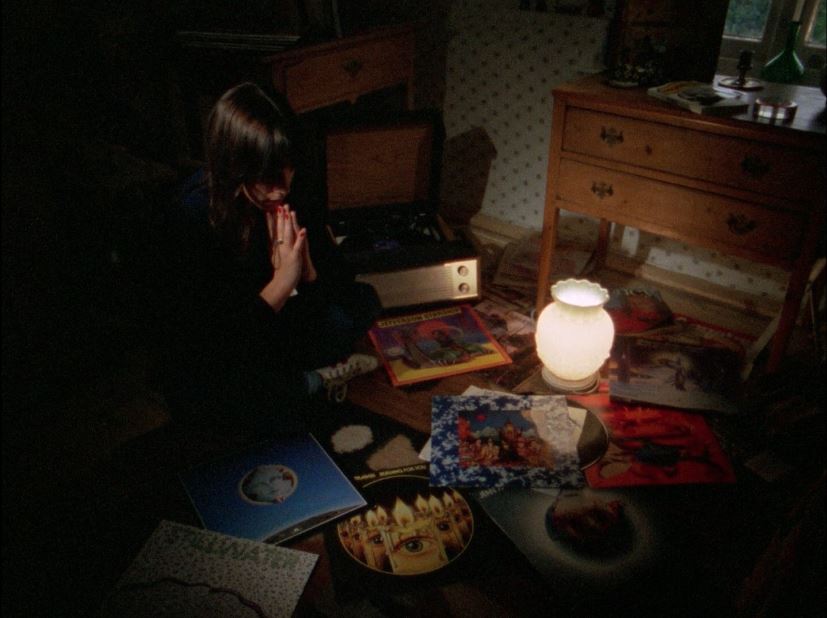
It's 1977 and no one can convince me that Maxine Gordon would be into The Grateful Dead, Jefferson Starship and The Strawbs! Mind you that Black Sabbath LP is worth a bit... Almost certainly from the cameraman's collection... bloody hippy!


Sunday, 4 December 2022

Seasonal haunts. Ghost Stories for Christmas Volume 1, BFI Blu-ray set out now.


There are more things in philosophy than are dreamt of in heaven and earth…


It’s Christmas time and there’s every reason to be afraid… yes, ‘tis the season to be scary, and the BFI have unleashed this chilling three-disc boxset containing four episodes from the BBC’s A Ghost Story for Christmas series, all based on stories from MR James. As Jonathan Miller explains in a voiceover at the start of the first film*, James was primarily an archaeologist, medieval historian, Vice-Chancellor at Cambridge University and then the Provost of Eton, but he was best known for his side-line in ghost stories all of which have a peculiar atmosphere of cranky scholarship. There are so many layers in these stories, originally written almost as a hobby to amuse James’ fellow scholars, but always accessible on a number of levels: tales of unknown, undreamt, philosophies.


I remember these films only as enticing features in the Radio Times as they were broadcast very late on Christmas Eve at a time I would have been wrapped up in bed trying to get to sleep so as not to put Santa off. Christmas mysterious, ghosts, holy or otherwise, always seem to fit the mood as set by Charles Dickens of course. The DVD releases from BFI have been among their best sellers so this newly remastered Blu-ray set will fill many a Christmas stocking, get you order in early for the limited-edition bonuses.


Included in Volume One are the first four instalments of the series, although we start off with a cracker originally recorded for Omnibus, just before they ran a feature on Abel Gance that I really hope survives somewhere… Everyone features superb performances from lead actors using the small early seventies screen to full effect, each presenting the febrile intensities of their characters’ very personal journeys into fear.


Michael Hordern


*Whistle and I’ll Come to You (1968)


Produced and directed by Jonathan Miller, a young man in a hurry and with every intention of addressing James’ hidden themes, this is less a “physical” ghost story than one about the hauntings of the mind. In Miller’s tale Michael Hordern is quite brilliant as Parkins, a professor of orthography, a science concocted by James concerning the study of reality so no foreshadowing there then. In a brief interview on the extras, a jaunty Miller, having spent a lot of time with philosophy professors at Cambridge, explained that he coached Hordern to mimic their intellectual detachment all of which we know is about to be violently undercut. I’m pretty sure Hordern had this in the bag anyway… but the two worked well together, Miller encouraging him to improvise Parkin’s agonies.


Parkin is, like James, a Cambridge academic who comes to north Norfolk to holiday and to fill his days with long walks along the bleak coastline located around Waxham. The location shifts to Dunwich, a town that crumbled into the sea due to coastal erosion and where the Professor finds a partially exposed grave where he picks up an old tin whistle. Back at his room, he cleans the instrument and exposes and inscription. In his entertaining and informative commentary, Jon Dear, writer on TV and film, talks about the nuance of the Latin translation of the inscription on the whistle, a warning on the whistle that Parkin doesn’t get, “who is this who is coming” is an inadequate translation, there’s a negative emotional connotation and the dread is wired into the language.


Dear talks of the haunted landscapes with its buried secrets that are carelessly unburied… by James’ characters and rightly praises the cinematography of Dick Bush who would go on to work on “Folk horror” classic du jour, The Blood on Satan’s Claw (currently on the BFIPlayer), William Friedkin’s Sorcerer, Pink Panthers and Ken Russells. Bush captures the bleakness perfectly as well as the fear eking out from every pore of Hordern’s face as he begins to suspect that something is coming for him.


There are more things in philosophy than are dreamt of in heaven and earth Parkin jokes as he discusses ghost with the Colonel (Ambrose Coghill) over breakfast. He’s so academically confident, and if you’re having an opinion on ghosts, you need to agree on what they are in the first place. Does Miller’s version have an actual ghost or is this dementia, a psychological breakdown and the externalisation of inner trauma? It doesn’t really matter; it’s still chilling either way.


Robert Hardy

The Stalls of Barchester (1971)


This was the start of the BBC series proper and was produced and directed by Lawrence Gordon Clark, who would perform these duties until the end of the initial series in 1978. Clark moves the story forward to the 1880s with Dr Black’s “present day” research being set in the 1930s…


Dr Black is an historian played by Clive Swift, another eminent performer whose face is synonymous with so much comedy as well as drama, these actors had range. Black is overseeing an inventory of materials in Barchester Cathedral’s library when he comes across the diary (sealed under the order of the Dean) of Dr Haynes a former Archdeacon of the cathedral, who dies in mysterious circumstances half a century before.


Black begins to read and we flash back to Dr Haynes as played by Robert Hardy, always so good at playing dislikeable authority figures, finds his ambition blocked by the stubborn longevity of the old archdeacon – Harold Bennett (only 74), famously Young Mr Grace in Are You Being Served. Whilst only briefly mentioned in the original story, here this is turned here into a running gag over the opening section, frustrating the ambitions of Haynes and his sister Letitia, played by the excellent Thelma Barlow, another with a huge career including that long stint in Coronation Street, before Dinner Ladies. In their lively commentary, Kim Newman and Sean Hogan suggest Clark cast Thelma, Harold and others as a way of filling out characters James paid scant attention to in his stories, there wasn’t space for too much characterisation in his short, sharp, shocks.


Barchester, as with most of the series was shot on film and on location with this making such a difference in terms of atmosphere and unease. Studio drama looks more mannered but these stories gain so much from the locations, actual environments reinforcing the impact if the unnatural events.


The old archdeacon has an accident and falls down the stairs, leaving the way open, rather conveniently, for Haynes. Has he a guilty heart? Soon, sitting within the stalls of his cathedral, he begins to feel the very wood morphing around him, carvings cast from medieval wood, writhing beneath his guilty grasp… Haynes diaries start to become desperate in tone as he battles against the gathering strangeness… his daily entries gradually reduced to just a few words: I must be firm. I must be firm.


Mr Swift and Mr Vaughan


A Warning to the Curious (1972)


Here Lawrence Gordon Clark scripts as well as directs for what Jon Dear sees as James’ last great ghost story, written in 1925, and influenced, of course, by the Great War. Here deathly vengeance gives no consideration to class or conscience, it is an absolute and unavoidable… probably. James invents a myth of three royal crowns buried on the coast of East Anglia, they are intended to protect against invasion yet only one of which remains with another stolen and the third covered by the sea, only one crown remains, lying somewhere in its royal burial ground.


Once again, we’re on the coast of North Norfolk, this time Wells-next-the-Sea (it is) where we find a man digging for the crown only to be brutally struck down by a man dressed in ancient clothes. This having established the threat level form the start, Clark introduces us to recently unemployed, amateur archaeologist Paxton, played by the amazing Peter Vaughan. Paxton is humbled on arrival at his hotel by the porter (David Gargill) who doesn’t like serving someone of lower status.


Paxton in the original story is a gentleman amateur and by making him working class and desperate he maintains our sympathy as he sets out to locate the buried treasure that will change his fortune. During his search he encounters Dr Black (Clive Swift), the only recurring character appearing here and in Barchester, who helps him in his search. The tension builds as Paxton starts to catch glimpses of a man called Ager (John Kearney), one of a family dedicated to watching over the crown. He even pursues Paxton in his dreams, relentless, single-minded, violent vengeance,


The play personifies a haunted society, according to Dear, a subject more prevalent in the seventies with horrors about hauntings being less frequent in the more affluent nineties when people were happier with the present culture. Now, we’re back again in a world we don’t like so much as the ones gone before… hauntology positively abounds in music, film and, of course, political discourse.


Vaughan is simply superb; he was able to convey vulnerability even as he was so good playing hard men like Grouty in Porridge. From the early fifties to Game of Thrones he had the most amazing career and I always enjoy watching him work. Here his nervy response to the theft and the growing sense of ghostly reprisal is so compelling, we think he deserves a chance but supernatural rules are rules… and can’t be outrun?


Lost children: Christopher Davis and Michelle Foster


Lost Hearts (1973)


Again directed by Lawrence Gordon Clark, this is the creepiest by far thanks to an excellent turn from Joseph O’Conor as Mr Abney, the older cousin of young orphan Stephen (Simon Gipps-Kent who starred in Midnight is a Place an endearingly wonky children’s serial recently screened by Talking Pictures), to whom he enthusiastically extends the offer of a home.


Abney is welcoming and can’t do enough to help his relative but Stephen soon starts seeing visions of a couple of pale children who seem to haunt the house and gardens… Clark does his usual job of gradually building menace and threat through glimpses, tight angles and a controlled claustrophobia that engulfs viewer and performers alike. A bit Edgar Allan Poe this one…


As you’d expect, there’s a host of spectral special features: 

  • Newly remastered by the BFI
  • Newly recorded audio commentaries for Whistle and I’ll Come to You and A Warning to the Curious by TV historian Jon Dear
  • Newly recorded audio commentaries for The Stalls of Barchester and Lost Hearts by Kim Newman and Sean Hogan
  • Whistle and I’ll Come to You (2010, 52 mins): John Hurt stars in this 2010 interpretation of M R James’s chilling tale
  • Jonathan Miller and Christopher Frayling interview (2012, 3 mins)
  • Neil Brand reads M R James’s original story (2001, 42 mins, audio only)
  • Ramsey Campbell on MR James (2001, 16 mins)
  • Ramsey Campbell reads The Guide (2001, 27 mins) 
  • Introductions by Lawrence Gordon Clark (2012, 33 mins total): the director of seven of the BBC’s classic A Ghost Story for Christmas episodes discusses his part in the first three instalments he directed
  • Ghost Stories for Christmas with Christopher Lee (2000): BBC Scotland’s ‘talking-head horror’ series starring the iconic actor as an M R James-like raconteur of fireside Christmas ghost stories. Included on this release are The Stalls of Barchester and A Warning to the Curious
  • First pressing only, Illustrated booklet with essays by Reggie Oliver, Jon Dear, Jonathan Rigby, Adam Easterbrook and Ramsey Campbell, credits and notes on the special features.


You can order Ghost Stories for Christmas direct from the BFI here, it’s out on 5th December, enough time to watch it yourself to get in the mood or to pack it well to scare your relatives to death!


The set is presented alongside the BFI horror season In Dreams are Monsters celebrating the horror genre on screen. It continues until 31 December at BFI Southbank, BFI IMAX, UK-wide cinemas and on BFI Player. Full details are here…