Showing posts with label Federico Fellini. Show all posts

Sunday, 1 March 2020

Too many tomorrows… Nights of Cabiria (1957), BFI Fellini Centenary


We’re going home but I don’t think we’ll get there…

So shouts a young reveller at the close of a film that still stuns the viewer with it’s brutal honesty, not everything can be sugar-coated in life and one of the positives of Federico Fellini making his wife Giulietta Masina the focus of his story is the knowledge that they remained married for fifty years until his death. But Nights of Cabiria is a very human story and Masina’s character, Cabiria, is personified by often unrealistic hope which, in the face of so much evidence to undermine its continued existence, is the very thing that keeps most of us going.

As Cabiria walks among the young part goers at the end she is astonishing, running a range of contradictory emotions like a combination of Clara and Charlie then looking directly into the eyes of the audience in a way that lifts your heart even as it breaks. It is an extraordinary performance and simply one of the greatest from the fifties and this period of Italian cinema; no wonder Chaplin said that "the actress who moved him most." She also inspired her husband who crafted this story based on her “humanity” and as a showcase its hard to beat.

As with its predecessor, La Strada (1954), the film won the Best Foreign Language Oscar and the director and his star were on top of their game. Le notti di Cabiria tells the story of a seemingly contradictory character; an innocent sex worker who, despite so much evidence to the contrary, still lives in hope.


In one of Fellini’s trademark stunning openings, we see Cabiria almost drowned as she is pushed into the Tiber by her boyfriend Giorgio, after he takes her bag. At first you think it’s a joke but it soon becomes clear that she can’t swim and with excruciating speed the men and boys on the riverbanks finally come to her aid. There’s an unsettling comic element as one guy worries about his suit and another saves her by holding her by her feet to let the water run from her lungs.

Recovered, Cabiria’s first thought is to find her ex-lover, still slightly in denial over what he has done. It’s a huge betrayal and one that would devastate surely but she’s not so meek; she has worked hard to achieve financial independence owning her humble home and saving as much as she can from her hard-working life. She keeps on keeping on but her grit is accompanied by a determined and, ill-founded, hope in the best of mankind. This film is regarded as the last of Fellini’s neo-realist films but it also sets the way forward to his more satirical work, and there’s something magically real about Cabiria’s resilience.

Amedeo Nazzari and Giulietta Masina
As with so much of his work, the film is episodic and after the first sequence she returns home crushed yet refusing to be consoled by her friend Wanda (Franca Marzi) as she decides to burn all trace of Georgio. Next, we see her at work on the tough streets of the Appian Way, her positivity allowing her to rise – mostly – above the taunts of fellow streetwalkers and their pimps, even if, sooner or later, she’s prepared to use her fists.

 
Again, the humour is on show as she walks past two much taller women as they compete for customers and has the last laugh as she ends up with a film star, Alberto Lazzari (Amedeo Nazzari) after he has an altercation with his girlfriend. He takes her to a nigh club where she is looked down on by everyone from the guests to the staff but she is determined to extract every once of enjoyment from her chance encounter. Her takes her back to his opulent flat for dinner and her face, as it is throughout, is a picture as she takes in the richness of it all. The night ends in boredom and humiliation as the actor’s girlfriend returns and she has to hide all night in the bathroom. But, so it goes and at least she gets paid, Alberto has been fair which is more than can be said for almost every man she meets.

Back to Earth
The episode is rich with direct and indirect comment on the gulf between her world and that of the movie star as she ascends a sumptuous stairway to his apartment, bumps her head on the glass door trying to make her way out and then tramps along a driveway filled with statues either side; culture assigned to the roadside.

The next night she meets a man who is handing out food to the poor living in hovels on the outskirts of town. He gives her a lift home and she reveals that her real name is Maria Ceccarelli and that she’s had to fend for herself since her parents died when she was young; it’s the first time she’s trusted a man to reveal her name. Oddly, this section was cut from the original release by the censors which is even stranger when you consider the reaction to the treatment of prostitution and some of the language included by subject expert Pier Paolo Pasolini.

Having seen a church procession, Cabiria travels with her friends to the church the next day in the hope of being in the presence of the Madonna; many hope for redemption and a cure for their ills and there’s a desperation about the convoy of hopeful believers who cram into the sacred place and make their plea for a better life. As with the sequence in the later La Dolce Vita, there’s an ambivalence in the director’s treatment of Christianity and faith; no cripples are cured and the daylight reveals the mess of litter left by followers and, as the holy procession continues, Cabiria struggles with Wanda.

The parade passes by
Onto another form of magic as the next night, Cabiria finds her way into a show where a magician (Aldo Silvani) calls members of the audience up on stage and hypnotises them into doing and saying things they instantly forget. He calls Cabiria and asks her to describe her romantic ideal and his face starts to drop as she reveals too much. After the show though she is greeted by a man from the audience, Oscar (François Périer) who says he has been very affected by what she said. Oscar’s an accountant with quiet manner and, despite her initial wariness, Cabiria begins to trust him romantically…

Where this all leads is for every cinephile to discover with an ending New York Times critic Janet Maslin described as being worth more than "all the fire-breathing blockbusters Hollywood has to offer." It’s the perfect combination of Fellini, his musical partner Nino Rosa and the extraordinary emotional display of Giulietta Masina. Another highlight of theBFI’s Fellini Centenary celebrations and the restoration is currently doing the rounds nationwide. Not to be missed.


Is Oscar a keeper?
Two-for-one trivia sentence: the film was the inspiration for the musical Sweet Charity and the name Cabiria was taken from Giovanni Pastrone’s silent epic, Cabiria which provides a tenuous link with the majority of content on this (mostly silent) blog.


Sunday, 9 February 2020

The libertines… City of Women (1981), BFI Fellini Centenary


"We do not go to Fellini to immerse ourselves in story and character or to encounter ideas. What we want from the maestro and what he gives us are fabulous adventures in feeling - a decidedly original mixture of nostalgia, poignancy, and joy that is unmistakably Fellini's own." John Gould Boyum, Wall Street Journal, 1981

"At the Cannes Festival the papers said that Fellini's last film was a total disaster, and that he himself had ceased to exist. It's terrible, but it's true, his film is worthless." Andrei Tarkovsky, 1981

I’m around the same age as Marcello Mastroianni when he made this film and just a few years younger than Federico Fellini who produced, directed and wrote this fantasy in which men of our age come face to face with feminism. I’m a generation or two below them and from a different cultural environment but I can’t say that I don’t know men like Snàporaz, Marcello’s character and therefore a cypher for Fellini. So, other than a snapshot of middle-aged male reactions to feminism, what can we make today of a film that so divided opinion at the time. We should also bear in mind what the director wrote about generational difference in the late sixties: “…faced with one of today’s youngsters, the young man of 1938 is like an accountant faced with a butterfly.”

I’m no butterfly counter but it’s safe to say that City is a startlingly inventive visual experience full of magically real episodes that are beautifully shot by Giuseppe Rotunno – Fellini in colour is always sweet-shop overload but capturing his mind’s eye took some doing and Rotunno worked with him on eight films. Mastroianni is also at his finest as the confounded Snàporaz who’s good nature allows him little awareness that he is part of a system of patriarchal oppression; it’s all a complete surprise to him, even when the points against become ever more personal.

Bernice Stegers gives Snàporaz the right impression, or so he thinks.
The film begins with Snàporaz waking up on a long train journey only to catch the eye of an attractive and enigmatic woman (Bernice Stegers) who excites his sexual interest so much he tries to make love to her in the toilets before mindlessly following her off the train at her station, which turns out to be a field in the middle of nowhere. Still following his base instinct, Snàporaz is left stranded as his train pulls away as does the woman after she calls out his crude advances.

Snàporaz begins a search for civilization only to find a hotel in the middle of a wood hosting a feminist convention with a particular focus on him; the woman from the train even pops up to target him personally. Snàporaz is initially fascinated and amused but this soon turns to concern. He is helped away from the febrile debating hall by a young woman, Donatella (Donatella Damiani) who seems friendly enough but soon has him on roller skates as dozens of other women come into this new room and skate at and around him.

He is helped escape again this time by a large woman (Iole Silvani) who finds him fallen at the bottom of the stairs and then offers to take him to the station on her motorbike. It’s a ruse though and she tries to have her wicked way with him in a greenhouse before being chided by her mother. It’s role-reversal for Snàporaz but things get even worse when he is rescued by girl gangs who drive too fast and eventually at him.

It's a trap and there are too many of them to quote George Lucas.
He seeks refuge at the large country house of Dr. Xavier Katzone (Ettore Manni) the ultimate woman hunter who has a hall of remembrance where he has recordings made of his 9,999 conquests… In the main hall Snàporaz finds his wife Elena (Anna Prucnal) who may become the 10,000th and he even has a cake to celebrate. Yet, whilst noting this impressive record, the priapic Doctor is now resolving to say goodbye to women… Then the police arrive, made up of the women from the hotel including the frisky motorcyclist and inform him that one of his precious pet attack dogs has died, a very male breed, a hunter for a hunter.

Dr. Katzone’s house is bigger than the hotel where the women convened and it contains a hall paying tribute to every conquest; pictures with recorded highlights which delight Snàporaz, who flicks them on and off with glee savouring their reduction to recorded signifiers of male dominance. There’s no love just lust and conquest. The film snowballs, and there’s no let-up in the escalation of the director’s cavernous visions. Fellini’s flash can be off-putting – Roma on the small screen is a tough watch; too much to squeeze through - and yet seeing it in cinema contains the exuberance rather than magnifying it. Either way, you have to tuck into Federico’s feast even when, cinematically speaking, you may just want to enjoy a contemplative sandwich.


But on it goes as Snàporaz’s unrepentant and, to be honest, almost uncomprehending, sexual attitudes are examined by a swirling array of larger than life women including his own wife, arrived to sing operatically and to throw herself at her reluctant husband:“I want to make love!”...“But it’s raining…” comes back his excuse as he looks for the younger women.

She’s less chance of lighting his fire than setting the drenched woodlands ablaze; he wants the ones he can’t have and he wants them all. As in a dream he chases two nearly-naked nubiles – including the ever-smiling Donatella until, unable to sleep in the huge bed provided for himself and his disappointed wife, he crawls underneath and through a hole to find a fairground in Katzone’s unfeasible basement.

As he descends on the slowest of helter-skelter slides, he sees his romantic life played out in front of him and his restless search for the perfect woman becomes a trial with the reward of a giant inflatable balloon variant of this impossible creature. Once more Marcello takes to the skies in a Fellini dream… or… is it?

Welcome to the House of  Fun...
Roger Ebert concluded his review in 1981 by saying the City of Women was ” …worth seeing because it's a bedazzling collection of images, because at times it's a graceful and fluid celebration of pure filmmaking skill, and because Fellini can certainly make a bad film but cannot quite make a boring one.”

City of Women is certainly not that and whilst it doesn’t have many answers it at least raises the questions. It deals with the feelings and, as with all feelings, they are not always rational or explainable. If nothing else we get to see Marcello dance like Fred Astaire… he’s the most charming of rogues and no one ever coped with the dual pressures of likable and roguish quite so well!

The BFI Fellini season continues for the rest of the month, full details on their website.


Silent film clearly was a strong formative experience for young Federico...

Saturday, 18 January 2020

Alien nation… Fellini Satyricon (1969), BFI Fellini Centenary


There is nothing as blatantly false as unconvincing statements made by men and nothing as blatantly unconvincing as their fake seriousness… Gaius Petronius, The Satyricon

Having started with La Dolce Vita (1960), dipped back to near the beginning with I Vitelloni (1953), I am left dazed and confused by the director’s outrageous acceleration in style and content with 1969’s Satyricon. I’d come to NFT1 straight from watching Be Natural the new documentary on early film pioneer Alice Guy and to find myself confronted with this eroticised Roman storytelling was more than a little culture jolt. Frederico and Alice would, I’m almost sure, have got on famously… maybe, if they’d just stuck to the films.

Fellini’s film is extravagant and frankly, very frank: nothing can prepare you for it on the big screen. There are clearly elements that influenced Passolini, Ken Russell and Derek Jarman as well as dozens of other less reputable film makers. Yet, as with Passolini and his Trilogy of Life, Fellini was trying to get inside the historical mindset, here that of the Roman scribe Petronius, who wrote this story in the first century AD when he was very much in favour with well-known fiddler Emperor Nero.

The Satyricon depicts the exploits of the narrator, Encolpius (Martin Potter), and his lover Giton (Max Born), a handsome sixteen-year-old boy who is the envy of Encolpius’ fellow courtesans especially Ascyltus (Hiram Keller), once his lover now his friend and rival. As the title suggests the “novel” is a satire and one that would go down well with the court of Nero and, Fellini correctly assumed, the debauched audiences of the late sixties. The characters on which the episodes are based would not have been known to contemporary viewers but their behaviours would; the hypocrites, the puffed up egos and the carelessness of the powerful are all timeless as is the blood and guts of the design – the mess-on-scene if you will (ha!).


It's a visual feast but one which quickly over-faces the watcher; you’re overloaded by a screenful of gruesome details from over-made-up actors to strangely-painted masks – there’s a bloated actor dressed as a pig who eulogises about his newly acquired boy-toy, Giton, breaking wind and blowing his pig-tail into the air. It’s not that easy to watch amongst the greasepaint, the sweat and the disorienting shade and tone but all these things are there for a purpose; presenting an exaggerated, heightened reality that spins with uncomfortable velocity. Fellini seems to be following the original document closely even the parts that are missing provide him with the opportunity to add to destabilise the viewing experience as we go from a battle to a maze to face a minotaur. The film even ends on an unfinished sentence even as the manuscript does.

Fellini described the film as science fiction and in a 1969 interview, said "I am examining ancient Rome as if this were a documentary about the customs and habits of the Martians." And, if you’re in the right frame of mind it is enjoyable. Roger Ebert said it was a masterpiece saying that “…films that dare everything cannot please everybody” and he would know havening co-written Beyond the Valley of the Dolls – which, incidentally, would make a great double bill with this film. I would agree with Ebert’s assertion that this is a very controlled piece of work from the director for, whilst it looks uncomfortable, everything is done with measured deliberation, all designed to alienate and shift our state.

Martin Potter debates ownership with Fanfulla as Vernacchio and Max Born
This Rome is a culture cut off from sincerity and even Encolpius’ passion for Giton may just be a response to other’s attempts to posses him. Everyone is an enemy and alliances pass quickly when they outlive their usefulness with hands chopped off for laughs and men thrown into furnaces when they have stopped being entertaining. There’s a coup and we find a well-off couple seeing their family off to safety as they take their own lives knowing that they’ll not fit with the new regime; the man is meant to be Gaius Petronius.

There are nine major episodes in the film and they are only linked by the presence of the three main protagonists as they stumble from the debauched banquets and brothels of Rome to being kidnapped by pirates – the leader of which wants to marry Encolpius (of course) – to encounters with an hermaphrodite on the road, who dies after they kidnap him/her for a ransom… death is very much what you make it. There’s a Minotaur and a duel with a gladiator, who spares Encolpius’ life after his “eloquent” pleas – just another random episode. Encolpius is rewarded with humiliation after he fails to perform in public with the sensuous Ariadne. There follows a journey to see a witch in order to regain his mojo…


Life, it seems, is what happens when you’re busy making other plans and there’s little our hero can do to direct his own fate in the face of the cruel and unusual rulers of this world. Is this what the smartly dressed hip set of La Dolce Vita are really like underneath, is this all there is when you strip away the manners and the inhibitions of accepted society?

As is usual, there’s a superb score from Nino Rota – with the help of others – which incorporates electronica and heightens the strange feelings of the film. Given the way the director and musician worked – Rota didn’t always watch the film and Fellini would sometime cut to the music - it would have been an interesting brief!

It works… but in truth I’m not sure after one viewing why. I can say for certain that Fellini was clearly developing his style and it’s hard to see the three films mentioned at the top as obviously directed by the same man in the way that Berman or Antonioni films over the same period might appear. Eclectic and difficult to fathom. Don’t ask me, I’m as clueless as Encolpius.


Monday, 13 January 2020

Wasted youth… I Vitelloni (1953), BFI Fellini Centenary


Seven years before La Dolce Vita, another of Federico Fellini’s characters formed an innocent relationship with a youth that may or may not signify the possibility of escape from a dead-end existence. In his third film he drew upon his upbringing in seaside Rimini to paint a slightly autobiographical picture of five close friends who’s get up and go has got up and gone or, if you will, si alzò e se ne andò! I Vitelloni are not exactly bored teenagers, they’re well into their twenties and are either not working or still living under the assumption that life is about to start. It takes that friendship with a young lad working early shifts at the railway station to help one re-connect to his own youthful ambition.

As the train pulls the escaper away, the camera cuts to the bedrooms of his four friends as the lie asleep in each case pulling away as his momentum carries him clear of the ties that bind. It’s a neat moment and another one of Fellini’s great endings to accompany his great beginnings… although this is certainly one of his films that maintains narrative energy and interest throughout with rich characters and compelling episodes in which revelations are made and fortunes pivot.

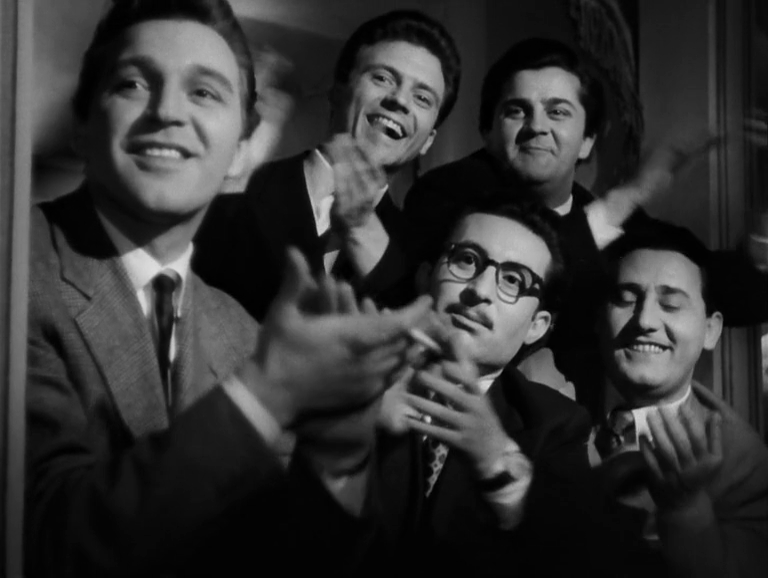
Franco Fabrizi, Franco Interlenghi, Leopoldo Trieste, Riccardo Fellini and Alberto Sordi
The subtitles translated I Vitelloni as The Bullocks and it could also be The Idle People, not so much the victims of post-war economic malaise as sheer boredom – anathema to Fellini who escaped the “Italian Blackpool” for Rome in the thirties in order to study law. The gang are stuck mostly living with parents and living the lives they have since they were 15. Fausto (Franco Fabrizi) is their leader, handsome, stylish and totally faithless, chasing girls with no self-control until the inevitable happens and someone gets pregnant.

That someone is Sandra (Leonora Ruffo) who in addition to having just won the local beauty contest, is the sister of Fausto’s best pal Moraldo (Franco Interlenghi) who is as considerate as Fausto is wild; the kind of guy the idiot needs and probably one of the few who would put up with prolonged exposure. Moraldo was described by the director as being closest to his own character although there is also a voice-over to provide additional context.

Fausto considering his options.
The others in the group are Alberto (Alberto Sordi) who has a fine singing voice, outgoing and not afraid to drag up for carnival. He lives with his mother and sister Olga (Claude Farell) who, unlike him, has a steady job and is also in a long-term relationship with a married man. As with later films, the women seem far more grown up than the men who struggle with even the basics of self-awareness and communication. Unlike her brother Olga is desperate knowing that her prospects are bleak and that she may have to seize the only chance she may have to get out.

Then we have Leopoldo (Leopoldo Trieste) a would be playwright who is awaiting his lucky break as he works away in his auntie’s house occasionally distracted by his pretty neighbour Gisella (Vira Silenti). He’s the most intellectual but not the smartest – as so often happens – and the butt of the group’s jokes. His big chance comes when an old theatre star comes to town Sergio Natali (Achille Majeroni) who leads the youngster on by allowing him to read him his play as they wine and dine. But Natali is far more interested in Leo than his words and as he tries to take their relationship in a different direction in the dockland shadows, the writer finally makes his escape.

Just watch the film Fausto...
The final member is the group is Riccardo (Fellini’s brother Riccardo) who is the least well realised character – a good guy who greases the social wheels of the group but who doesn’t have much of a dramatic arc. For that we need to go back to Fausto and the Rubini family…

Fausto’s father (Jean Brochard) who still doesn’t spare the rod for his man-child, makes sure that he marries Sandra and the couple seem happy enough. Sandra’s father (Enrico Viarisio) gets Fausto a job at his friend’s shop selling religious paraphernalia to nuns – hardly his dream but then he doesn’t appear to have one, except the life of a womaniser. He goes to the cinema with Sandra only to leave in order to pursue another woman (Arlette Sauvage) even as his wife is engrossed in the film and the whole experience with her husband. Fausto can’t commit even to the fantasy as the woman is just too distracting; he plays footsie, lights her cigarette and, after his inconclusive pursuit, returns to find Sandra outside, the film over.


Fausto flirts with the boss’s wife and ultimately loses his job as a result, falling foul of a more solid marriage. He enlists Moraldo’s help to steal an angel from the shop in revenge and tries to sell the statue to a nun and then a monk. Both have enough angels already and whilst Fausto sees only the monetary value of the piece, the “simple-minded peasant” (Silvio Bagolini) who pushes the angel on a barrow, is in awe.

The carnival scene is the film’s centrepiece and all the characters collide in one gloriously choreographed sequence. The camera moves through the mass as they dance, the tickertape falls and the music is incessant. After the ball the hangovers kick in and reality bites in the harshest of ways… Some will grow and others will fall back in the fantasy of routine.  

I Vitelloni is a fun film with a serious heart which I guess is Frederico all over. Nino Rota’s music is here too as it would be for decades; he weaves some gorgeous themes and as with 8 1/2, La Dolce Vita and the rest, holds the emotional lines together through the episodes. Not surprisingly the director called him the "most precious collaborator" he ever had and the two work so well with Fellini often cutting to Rota’s music, as the composer didn’t always see the visuals. That’s a fascinating level of trust.


Saturday, 28 December 2019

Modern times… La Dolce Vita (1960), Fellini Centenary Season at the BFI


Some films you just have to see screened in cinema and Fellini’s epic is a key text, a fulcrum of the artform released sixty years ago at pretty much the mid-point in cinema history. Stylistically, La Dolce Vita has more in common with say Bait or The Irishman than Georges Méliès A Trip to the Moon or Alice Guy Blaché’s early films, which says as much about the influence of the Italian’s film as the maturation of cinematic language and technology. It is a massive film, three hours long with dozens of characters all revolving around Marcello Mastroianni’s central character over seven main sections.

Original producer Dino de Laurentis had apparently wanted Paul Newman for the role of gossip journalist Marcello Rubini but Fellini wanted the subtler presence of Marcello Mastroianni rather than the Hollywood star who in this film featuring actual characters, would have been the subject of press attention rather. Mastroianni perfected the role of sold out-burned out writer for Michelangelo Antonioni too in La Notte, but it started here; his character only able to communicate with women through sex or, as he falls, physical intimidation. He still manages to attract our sympathy (mostly!) and, dear reader, I feel more than a little sell-out Rubini myself from time to time…


Last year we were treated to an Antonioni season at the BFI and this year we have Fellini – two giants of post-realism with distinct voices. Fellini differs from Antonioni in his sense of fun and outrageous ambition; Michelangelo would never start his film off with a statue of Christ being flown through Roman skies or finish it off with the dead-eyed stare of a massive weird fish all via a shedload of casual transvestism, prostitution and the earthy subjects that came to dominate later Fellini films. We can see all this for ourselves as the BFI, in addition to re-releasing this new 4k restoration, marks Fellini’s 100th birthday in 2020 with restorations of ​8 1⁄2, Juliet of the Spirits, I Vetelloni and The Nights of Cabiria as well as screening of his other key works.

La Dolce Vita is one of his most defining statements and is so opulent and inventive that it flies by even on four hours sleep after a full day’s work… that’s quite something given the episodic narrative but you hang on for the truth about Marcello and the main strands of a quietly devastating story. Fellini confounds your expectations at pretty much every level not least with his unheroic main character who sleeps with everyone but his girlfriend and at one point berates her violently as they argue in his Triumph sports car.

Maddalena and Marcello emerge into the light 
The film features uncredited contributions from Pier Paolo Pasolini and, having just watched Canterbury Tales on the new BFI box set of his life trilogy, you can see something of his influence especially in the second main section as Sylvia, a famous Swedish-American actress played, of course by the iconic Anita Ekberg, leads the dance in the Baths of Caracalla. There a mix of rich characters in the line which also brings to mind the knight and his soldiers dancing on the fateful shoreline in Bergman’s Seventh Seal. Enjoy yourself, it’s later than you think, but this night in Cabiria ends only in damp disappointment for Marcello as he tries to catch Sylvia in her Trevi Fountain dance only to be absentmindedly dismissed. He also gets a thump from Sylvia’s alcoholic fiancé, Robert played by Lex Barker, a former Tarzan, a fact that is even referenced in the script.

Marcello is a confused individual, but he’s also remarkably pragmatic, he thinks nothing of calling occassional girlfriend, Maddalena (Anouk Aimée), to see if he can use her apartment for a liaison with Sylvia; using her just as they’d used the prostitute in the first segment; casually paying her to use her bed for their tryst. The morning after they drive off in her expensive car, their “landlady” delighted with her tip and the already run-down modern apartment buildings put into sharp relief by their “escape” after slumming it.

The man with a moving camera; Paparrazzo (Walter Santesso)
The film’s depiction of the media circus surrounding glamour is eternally resonant. Dozens of photographers like Paparazzo (Walter Santesso) swarm around the famous attempting to capture a moment or two of their time, whilst Marcello and other journalists live off this world whilst also wanting to be a part of it. Marcello is conflicted and faithless, torn between the needs of his lover Emma (Yvonne Furneaux) who tries to take her own life after his night with Maddalena, and the need for a connection with a star like Sylvia or even a deeper love with Maddalena. For the first he gets a smack in the stomach from the former Tarzan and for the latter he’s left humiliated – taking to her sat alone in a whispering gallery whilst she leads him on from another room as her new lover silently embraces her.

Marcello and co race off to bear journalistic witness to two children who claim to have seen the virgin Mary. It’s a chaotic scene as the rain ours down and the crowd, a mix of the curious and those hoping to be cured, follows the children as they try to summon the apparition; turns out she’s no less substantial than Sylvia at least in terms of meaning.

Promised you a miracle
Marcello also has the hope of writing more seriously – he has a novel on the go - and looks up to his old friend, the intellectual Steiner (Alain Cuny) who has seemingly both material and cerebral grace, the family ideal achieved along with career success on his own terms. Sadly, Steiner has thought himself into a hollow existence and all is not as it seems at his elegantly intellectual party.

Marcello takes himself away to the beach for some peace and quiet with his typewriter. He encounters a young girl, Paola (Valeria Ciangottini) who seems to represent the ideal of innocence and the (illusory) potential of unformed youth. He calls her an angel and then asks if she has a boyfriend… typical Marcello. This being Fellini she turns on pop music on the jukebox, Marcello’s thoughts grounded to Earth.

Marcello’s father (Annibale Ninchi) comes to visit and we quickly see that his son is a chip off the old block who just wants to party, dance with young women and generally join in. But father cannot keep up with the pace anymore and is taken ill late into the night, returning home with an indication of the finite nature of Marcello’s lifestyle.

Nico arrives.
Then we have an injection of the 21-year old Christa Päffgen aka Nico – future singer with the Velvets and beyond but then known mostly as an actress. She adds energy to a sequence that ends up with an all-nighter at an aristocratic party, wearing a knight’s helmet as the revellers dance till dawn, get drunk and look for the dead. As they wander bedraggled in the early morning, they encounter some locals off to church; there’s faith and there’s hope.

Then the film turns on one truly tragic event and we will see which way Marcello will take himself. Paola returns at the end for a wordless conversation with Marcello, highlighting what Robert Richardson calls the film’s "an aesthetic of disparity”, the difference “…between what life has been or could be, and what it actually is". The film is over and Marcello may well be but Paola’s smile is sweet as she looks on with knowing, almost parental, exasperation.

La Dolce Vita is sprawlingly intense and I took far more from it on the big screen. I’m going to see it again and would urge you to not miss this rerelease or, indeed, any of Fellini’s extraordinary cinematic statements over the next few months.

Full details are on the BFI site. What a way to start the new Twenties!


Wednesday, 26 August 2015

FF + MM = 8½ (1963)


Of all the accolades for this film – and it’s on pretty much every “best of” list – perhaps the Vatican’s ranking it among the best films made in the first century of cinema is the one Federico Fellini would have been most amused by. Who knows? But the answer might well be in 8½ itself, a film that is entirely about the question: “why make a film?” and about which it is probably impossible to say anything new.

So, why bother trying? There are choices to be made and this is one you can just watch, enjoy and leave alone, you’re not going to add anything to a pile of opinion 52 years deep and yet, why say anything about any film unless you feel you’re either a valuable show off of you just have to make a note of your personal response.

On the way to work
I’m sat on a train, heading down to work, it’s a sunny morning after the rain before and it’s either this or a spread sheet… Having sat in the same room as Federico and Marcello for over two hours, it would be rude not to acknowledge their presence.

Hang on… isn’t that Claudia Cardinale smiling at me over the ranks of Italian tourists packed onto the Gatwick Express? She’s leading me on.


Claudia
8½ is the most numerically-accurate film in history: the precise number of films it’s director had made up to that point with one co-direction preventing its being rounded up to an even 9.

It is ostensibly a film about a director, Guido Anselmi (Marcello Mastroianni) trying to overcome his doubts about his own credibility in order to make another movie. Throughout he’s pestered by producers and performers all anxious to work as well as an intellectual film critic Carini Daumier (Jean Rougeul) whom at one point he imagines being silenced by "hanging" (don’t worry he returns).

Rossella Falk and Anouk Aimée - funny and serious
It takes a lot to take the mickey and yet still produce such a powerfully-immersive film as 8½ but Federico also manages funny and serious, imagined and real and counter-balances everything impossibly well all through the intense focus of his remarkable star.

Mastroianni is a wonder throughout and has qualities akin to Gish and Huppert – he can show interior worlds and hold Fellini’s contradictions within his character with a stillness that belies the conflict and moving with graceful transitions between the states of confusion, hope, desperation, pity and love. What can appear as a cool demeanor very soon dissolves into apathy and inertia.

Marcello not in neutral...
Very few men can act this way and carry it off – Mastroianni’s “neutral” is so poised that he is able to flex his mood far easier than other more overtly demonstrable actors.

Here he takes even the most unforgiving statements form his inner critic on his chin … He is apparently making a film full of “gratuitous episodes, perhaps even amusing due to their ambiguous realism. One wonders what the author’s point is… The subject matter doesn’t even have the merits of an avant-garde film…” No wonder he “hangs” him!

Lengthy queues for holy water
Guido is in a sanitarium in an attempt to recover his strength and find his movie-making mojo… his self-doubt (The Critic) is soon joined by his over-bearing mistress, Carla (Sandra Milo) who arrives by train to collect her man and her part… It’s hard to see what Guido sees in the obvious charms of Carla and it’s only when we encounter his wife that all makes sense.

Carla is straightforward, if demanding, and doesn’t pull Guido into the deeper waters of his marriage where Luisa Anselmi (Anouk Aimée) is every inch his match. But Carla is also crowd-pleasing cinema and that’s a place the director likes to visit even though he hates himself for staying there.

Carla being straightforward, not demanding...
He calls Luisa and asks her to come and join him – we know and he knows that it will make his life more difficult and that’s the challenge he’s seeking.

Before all this, Guido wanders through the the sanitorium-cum-holiday camp accompanied by his nagging arty conscience. He finds his friend Mario Mezzabotta (Mario Pisu) who is a similar age but has left his wife to be with a younger woman, Gloria Morin (splendidly played by Barbara Steele). Gloria is highly intelligent and an art-house dream of hipster fringe, darting glance and angular black fashion: the cutting edge Guido feels he may lack.

Gloria makes Mario move
Guido seems to relate to the world through the women in his life and imagination – he catches sight of a beautiful young woman (Claudia Cardinale) a vision in white who dazzles as she hands him a glass: the perfect woman for the film and for life?

Claudia (again)
Dreams lead the narrative; Guido ascends from a murderous traffic jam at the start and is pulled to earth by a rope attached to his ankle and then he dreams of his dead parents, visiting them in their graveyard where his mother turns into his wife as she kisses him: one for the Freudians no doubt. But, as one of his father’s minders says, don’t let him play with your emotions.

Guido bows in mock worship when his producer Bruno (Bruno Agostini!) arrives with his entourage but he pays homage only to buy time. As the film progresses though the money wants solid return and Guido is increasingly backed into a corner.

Earthed
He can’t decide on his cast and has only an outline for his story; something to do with man’s escape from the dying Earth in a massive rocket. We see the erection of the launch tower which will have the ship superimposed… it’s another chance to imagine a metaphor not just the hollow film inside the hollow tower but an escape from reality all round.

Luisa arrives with her best friend (Guido’s sister) Rossella (Rossella Falk) and the intimacy both bring make us focus on Guido’s weaknesses: he can kid us with his friends but not with his family.

Imagine space ship right here...
Then Guido has a spectacular dream with all the women in his life slaving over him until they become too old and are sent “upstairs” to retirement with the rest of the middle aged and faded… doesn’t happen in films much does it?

Time is running out but at the screening Beauty returns as Claudia arrives to discuss her part. Guido has pinned everything on her youth re-invigorating his project but, just as he realises that he cannot use her as a substitute for his own integrity, the producers arrive. There is no escape he must face the film crew on set – film or die.


The initial rushes don't look encouraging
8½ works on so many levels and despite what may appear a meandering narrative, always engages with its intelligence and observation. The music of Nino Rota is rightly lauded, matching Fellini note for note whilst Gianni Di Venanzo’s cinematography makes this one of the best looking films of the era: so much light!

But it’s the playing that holds the attention most of all – in particular Anouk Aimée is the perfect foil for Mastroianni and does much to reveal his character’s weakness and way forward.

Here's hoping
It is an incredibly honest film and a brave one too: imagine if your film about writer’s block turned out to be the clunker that confirmed that, yes, you have actually lost it!? But no, Fellini always had it and he proved it again and again – I especially like Toby Dammit his quite stunning short film as part of Histoires extraordinaires (1968) but you know the rest.

There are many ways to consume 8½ - probably the best is from Criterion which is available direct or via Amazon. There’s also a British Blu-ray from Argent Films available here.