Showing posts with label Daan van den Hurk. Show all posts

Sunday, 15 October 2023

Of time in this city… Le Giornate del Cinema Muto 42, Day Eight


Is an interest in silent film nostalgia for a time before we were born? Let’s ask Albert Camus shall we, who said that: A man's work is nothing but this slow trek to rediscover, through the detours of art, those two or three great and simple images in whose presence his heart first opened. So, the fascination is more in understanding the working parts as much as the feeling and in the historical, creative circumstances for the filmmakers and film audience alike. 


Camus also said that the artist must contact the reality of his or her time, wresting from it something timeless and universal so what we are searching for is people who have done achieved this for their time and to look beyond the ludicrous concept of “dated” in assessing the content and the context.


Succeeding today was William de Mille who came up with some very pertinent questioning of his own in Conrad in Quest of His Youth (1920) in which Thomas Meighan’s Conrad has something of a mid-life crisis and tries to regress to childhood. So, not too far off Camus’ concepts but in a more homely way which is frankly more on my level and that of Thomas Meighan, pretty well-educated but in pharmacology not philosophy. Thomas plays the titular Conrad, who a few years after the First World War is living in comfort, supported by his faithful valet, Dobson (Charles Ogle) and wondering what it’s all for. Conrad is jaded and decides the best way to reconnect with his zest for life is to revisit his childhood by calling three old friends back to the cottage they used to spend summer in.


It's all too much for Conrad - he's watching a Pat and Patachon...


Ah, but you can’t just go back Conrad, as his pals quickly tell him but he’s not listening and decides to track down his first love, with future director and Mr Louise Brooks, A. Edward Sutherland playing him in flashback with Kathlyn Williams playing the older woman Mrs. Adaile, who gently rebuffed him. Conrad tracks her down to Italy and tries to rekindle their previous affection; can reliving young love work for either?


No spoilers, but Conrad is to discover that you can over-analyse and that sometimes you need to just stop thinking and simply engage with “Life” to find that chance of happiness. It’s a perfect little fable and Meighan is his usual self, intelligent, sensitive and always watchable.


Donald Sosin accompanied with the air of a man completely in touch with his creative consciousness (and moral compass).


Also connecting with the timeless and universal and in doing so creating it, was Daan van den Hurk whose emphatic new score for Buster Keaton’s Sherlock Jnr (1924) made me enjoy this very familiar film anew. The music highlighted pretty much every section of the Orchestra da Camera di Pordenone and it just grew in momentum and delicious tonality with the film. After an opening prologue including the earworm main theme, the music chased around with Buster in the quieter early stages only fully coming to life when his projectionist’s dreaming begins. From then on, it’s a symphony to silent style pretty much as Keaton intended but given extra emphasis and depth as the adventure of the Projectionist and all the films he has shown is laid before us.


Daan reveals Buster’s own symphonic approach as the film and the music crescendos with stirring strings and full-bodied brass – and tha’ knows, I love a bit o’ brass as Hindle Wakes’ Fanny Hawthorn might say. It was one of those uplifting orchestral moments Le Giornate does so well and congratulations must go to Daan, the full orchestra (70+ players?) as well as Ben Palmer who conducted so well. I was up in the Gods again but, by ‘eck the sound filled the space so well. A thrilling sonic adventure all round!


Most of us tired after a full week, the Verdi still erupted with the joy of recognition or holding this shared fascination close!! In the best showbusiness tradition, Le Giornate always leave ‘em/us wanting more!


Charlie and Monta Bell


Before Buster there was Charlie with a film I’ve not seen before, The Pilgrim (1923) which featured Chaplin’s 1958 score arranged by Timothy Brock and performed by the Orchestra da Camera di Pordenone as conducted by Ben Palmer.


It’s a film full of Chaplin’s movement and impish humour with heart as his escaped convict steals a pastor’s clothes as he bathes and then gets mistaken for the new vicar and has to follow through as the citizens are so friendly. This was Chaplin’s final film with long-term collaborator and paramour, Edna Purviance and once again her character provides the key to Chaplin’s redemption as a former cell-mate recognises him and wants in on “the action”. It’s an old argument but there’s enough comedic violence and pointed situations to make political points and some evangelicals were also upset by The Life of Charlie. Who knows what modern US politicians would have made of the closing sequence on the US/Mexican border… or what their fundamentalist Christian brethren would. Chaplin was another able to create something timeless and universal out of the realities of his time.


Marlene by the wall next to Harry Piel.

A Marlene Surprise!


I need to pay more attention as I had no idea that our Marlene was going to feature in Harry Piel’s Sein größter Bluff (The Big Bluff) (1927) nor that he was going to play himself and his brother as well as write, direct and produce. Nobody likes a show-off Harry apart from Marlene that is.


This was a lively adventure which featured car chases filmed in the South of France, double crosses and quadruple bluffs which make me extra thankful for being woken up by my esteemed colleague Ms Hutchinson of Worthing just as Giornate fatigue kicked in and I was able to re-join the film as it stepped up a gear in search of stolen diamonds with a hoard of gangsters chasing it as well as the twin Piels. Over the Festival we’ve seen Harry advance his work to such a level of polished populist filmmaking that this had so many elements of a sixties caper movie; he wasn’t Pabst or Murnau but as this 76th film shows, he was a skilled crowd-pleaser, no matter whatever came after 1932…


Dietrich often played down her silent films not wishing to be deemed as too old school but by 1927 she was beginning to feature more and here she plays Yvette, “a ‘lady’ who puts her intellectual – and other – qualities exclusively into the service of worthwhile enterprises”, in this case acting to steal the jewels before her rivals can. She’s a perfect fit for a Lang-type super spy/secret agent and stands out in her scenes for poised screen energy. Having just watched A Touch of Evil I can see how she refined this persona of intelligence and bold sexuality. The perfect fit for Harry’s anti-hero and twin heroes with floppy fringes and fast cars: the name’s Piel, Harry Piel.


Accompaniment was from Masterclass student Timothy Rumsey who did a splendid job, I look forward to hearing more in future!


Madeleine Renaud and Maurice Touzé

I Married the Sea, Part Deux - Vent Debout [The Headwind] (1923)


After the French fishermen of Pêcheur d’Islande (screened on Tuesday) gave their life to the Atlantic Ocean, Jacques Averil (Léon Mathot) finds himself drawn to the sea to rebuild his life after his father ruins the family business and commits suicide. Viewed as a part-timer by the tough nuts on the fishing boat, he asserts his authority through violence emerging as top sea dog and winning grudging respect. This maritime Fight Club does move beyond the sea and there are many turbulent times on land as a potential fortune to be made from fossil fuels presents itself.


After being flung into an alcoholic depression after the accidental death of the ship’s cabin boy, Guillot (Maurice Touzé), Jacques meets Marie Richard (Madeleine Renaud) begins to find his legs on land again. So, my headline isn’t entirely appropriate, will he divorce the sea and marry a human? And, will he be able to avoid financial ruin from the land-based sharks aiming to drag him down?


Meg Morley accompanied with the smooth transitions we’ve come to expect and melodies for drama in all weathers and surfaces!


So, returning to the questions at the top; why exactly do I write this blog? Well it’s an attempt to capture the feeling of what has been screened and the experience of the location, audience and accompaniment for the screening. It’s a diary, one featuring well over 1000 screenings now and which evolves over time and circumstance. Like any diary it’s a discipline and I only keep on because I enjoy trying to that slow trek to rediscover, through the detours of art…  I hope you do too and thank you so much to everyone who has read so far!


See you next year for #GCM43!


The Queen of Le Giornate Blogging is, of course, Pamela Hutchinson and if you haven’t already caught her daily reports on Silent London head over there right now!


The orchestra and crowds pack the Verdi for this year's finale.


Sunday, 9 October 2022

Down and out in London and Marseille... The Lady (1925), Daan Van Der Hurk, Le Giornate del Cinema Muto, Streaming Day 8


Now we have it, Norma Talmadge’s finest dramatic performance and a story in which she gets through two or three times the amount of work for a normal film and probably even more for Heart of Wetona. Directed by Frank Borzage, it’s tempting to visualise him coaching her through some of the heaviest emotional lifting, which occasionally stretches her technique but she always comes through, sometimes with cheeks soaked in tears, a dewdrop on her retroussé nose, working at a pace with even Gish or Garbo. It’s a remarkable film and it gives her the opportunities she often missed, partly through her own choice.


For most of her career, Talmadge called the commercial shots and as Jay Weissberg pointed out in his introduction, The Lady was too louche for middle American audiences and did not perform that well. As Talmadge herself said, quoted by Ben Brewster and Lea Jacobs in their notes on the Giornate site, she wasn’t going to follow up the film’s style “… I am not going to do any more like it for a time, anyway. Not that I don’t like to do characterizations – I love it. But what can we do? We must play to the box office… So, for a while I am going to do modern things. I think they want to see me in gowns, in style.”


To European audiences, there would have perhaps have been less of a negative reaction but maybe Norma was also typecast to a degree and the idea of her playing a character making a living as a prostitute, no matter how understated, was not the "Norma" her public loved.


Frank Borzage had already worked with Talmadge on the more successful Secrets (1924) and must have earned her trust for this bolder film. Adapted by Frances Marion from Martin Brown’s play of 1923, the narrative is unusually structured with an older Talmadge running The Brixton Bar, a “British” pub in Marseilles, during the Great War before a flashback which explains how she got there. Apparently, the play was the first in mainstream theatre in which the heroine announces she is pregnant, be that as it may, it’s less “announced” in the film and the child appears allowing inferences to be drawn.


Two Tommies wander, one a young private the other a rather drunken sergeant, very very arf’arf’an’arf, who staggers around before squirting the landlady, Polly Pearl (Talmadge) comically in the face. That ain’t no way to treat a lady she exclaims to general mirth from some of the regulars before settling down and talking with the kindly Mr. Wendover (Marc McDermott). Wendover comes from the same village as Polly although the pictures he shares are of Magdalen Bridge and the Radcliffe Camera in Oxford, rather bigger than a village!


You wouldn’t believe that 24 years ago I was knockin’ them off their seats in a London music hall…


She recounts her history and how she came from England to this moment… the camera pulls across a swarming theatre floor and we meet Polly Pearl, the Girl with the Glad Eye, entertaining the throng with a song and a dance. Watching intently is Leonard St. Aubyns (Wallace MacDonald) a proper swell who, only has eyes for his Pearl as she arranges for a cigar-chomping stage boy to rebuff other visitors.


Soon the fantasy is rudely interrupted by the arrival of St. Aubyns, Sr. (Brandon Hurst, lovable as always) who offers her money to leave his son alone but it’s too late old chap, the couple have already married and, as quick as Senior can say “you’re disinherited” they’re off to Monte Carlo for an extended/belated honeymoon with fellow dancer Fannie Clair (Doris Lloyd) and her man Tom the Bookie (Alf Goulding). All seems fine until Leonard, unlucky at the tables, starts taking an interest in a Countess Adrienne (Paulette Duval) and, in front of her very eyes, Polly’s live crumbles. There are two moments in the film when Talmadge absolutely lets rip and here she attacks Duval’s character, knocking her swiftly to the ground. I’m not saying Borzage encouraged proto method but you don’t often see silent actresses engage in a proper Bank ‘oliday (c.f. your Cockney Music Hall Dictionary).


Polly is Friendzoned in the cruelest way...


Down and out on the Riviera, Polly finds herself in a bar run by one Mme. Blanche (Emily Fitzroy), completely unaware that it’s a bordello. It’s at this point that Polly’s baby appears and, out of options she finds friendship and a way to survive in the bar, whether by performing on stage or other means… you can see how some would have been displeased with Our Norma’s predicament.


Polly has her standards though and has the boy christened by preacher John Cairns (John Herdman) who, along with his wife (Margaret Seddon, as featured in Just Around the Corner elsewhere in this Giornate). Who turn out to be crucial when St. Aubyns, Sr. arrives with the news that his son has died and that he wants to take possession of his grandson. He has the legal papers to do so and Polly has no option but to hand her baby over to the Cairns. Talmadge is at full stretch during the sequence, misery piled on misery and injustice. She launches herself at St. Aubyns, Sr… echoing the wishes of the entire audience.


The only gig in town?

Polly heads back to London in a forlorn search for her son, at rock bottom she’s shown in blue darkness trying to sell flowers and hoping beyond all reason to chance upon her boy. It’s desperately sad and, Talmadge judges it just right and there’s not a dry eye in our house… We fast forward another two decades and her old friend Mme. Blanche has helped set her up in this bar where she can life out what remains of her wasted life in relative comfort.


Wendover urges her to not give up, even as she displays every sign of having done so. But… well, you really have to seek this out and marvel at her final flourish!


The Lady thoroughly deserves its reputation and this restoration has balanced the meaning as far as possible given the state of the surviving materials. Now we can all see for ourselves what the reviewers and audiences of the time could see in this remarkable actress and I would echo Jay Weisenberg’s hope that this is just the start of Norma’s wider rehabilitation.


Wit's end?

As he said, Talmadge is also so generous with her co-stars, allowing them to shine alongside her; it was her production company after all but she knew the value of teamwork and of honest artistic expression as well as crowd-pleasing box office fare.


Daan Van Der Hurk accompanied with some gorgeous lines and the full measure of Talmadge’s ambitions here. This was delicately nuanced playing that, just like the star, never dropped into melodrama or over-expression. Wonderful stuff that, again, I really wish I could have been there to see live! Next year Pordenone, I’ll be Covid free and ready to buy round after round of Aperol Spritz… just you wait!


Talmadge’s career dénouement has long been a puzzle with legend having Constance reminding her that Ma’s trust funds meant that they didn’t need to work again and Norma saying to fans, "Get away, dears. I don't need you anymore and you don't need me." as quoted by both Anthony Slide and Denise Lowe. Jay suggests the words of her second husband George Jessel in his book Elegy in Manhattan (1961, after Norma’s passing), offer a clue with his poem, told from her point of view explaining that she’d never been a stage actress, only a silent one, and it was just too late to learn another craft. She’d done enough and now it was time to just live.


Norma Talmadge


Saturday, 29 January 2022

Mabel undercover... The Floor Below (1918), Daan van den Hurk, Nederlands Silent Film Festival


She was born knowing more about comedy and comedy routine than any of the rest of us ever learn... Charlie Chaplin


It says in the programme notes for the NSFF that Mabel Normand is sometimes considered the female Chaplin but, given that she, along with Henry Lehrman, directed the Kennington clown in some of his first films in Hollywood – his Tramp persona first appearing in Mabel's Strange Predicament (1914) – maybe Charlie was the male Mabel? He certainly respected her abilities as the above quote suggests. This aside, there’s no doubt that Normand was one of the most successful directors, writers and actors of the teens who, according to Adela Rogers St. Johns would have been a success in any era of film.


By 1918 Mabel had moved into features and produced the biggest grosser of the year with the uproarious Mickey. This was the last of nine features Normand made in 1918 and The Floor Below was the third and it comes in at almost 78 minutes compared with Mickey’s 93 and Wikipedia’s 60?! It was considered lost for a long time until being rediscovered "in the estate of a Dutch collector" by the Nederlands Filmmuseum in 2005 – they also found Gish and Valentino’s Beyond the Rocks there too. It was screened at the NSFF and now again after restoration in 2018 and it looks great.


Amabel Ethelreid Normand aka Mabs

Given how few of Normand’s features survive, we’re very lucky to have The Floor Below and, whilst it’s not as good as Mickey, it does show another side to Mabel’s performance with less slapstick and more acting with expressions that almost never fail to remind me of Stan Laurel: direct to camera, a crestfallen look, a sniff, the edge of tears, hands moving helplessly as the hopelessness of her situation overwhelms. It’s impossible for the audience not to respond with sympathy and once she’s got you, the laughter’s not far behind. And, in this case, it’s definitely Stanley who’s the male Mabel… he copied her without much doubt.


There are many of these jolting moments in this charming if slightly predictable and film… and the spirited orchestral score from Daan van den Hurk uplifts the film with emphatic force, picking up on Mabel’s energy when the narrative slows and making the audience feel like we’re as invested in this story as much as our great grandparents would have been. Writing about the 2007 screening, Jay Weissberg essentially saw Clarence Badger doing the same thing by allowing Normand’s fun-loving personality to shine through. Goldwyn Studios were rapid-prototyping Mabel to be a more dramatic star and this was very much a work in progress… which is fascinating in itself.


Mabel plays a cheeky (natch) copy girl at a big American newspaper, she’s called Betsy Donnelly (oh, those Oirish!), name shortened to Bep probably because she has plenty of pep! We first see her shooting craps with the elderly delivery boy on the floor behind her desk as the rest of the floor is busy and her boss, the publisher (Willard Dashiell) is discussing a recent spate of robberies on Madison Avenue with his ace reporter, Mr Spitsfinder (Romaine Callender – nothing gets past him). Spitsfinder bemoans the lack of police cooperation as his boss hands him a piece describing the detectives as helpless against the “bold and shrewd” criminals who seem to be one step ahead, possibly using inside knowledge.


Louis R. Grise, Mabs, Willard Dashiell and Romaine Callender

The Police suspect that the mission house of the rich but benevolent Hunter Mason (Tom Moore), The Good Harbour, could be the heart of the operation. The boss tells Spitsfinder to stay close to the police station in case anything breaks. Meanwhile in editorial, the paper’s agony aunt, Florrie Fredericks aka Janus Stuppel (Louis R. Grise - I think) is involved in a running feud with Bep! Things get out of hand after she starts reading out his latest advice in mocking tones only for the Publisher to crunch his chewed cigar in her general direction prompting one of those “Stan Laurel” moments as she turns on the waterworks, dabs her hankie to her nose, forgetting that’s where she’d hidden the dice…


“…and it will prevent thousands going into poverty and crime.”


Meanwhile, at The Good Harbour, “the one bright spot in a drab part of town”, designed to assist “derelicts”, we find the good Mr Mason stopping off on route to the opera, to explain his plans for expansion to his mother (Charlotte Granville) and his Uncle Amos (Lincoln Plumer). They’re impressed but his fiancée, Helen Harrison (Helen Dahl), “a designing woman, who looks from the man to the fortune beyond…” is most distressed at the inhabitants and looks down her well powdered nose at the whole enterprise… We’re even more sure she’s a wrong un when she goes downstairs and immediately embraces Mr Hunter’s PA, Monty Latham (Wallace McCutcheon). Such wicked folk, clearly intent on making bad with Mr Hunter’s fortune in their different ways. As Helen buries herself in Monty’s arms, two strange men poke their heads in only to be moved on by a wave of his hand.


Helen Dahl, Tom Moore, Charlotte Granville and Lincoln Plumer
 

“You’re all wrong Hunter! Once a crook always a crook… Environment may keep ‘em straight, but they all fall when tempted…” warns Uncle Amos, almost quoting from Tory Party literature. Hunter makes him a wager of a thousand dollars that he can straighten out even the finest thief…


Meanwhile Bep pushes her foe too far and temporarily gets sacked before being selected as exactly the right person to go undercover with the Hunter’s to find out who’s doing what to whom and why after Spitsfinder overhears a suspect being interrogated by the police after arrest at the Good Harbour and who has plans of the Vandervent building – the next robbery? To be honest… this is as clunky as it reads and there were probably more elegant ways of getting Mabel into position…


If only we had and inconspicuous person who wouldn’t arouse suspicion…


Florrie Fredericks vs Bep!

She affects her own introduction after one last confrontation with the male, pale and stale agony aunt which leads to the police being called and her scaling the side of what turns out to be Hunter’s mission house… She bumps into him and their chemistry begins as a cop pursues her into the Mission and she asks Hunter for help; he duly obliges. For Bep this is the chance to get the dirt on the Morgan operation and for him it’s a chance to win his bet with his uncle for Bep is surely the “fine thief” he was looking for to reform. A position of mutual mistrust, but clearly something more as Bep makes him a fine breakfast after a night kipping on the couch.


Spitsfinder is delighted with this fortunate event and tells her to sit tight and dig in to understand which of the party is involved, convinced that Hunter Mason is somehow involved Cue Mabel as the fish out water in the family mansion as he tries to make a lady out of her. Cue also a thousand expressions of disquiet and comedy outrage… as the cultural cringe unravels and haughty Helen and mendacious Monty are exposed by Bep’s pep!


Mabel is given plenty of opportunities to improvise her way towards a more disciplined persona and as Jay says, director Badger allows her the room to do this. It’s a compelling watch because of Mabel but it’s also still entertaining as a cultural and crime caper after the twists and turns of the opening half. Normand looks to have already transitioned to a subtler comedic actress and that’s no surprise given her first five year were not just with Mack Sennett but also DW G.


Mabel gives us The Look

Another important part of the Normand legacy from when she was up there with Mary, Lillian, Norma and Gloria and full props to Daan van den Hurk for the colourful score which even online, made this feel like a real event; one of the highlights of the online festival.


* Adela Rogers St. Johns, quoting from a conversation with Charlie Chaplin in Love, Laughter and Tears. My Hollywood Story, Doubleday & Company, Garden City, 1978, p. 69.


Trade ad from The Moving Picture World 


Sunday, 16 January 2022

Blood and Sand (1922), Daan van den Hurk and Tijn van der Sanden, Nederland’s Silent Film Festival


To the Spaniard, the love of the bullfight is inborn. A heritage of barbarism – its heroes embody the bravery of the knights of old…


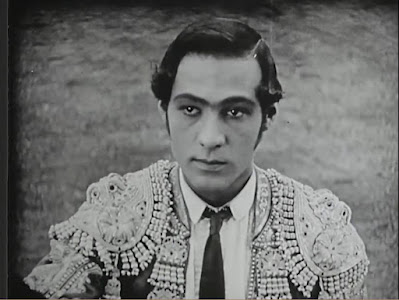
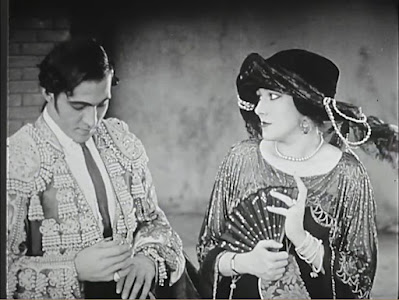
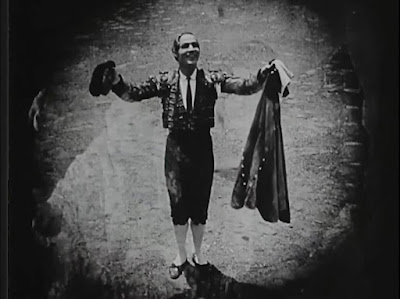
Enter Rodolfo Pietro Filiberto Raffaello Guglielmi di Valentina d'Antonguella for the opening screening of this year’s Nederland’s Silent Film Festival, playing a bullfighter and a Latin lover with a sexuality as exotic in his own way as Pola Negri (don’t mention the funeral) and other Europeans deployed by Hollywood to break boundaries and post-Victorian taboo. Valentino’s Juan Gallardo is driven by desire in life and love, and whilst being a masculine ideal is also at the mercy of his passions when torn between his true love Carmen the wanton Doña Sol, a spoilt, rich man-killing vamp who dominates and discards at will.


Blood and Sand leaves you emotionally rung with its derivative charm, wearing its Bizet firmly on its embroidered sleeve, elevated by superb performances and, as we now know, Dorothy Arzner’s innovative editing making us feel the heat of the bullfight even when matador, the bull and “the beast with ten thousand heads” are thousands of miles apart. As festival director, Daan van den Hurk said, no bulls were harmed in the making of this film, but it seems so purely because Arzner’s editing of stock bullfighting footage and Fred Niblo’s shots is seamless. The frenzy and the threat feel real as Juan takes on man and beast in a “sport” the film clearly disapproves of.


Daan was also multi-tasking, providing stirring accompaniment with the assistance of flamenco guitarist Tijn van der Sanden whose fleet fingered flourishes added diegetic immediacy to the film as well as dramatic flavouring. I loved the way the two worked together and it sounded fantastic on my new speakers, not as good as live but hopefully one day we’ll all be in the same room.


Meet the family


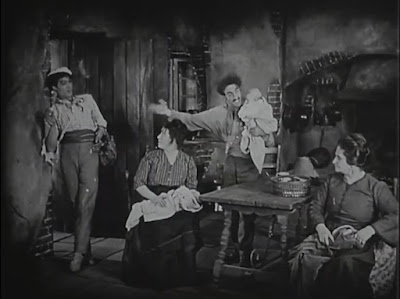
June Mathis wrote the screenplay based on Thomas Cushing’s smash hit play, which was itself formed from Vicente Blasco Ibáñez’ novel, Blood and Sand. It tells the tale of a poor boy from Seville, Juan (Valentino), “a son of the people” whose natural bravery enables him to become a toreador. His humble beginnings are set out complete with wise and loving mother Angustias (Rose Rosanova), sister Encarnacion (Rosita Marstini) and comedy brother-in-law Antonio (Leo White). Despite being called Zapaterin, Little Shoemaker, Juan has no interest in learning his father’s trade and dodges working with Antonio, a saddle maker, in order to go play at bullfighting.


Juan and friends head off to Andalucia where the locals enjoyed watching the amateurs from Seville. Juan does well but one of his friends is not so lucky with a watching bandit, Plumitas (Walter Long), accompanied by a title card noting that bandits and bullfighters both “risk life to gain a livelihood.” Juan avenges his friend’s demise and is not discouraged, dreaming of building his mother a fine house when and if he succeeds.


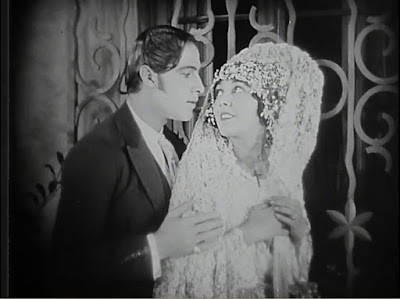
Naturally Juan gets talent spotted and ends up impressing the crowd mightily on his debut including his childhood sweetheart Carmen (Lila Lee) and the two grow close as his career advances and marry.


He searched deep into men’s hearts, ever willing to excuse weakness and, in a master ledger, recorded the lives of those who interested him.


And he can dance...
 

Throughout proceedings, a local philosopher keeps popping up, almost at random… Don Joselito (Charles Belcher) “a student of humanity” who will act as a guide to the morality of events passing comment and offering advice… ultimately condemning bullfighting. That beast with ten thousand heads… the audience bloodlust driving the barbarism that costs lives.


Gallardo’s success makes him the idol of Seville’s café culture and he gains a manager (Fred Becker) along with a matador, El Nacional (George Field) who “fought for living and not for glory” as well as a popular picador, Potaje (Jack Winn) and old Carabato (Gilbert Clayton) who served Juan “in order to cling to the arena and retain his pigtail” – worn by the fraternity. The film may disapprove of the sport, but it takes a delight in the details.


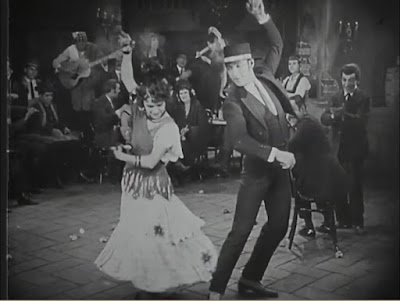
There’s a lovely scene in one of those cafes when we get the chance to see Valentino dance – he had made his way initially in Hollywood by dancing and teaching dance – and you can see his poise on the dance floor alongside and a dancer named Rosa. The women gets just too close though and Juan’s loyalty to Carmen makes him push her onto the floor… it’s a foreshadow of things to come.


Rudolph and Lila Lee
 

Men were Doña Sol’s hobby. A bullfighter was a new experience.


Time passes and Juan is famous across Spain, and he catches the eye of the daughter of the country’s bull-breeder, Doña Sol, played by the “exotic” Nita Naldi, who was born Mary Nonna Dooley to Irish parents in New York…  Juan’s reaction to this new attention is primal, and he willingly accepts her gift of a ring given by Cleopatra to Ceasar… he’s flattered but still loyal to his wife, but Doña Sol is not easily dissuaded.


The two begin an affair, with Doña Sol dragging out the dark aggression in the man, a strange sadomasochistic edge to his fifty shades of betrayal. He doesn’t feel comfortable in her world of refined hypocrisy and artificial emotions, but he can’t resist the animal games she makes him play.


A page from Don Joselito’s book reads: Juan Gallardo has reached his goal. Will success spoil him or will his love for little Carmen overcome the plaudits of the populace and the cruelty of the national sport?


Which sets up the finale perfectly!


Rudolph and Nita Naldi

Blood and Sand has Glamour and Alvin Wyckoff’s cinematography captures some lovely atmospheres, Juan’s wooing of Carmen, the mock action in the stadia and the streets supposedly in Seville. Valentino has the star power and is able to convey humour as well as sexuality, he doesn’t take himself too seriously – an attractive feature for most of those watching – but he is passionate beyond reason when push comes to shove. Here his masculinity is used against him by the vamping Naldi… who else could carry this all off and still remain heroic?


The version screened was from a Lobster print of the David Killiam restoration which is shorter than the recent version released by Kino on Blu-ray. This has the tinting restored and comes in at over 25 minutes longer with a smashing score played by the Monte Alto Orchestra and a booklet including an essay from noted Valentino expert Donna Hill. Well worth purchasing if you haven’t got it!


And remember, as Don Joselito says, Happiness and prosperity built on cruelty and bloodshed cannot survive.


Monday, 5 October 2020

"Down with luxury and romance!" Guofeng (National Customs) (1935) with Gabriel Thibaudeau, Pordenone Day 2


“We are country people, they come from the city. They are too extravagant and modern, we mustn’t imitate them.”  “If all peasants in China behaved like modern citizens, we would lose the virtues of simplicity and frugality and the country would succumb!”


Day Two of Le Giornate del Cinema Muto #39 and I’m already planning to become a schoolteacher in rural China. Frivolity and beauty products are undermining the country’s resilience, culture and productivity and frankly, I think it’s about time I did my bit.


Guofeng (National Customs) (1935) was made during a fighting pause in the China’s lengthy civil wars with Chiang Kai-shek’s Kuomintang (KMT or Nationalist Party) advocating a return to core values with its New Life Movement. The movement, sharing values with the opposing Communist Party, was reaction against Western imperialist influence and urged the people to observe social and political responsibilities, practice frugality and to know one’s sense of shame.


This period of Chinese history is a complex one yet the interpretation of these issues by director’s Luo Mingyou and Zhu Shilin speaks largely for itself with a clear message that modernity and western ideals are to be at least kept at arm’s length as people work hard to secure social cohesion and prosperity during harsh times. At one point the Principal of the rural school at the heart of the story, appeals to her pupil’s conscience, asking them to recognise their privileged position at a time when many were starving and in poverty. Similarly, the obsession of her daughter Zhang Jie (Li Lili) with make-up, western style and consumerism, is nearly everyone’s downfall.


Lim Cho Cho's Principal


Things have gone and will, in the film, go too far, but there is redemption in working together towards common goals. There’s an almost slapstick ten minutes in which the town councillors see an opportunity in modernisation and Western-style shops pop up all along the main street with the councillors getting western suits, cigars and even "Western socks" to make themselves look younger. This is then juxtaposed by a stirring segment in which Principal Zhang (Canadian born Lim Cho Cho) and her loyal teacher, bring the people back together with forceful speeches that push back the torrents of decadent confusion.


I have another love, says Zhang’s other – sensible – daughter Lan, to her former lover, it is for education!


Lan is played by the radiant Ruan Lingyu, the star of Goddess (1934) among many other Chinese silents, before she committed suicide aged just 25 in early March 1935, some two months before the film’s release. She is extraordinary here as every time I’ve seen her, gently emoting and disarmingly direct, sometimes straight to camera if not to the audience, she never leaves her character. She has a direction in life and is hardworking, believing in truth, justice and the Chinese way. She is betrayed by her flighty sister Jie played by Li Lili who is superbly sassy, with the “pre-code” “presence” of a Joan Blondell or Glenda Farrell and the cruel sneer of a Barbara Stanwyck.


Li Lili dresses for the part

The film itself is a study in the New Life aesthetic and in the ways that Western culture was absorbed and utilized in new ways. The direction is very “European” with fluid camerawork and plenty of tracking and dolly shots, montage and inventive cross-fades; it’s a very well-made film with state-of-the-art design, costumes and staging. Allowing for the odd drop of pace and it is also clearly addressing a cinema-literate audience with a narrative economy that knows somethings can be un-said or un-shown.


“If you love him you have to stop dressing up and behave more seriously…”


The story? The two sisters couldn’t be further apart in their view of life, Lan the best in class and gaining a scholarship to Shanghai University and Jie, obsessed with make-up and social excitement. Lan warns her to forget about the foundation and knuckle down but she won’t listen. Yet Lan not only loves her sister she also loves social order and for this reason selflessly backs away so that Jie can marry the man that she loves and who had just proposed to Lan, Chen Zuo (Zheng Junli).


Westerngoods undermine cohesion


Lan cannot lie and tells him she loves another, she says this twice and always means it, and departs leaving him to marry Jie. Lan goes to work in an elementary school in Huai’an and three months later… Lan reads of her sister’s marriage just as she is selected to go to Shanghai at the expense of the state for further education… Lan was the best in class. Her sister is already bored with married life and jealous of Lan asks Zuo to pay for her to join her in Shanghai.


Meanwhile, handsome Boyang is also sent to Shangai – “what a lively city!” – and we spy trouble ahead. Jie asks for more and more money from Zuo who is tearing his hair out at home whilst she wears make up and goes out more with her flighty friends… meanwhile goody-Lan sends money to her old school to buy books. It is heavy handed to us western sophisticates from the future but was clearly designed as patient propaganda for a rapidly changing society.


Boyang also asks for money from his long-suffering parents and whilst he tells them he’s working hard the reality is that he’s skipping lessons and gets reprimanded. We just know the lad is perfect for Jie and Lan tries to put him off by urging them to be good citizens, highlighting the problems of this new generation who come from the country to be city educated and then, when they cannot adjust, bankrupting their parents in their demand for material goods and leisure experiences.


They don’t listen and remind me so much of Gen-X…


Ruan Lingyu battles Li Lili's smarmy bf

“Are you scolding us, we don’t have time to argue with you…”

Lan plans to ask Boyang to marry her but her sister and he use it to humiliate her and to encourage the other students to take revenge on her and her “saintly” ways. She ends up ill and will have to graduate late... giving the film time for its final flourish as the two return to their town laden down with luggage and take up posts as teachers in their old school.

They proceed to make a mess and set the worst of examples for students and the local populace leading to the final fight back from Principal Zhang and the film’s central address and dramatic conscience call. It’s as dramatic as anything you’ll see with Walter Pigeon and, frankly, I was stirred.

Gabriel Thibaudeau accompanied and provided his own discourse between ancient and modern with subtle lines that reflected the film’s central concerns as well as delighted in its dynamism and emotional force. A reminder of the skills of Le Giornate’s musicians and the due diligence they pay to their source material: a fine duet of audio-visual balance.


Zheng Junli and Ruan Lingyu


Before this we delighted in The Brilliant Biograph: Earliest Moving Images of Europe (1897-1902) captured in 68mm with expert accompaniment from Daan van den Hurk.


This was a tour of Europe drawing from Eye Filmmuseum’s The Mutoscope and Biograph Collection – which includes over 200 films on the original 68mm stock – as well as the British Film Institute and The Museum of Modern Art in New York. Some I had seen before but all were a feast for the eyes and you could only wish to see these on the big screen as we had with the BFI’s Victorian film show at the BFI’s Imax a few years back.


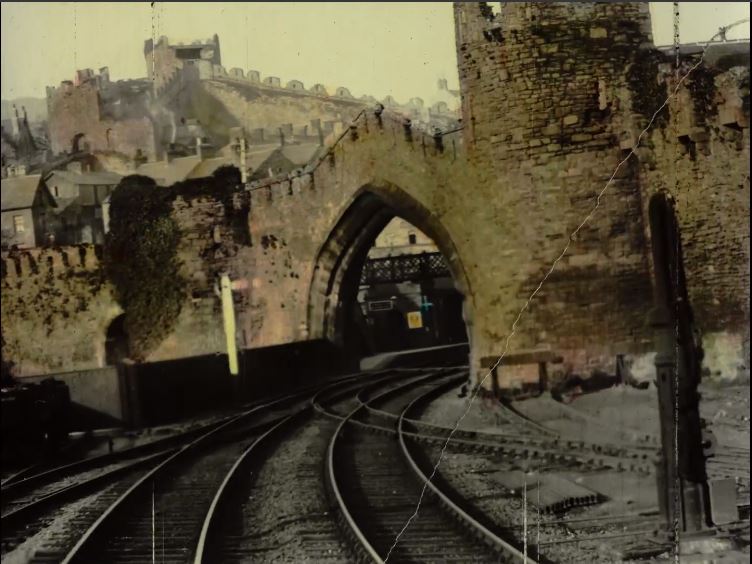
It was a stunning compilation though and I especially enjoyed hand-coloured Conwy (1898), Funeral procession in Rome (1898), Venice, Grand Canal and Ponte dei Sospiri (1898) and Captain Deasy promoting Martini cars, Switzerland (1903)!


And, never forget...


Sunday, 28 January 2018

The People’s Pictures… Slapstick Festival Gala Friday, Bristol Watershed and Colston Hall


My third year at the Slapstick Gala and again I marvel at the event’s support from the city of Bristol; the Colston Hall was filled to the rafters not just by curious locals or travelling hipsters but by local folk who know how to have a grand time! No one talked throughout the show, continually checked their phones, laughed at the quaintness of it all or, indeed, some of Tim Vine’s jokes*… they get it: they know Stan and Buster and they really understand Charlie and Oliver. Heck, even the obscure Arthur Lake, casually dropping a baby in convenient dump bins… they got him too.

Waves of laughter flowed around the Hall, genuine, belly laughs, all feeding each other as recognition of the ridiculous, the daft and the jaw-dropping was shared by the warmest audience you’ll find in all the kingdom. Bristol, you are the most educated and fun-to-be-with crowd! Comedy is a team sport and in this respect, you are City and Rovers united.

I had a conversation with my mother-in-law about why she hadn’t found Chaplin as funny as she’d expected up to now but what’s been missing is an audience and a live musical setting – tonight’s showing of A Dog’s Life (1918) took the roof off and she laughed.

The Bristol Ensemble played Chaplin’s own score and Günter A. Buchwald conducted for a film that is so much more knowing than most “civilians” would expect… aside from this crowd that is. From Edna Purviance’s tear-jerking singing – buckets of tears… a splash in the face for those who talk “sentimentality” – to Charlie’s knowing look at the end, the film is razor sharp.


Laurel and Hardy kicked us off in fine style with Angora Love (1929) – accompanied by maestro John Sweeney on the Hall’s amazing grand and Frank Bockius on percussion. This film may well have been the origin of the “don’t work with animals” rule as the lads just about manage to cope with a goat that just won’t let them go.

Arthur Lake’s Whose Baby (1929) may well have completed the other half of that rule as our rarely-screened hero has to cope with looking after a baby whilst convincing his girl that it’s not his. I use the term “looking after” loosely as Arthur dumps the kid in bins, lets his pram run into traffic and hangs him up on hooks. It’s all in the best of bad taste but a riot all the same.

Sherlock Jnr (1924) was the headline act and not the first time Buster’s meta-masterpiece had an audience gasping in disbelief as he puts his body on the line for laughs in some of his best stunts. The action is far-fetched but as the boy in the row behind observed, these things make sense as he’s in a dream… this Bristol audience is well informed at all ages!

Gunter played along on violin and piano with The European Silent Screen Virtuosi featuring Frank Bockius (percussion), Romano Todesco (double bass) and Marc Roos (trombone). The acoustics in the Hall are darned good to my ears and, sat dead centre, the music was rich and satisfying.

A stunning end to a full Friday which began with...

The Three Keatons
The Young Keaton (1895-1917) with David Robinson

David Robinson talked us through the golden age of vaudeville and variety and the birth of Buster! Keaton’s remarkable theatrical career began in 1899 aged 3, and we learned that it was not Harry Houdini who earned him his nickname but another vaudevillian who witnessed his fall down the stairs. Keaton’s father was an astute self-publicist and came up with the “better story” later. It was a tough existence and seeing Buster talk on film later in the day, you got the impression that he was a forceful, intelligent man with intent forged on the road in medicine shows and lower-league theatres. 
By the time he stepped in front of a camera he was a comedy seventh dan ready to knock his block off for our delight.

Betty Balfour's eyes

Vagabond Queen (1929), Betty Balfour with introduction form Lucy Porter

In which our Queen of Happiness plays Sally a humble maid in a London boarding house who temporarily becomes the Princess of Balonia – a woman she resembles to the last freckle – in order to act as a decoy on coronation day as rebels in the fake Balkan state, use knives, bombs and bullets to try and assassinate their future monarch.

It is an aptly named country and there’s a certain Marx Brothers zaniness to Douglas Furber’s script: “My friends and Balonians!”, directed with brisk efficiency by Géza von Bolváry. The film was essentially a silent but had a recorded soundtrack added post-production to turn it into a “talkie” of sorts. The score was from John Reynders – a renowned musical compiler – and sticks like glue to the narrative with sound effects galore as it follows the action like a shadow.

Betty is super-charged charm throughout and is aided by Ernest Thesiger as Lidoff, the Balonian diplomat and young Glen Byam Shaw as her boyfriend Jimmie. The real Princess’s actual husband, Prince Adolphe, as played by the decidedly louche Charles Dormer, is in a drunken confusion wondering how his poor Zonia has lost her loving feeling.

Like anyone introducing their mate to a party, Lucy Porter perhaps worried that we’d not get Betty, but who couldn’t love Chester-le-Street’s finest: she does indeed still make us happy!

Seff on the left and Cocl on the right
Cocl & Seff: Austria’s Laurel & Hardy, introduced by Chris Serle

Now here’s a couple of queer fish… one of cinema’s very first double acts who from 1913 appeared in many films sometimes together and sometimes apart. Both Austrian boys, Rudolf Walter (Cocl) and Josef Holub (Seff) had the distinguishing traits of most double acts: one tall, one short and one brainy the other less so… as things progressed Seff – who on this evidence was slightly funnier – evolved to look a little like Harold Lloyd.

Their earlier shorts shown lacked the finesse of a Chaplin or Mabel Normand but by the twenties they were more oddball. One film was set in a hotel with the characters all moving like jazzed automatons, John Sweeney expertly followed their rhythm and it was an hilarious combination.

The funniest film was a Seff solo from 1926: Seff on the way to power and beauty (extracting der Mikel from the earnest Wege zu Kraft und Schönheit) which was a commercial for the Viennese Dairy that – wait for it! – milks the association for everything it’s worth. Also features cheese.

John Sweeney and Elizabeth Jane Baldry took turns accompanying and played together to sublime affect. Let’s have more piano and harp!

Lost and Found… David Robinson, Elizabeth Jane Baldry and Daan van den Hurck

Mr Robinson was on fine form today and took us through some enthralling snippets starting with the Odd-Father of Slapstick film, Leopoldo (Luigi) Fregoli a hugely-popular transformist, a quick-change artist, who could go from old gentlemen to lady… and young man faster than you could say, er, David Robinson.

There followed an English film featuring a lady on skates flying through the streets at an incredible whack, causing all manner of chaos; well done that stunt man!


Next an Italian film, featuring a lady whose huge hatpins knock into the heads of all around her and wonderful solo accompaniment from Elizabeth Baldry who plays her harp as percussion, rhythm and lead – a one-woman band who finds rich tones from deep bass, atonality (scratched strings) as well as the gorgeous lines you’d expect: a joy to watch her work form the second row!

André Deed – the World’s first comic superstar and a man of many monikers, featured in Boireau déménage (Boireau Changes House) and a bonkers tale of a door fitter creating mayhem with his door en route to a job… improvised and shot mostly on location, these are fascinating as well as funny.

As David Robinson said, there’s hardly any visual gag going that Max Linder didn’t invent or improve and we got to see a sample of his earlier work in Two Great Sorrows (1908) that even David hadn’t seen. It was a darkly comic tale about a young widower and a young widow that showed the root of Linder’s appeal was his ability to act…

Marcel Perez
Marcel Perez – who had even more names than Monsieur Deed – was next Mademoiselle Robinet (1912) in which he has to cross dress to cover up a dalliance with another man’s wife with the inevitable consequences.

Ray Hughes, a Chaplin imitator, was next in the genuinely “lost and found” Love and Lunch. I had no idea that there were Charlie tribute acts at the time but given his popularity it’s not too surprising… he’s pretty good but he’s no Charlie!

Lastly, we had a Stan Laurel treat, the recently recovered full version of his 1924 solo movie Detained (1924), provided by The Frisian Film Archive in Holland. Stan was great in this film and very funny; not for nothing did Buster consider him the greatest, he connects so well with the audience, even now, we’re all in on Stanley’s jokes!

Stanley hanging on...
As David said, having seen these films so often, they’re a lot funnier when accompanied by Elizabeth and Daan, there’s so much range in their playing and they make for an intuitively subtle combination –  as indeed did Elizabeth and John.

So Funny it Hurt: Buster Keaton and MGM (2004), Kevin Brownlow and David Robinson

Perhaps the abiding memory of this day will be our Kevin and our David trading tales of meeting some of the artists featured: yes, Mr Brownlow met Buster Keaton and Mr Robinson met Laurel and Hardy.

They were in conversation after the screening of Brownlow’s documentary of Buster’s difficult years at MGM, a period of declining creative output despite commercial success. The Cameraman was perhaps the last film in which Keaton had something like full creative control and the MGM brass mistook its success for their own… With every subsequent film from Spite Marriage (screened the day before) onwards, the studio took more away from its star in an attempt to leave him as just a “performer”. Buster was more than that though and even though the film’s earned good money he 
wasn’t going to go quietly.

It’s a shame we can’t see more of Brownlow’s amazing interviews with Keaton and others but when studios are asking up to $600 per minute for use of footage integral to the stories in Hollywood and elsewhere, there’s no affordable way. So… the very same guys who wasted these talents and destroyed their work in the first place, now stand in the way of what remains being more widely seen. And yet… Warners can find the odd $70 million just for Justice League re-shoots and MGM/Sony $100s of millions for remakes of Death Wish and Tomb Raider. Valuable work gentlemen, valuable work.

If you want to see the true spirit of cinema, you only had to look at David and Kevin, two people in love with film and who, after many decades of involvement, are still youthfully excited about their subject. Right back at you boys!

Kevin Brownlow and David Robinson


*To be fair, Mr Vine was very funny too!